
Climate change to become ‘greatest pressure on biodiversity’ by 2070
Wayward wildlife
Rising temperatures and changing rainfall patterns are expected to make existing habitats inhospitable for many animal species. Biodiversity is also under threat from land-use change caused by agriculture, deforestation and land degradation. The new study, published in Proceedings of the Royal Society of London B, considers how both of these threats could combine to affect ecosystems across the world in the coming decades. The research finds that, in a future with relatively high amounts of global warming and land-use change, the number of animal species in the average ecosystem could fall by 38%, when compared to conditions from 1961-90. However, some ecosystems are expected to face larger species losses than others, says study author Dr Tim Newbold, a research fellow at the Centre for Biodiversity and Environment Research at University College London. He tells Carbon Brief:“Climate change is to become, perhaps, the greatest pressure on biodiversity and overtake land-use in terms of impacts on biodiversity. If you combine these things together, the predictions are – at least under business as usual – for very large losses of biodiversity.”
Parallel futures
For his research, Newbold used modelling to produce a set of maps showing the expected impact of global warming and land-use change – and where these threats could overlap – in different parts of the world. His results were based on four possible future scenarios, known as the “Representative Concentration Pathways” (RCPs). Each scenario makes assumptions about a range of parameters, including the future rate of greenhouse gas release, the efforts made to combat climate change (mitigation) and the rate of global population growth. The scenarios include: an “optimistic” scenario which assumes global warming is restricted to below 2C (RCP2.6); a scenario where warming reaches 2-3C (RCP4.5); a scenario where warming reaches 2.6-3.7C (RCP6.0); and a “business-as-usual” scenario where warming reaches 4-6C (RCP8.5). (Carbon Brief has previously described these four RCPs in more detail.) The maps below show where losses are expected to be “high” (greater than 10% of species lost) as a result of climate change (orange) and land-use change (blue) for each scenario. Areas where high losses from global warming and land-use change overlap are also shown (black), as well as where species loss is expected to be low (grey).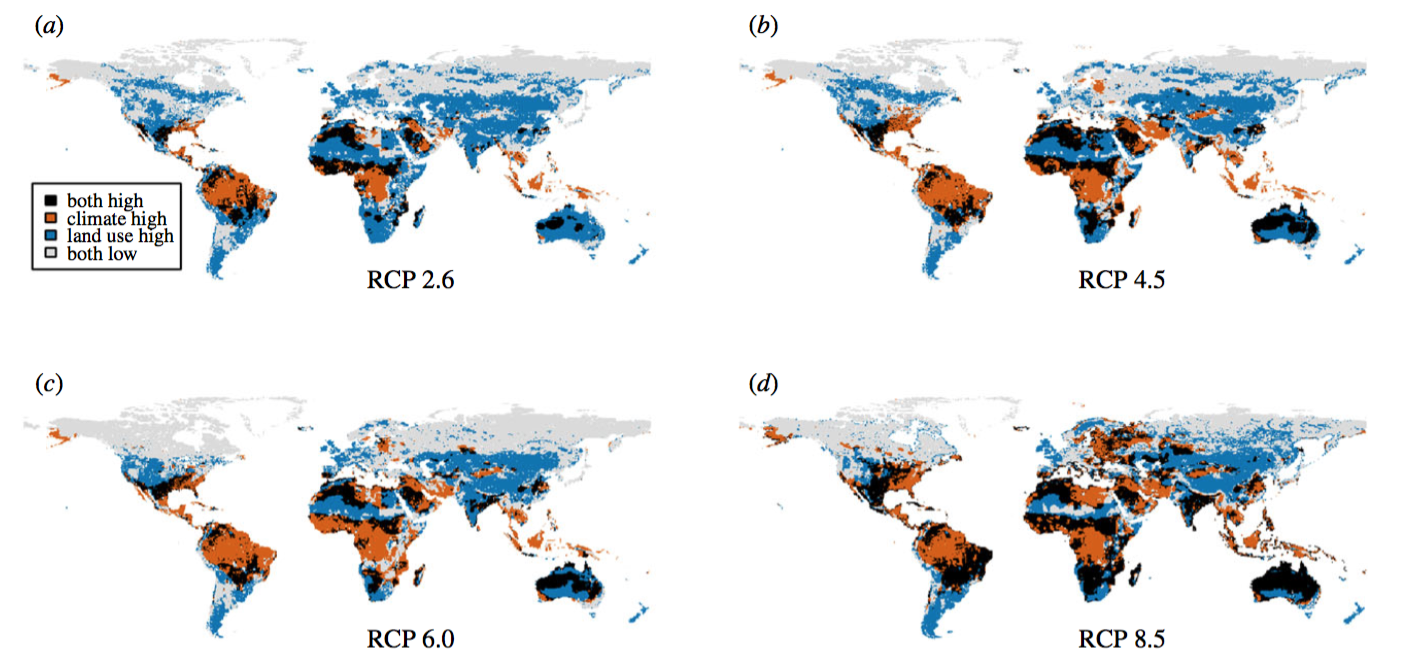
Bargaining with BECCS
The results show that the RCP2.6 scenario, which projects the smallest level of future climate change, leads to the second most negative land-use impacts on biodiversity. This is largely because the scenario relies on considerable use of bioenergy with carbon capture and storage (BECCS) to limit the effects of climate change. Put simply, BECCS involves burning biomass – such as trees and crops – to generate energy and then capturing the resulting CO2 emissions before they are released into the air. In theory, this process could reduce the amount of CO2 in the atmosphere – making BECCS a “negative emissions technology”. However, using large-scale BECCS to limit warming to 2C could require up to 18% of the land surface to be converted to biomass plantations – which could pose a significant threat to biodiversity. The new study, however, shows that when the impacts of global warming and land-use change are considered together, RCP2.6 still projects the lowest risks for biodiversity out of all of the scenarios. This suggests that the large land-use costs associated with BECCS may be offset by the resulting reduction in climate change impacts. However, it is important to consider that there could be other solutions for tackling climate change that would not take up large amounts of land, Newbold says. Such options would be the most beneficial for biodiversity, he adds:“The results of studies like this suggest that we should be looking for solutions that mitigate climate change that don’t rely on using lots of land – because we know that has large impacts.”
Article information
Newbold, T. (2018) Future effects of climate and land-use change on terrestrial vertebrate community diversity under different scenarios, Proceedings of the Royal Society of London B, doi:10.1098/rspb.2018.0792