
DeBriefed 18 September 2026: ‘Fresh wave’ of oil attacks | India power emissions ‘flatline’ | Scotland’s wildfires

Welcome to Carbon Brief’s DeBriefed, an essential guide to the week’s key developments relating to climate change. In this edition…
- Fossil-fuel supplies from the Middle East looked uncertain amid more conflict.
- Scientists found a link between climate change and the Himalayan floods.
- Carbon Brief interviews an expert about wildfires in Scotland.
- Key dates for next week and pick of the job vacancies.
This week
Fossil-fuel conflict
DEMAND DROP: Asian demand for liquefied natural gas (LNG) is set to decline 3-10% from 2025 levels this year, reported Reuters. The newswire said that this would be the second consecutive year demand has dropped, “as the US-Israeli war on Iran curtails supplies from the Gulf”. The Financial Times reported that the Hormuz crisis “threatens to undermine long-term LNG demand”, as developing markets “recoil” at the raised prices and instead turn to “low-cost renewables”. Reuters covered “worsen[ing]” energy disruption in Bangladesh and Pakistan, due to the crisis.
OIL ATTACKS: Saudi Arabia has shut down its “crucial” east-west oil pipeline after it was attacked by what the foreign ministry described as “drones from Iraq”, according to the Financial Times. The newspaper explained that the pipeline had allowed Saudi Arabia to continue exporting oil despite Iran blocking regional trade. Reuters reported that the halt threatened 4% of global oil supplies. The Times said oil and gas prices rose sharply following a “fresh wave of attacks in the Middle East”.
Himalayan floods
CLIMATE CAUSE: A new study concluded that climate change contributed to the devastating flash floods in Nepal and the Chinese region of Tibet last month, reported BBC News. The news outlet said that analysis by the World Weather Attribution group explained that the disaster was the result of a “compound event”, caused by rising temperatures, thinning glaciers, thawing permafrost and pre-existing geological weaknesses. Reuters noted that, weeks after the floods struck, around 5,200 people are still missing. (See Carbon Brief’s Q&A on the Himalayan floods.)
‘TIPPING POINT’: Reuters covered another new study that found the Himalayas are approaching a “tipping point”, as “Himalayan glacier mass loss [has] accelerated in recent decades”. The newswire added that the study identified hundreds of glacial lakes as “high risk” in India, threatening millions of people downstream.
Around the world
- NO STANDARDS: The US Environmental Protection Agency is scrapping carbon pollution standards for coal and gas power plants, reported Bloomberg.
- JUST TRANSITION: The Indian Express covered the 2026 BRICS summit in New Delhi, which yielded a joint declaration from the emerging economies calling for a “just, orderly, equitable and inclusive” energy transition, while acknowledging the “important role” of fossil fuels.
- MOVING ON: The Netherlands outlined a roadmap to “move away from fossil fuels”, but faced criticism for not providing a phaseout deadline, according to Energeia.
- EV AMBITION: China has targeted 70% of new passenger vehicle sales to be electric or “new energy” vehicles in its most recent five-year plan, a target likely to be achieved ahead of the 2030 deadline, reported Bloomberg.
- RUNWAY CHECK: Government advisors at the Climate Change Committee (CCC) said expanding Heathrow airport is “incompatible” with the UK’s climate goals, reported by the Financial Times. See Carbon Brief’s article for more details. Meanwhile, Andy Burnham wrote in the Guardian that he was “determined” to hit the UK’s 2050 net-zero goal, in his clearest statement since becoming prime minister.
- EU INSURED: In her “state of the union” address to the European parliament, European Commission president Ursula von der Leyen announced that the EU will create a “climate insurance alliance” to increase coverage for extreme weather events, according to Reuters. She also noted that, since the start of the Iran war, “imported fossil fuels cost us an additional €90bn”, added Bloomberg.
0.5%
The amount that global fossil-fuel emissions are set to drop in 2026 amid the fallout from the Hormuz crisis, according to Carbon Brief analysis.
Latest climate research
- “Temperature anomalies” increase emotional and physical “intimate partner violence” across sub-Saharan Africa, with rural, less-educated women facing the greatest risk of temperature-related violence, according to a Global Environmental Change study.
- A five-year field study in Global Change Biology found that warming reduces the diversity of bacteria living in soils.
- An assessment of drought over 1981-2014 by Communications Earth & Environment detected “no significant acceleration” in global “drought trends”.
(For more, see Carbon Brief’s in-depth daily summaries of the top climate news stories on Monday, Tuesday, Wednesday, Thursday and Friday.)
Captured
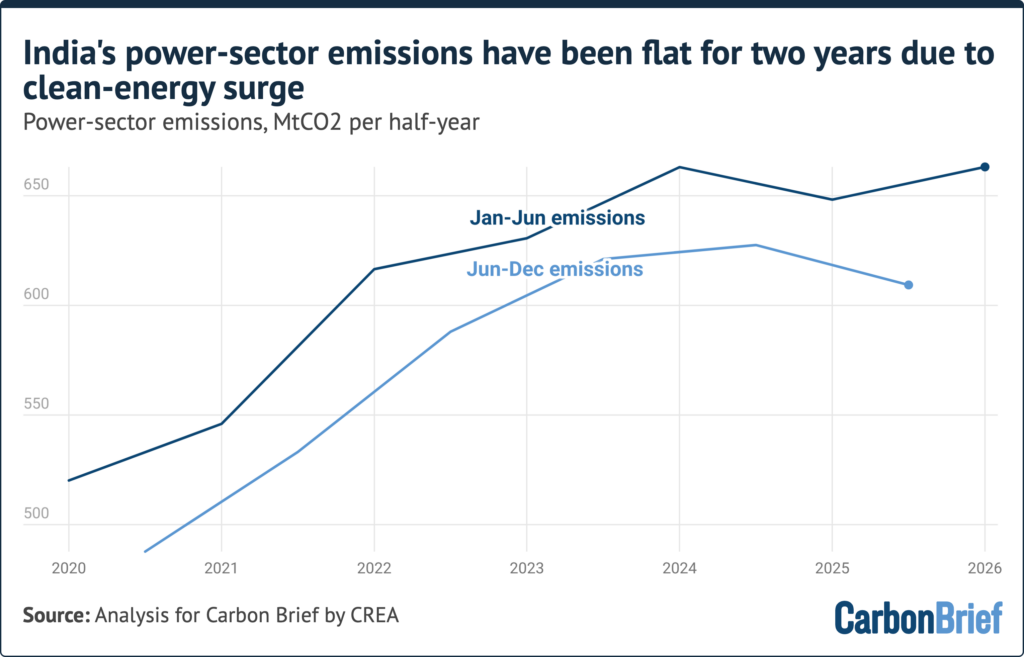
New analysis for Carbon Brief showed that India’s power-sector emissions have roughly flatlined over the past two years. After declining last year, emissions for the first six months of 2026 increased by 2.3%, so they are now back at 2024 levels, according to findings from the Centre for Research on Energy and Clean Air (CREA). This marked the first time in more than 50 years that there has been no growth in India’s coal power over a two-year period, with clean-energy expansion covering the nation’s electricity demand growth instead.
Spotlight
Wildfire in the Highlands
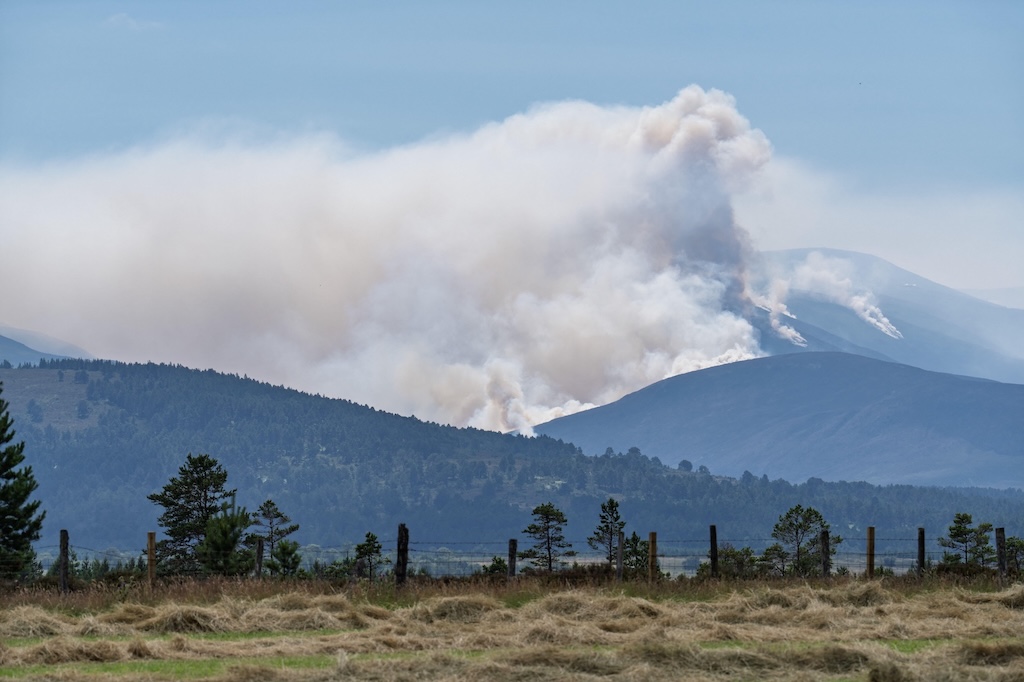
Carbon Brief speaks to Grant Moir, chief executive of the Cairngorms National Park Authority, after a major wildfire struck the park in the Scottish Highlands this summer.
Carbon Brief: How did the wildfire this summer compare to previous years?
Grant Moir: The large fire at Dava moor last year was the biggest wildfire by area recorded in the UK – about 10,000 hectares. The one at Glenmore this year was about 3,000 hectares, but it lasted longer and had a bigger impact. It builds on fires that have been happening in the national park and other parts of Scotland more frequently over the past five to 10 years.
CB: What were the impacts on the national park?
GM: A big area was closed to the public for a long time, with several businesses behind the cordon that couldn’t operate during the height of the tourism season. There were evacuations of homes as well.
Then there’s the impact on nature and land, species and habitats – and all the work to build fire breaks, cutting down trees.
CB: What is being done to help the land recover?
GM: We’re pulling together a monitoring recovery plan. Some areas that had a relatively light burn will recover quite quickly. [Following last year’s fire] in Dava, there was bog cotton as far as the eye could see across the burnt areas, so nature has a way of coming back. Where it got into deeper peat and where we’ve got the felled trees, recovery will be longer.
The impact on species [after this year’s fire] is as yet unknown. There are already wood ants coming back onto their nests in burnt areas. Fires are not unknown in the natural world, but there are obviously areas where we have to intervene.
CB: What is your stance on the argument that rewilding activity can cause or exacerbate wildfires?
GM: It’s easy to have an argument about these things, but it’s not that useful. I don’t think the fire at Dava was in a rewilded area. The fire that we had at Dinnet last year wasn’t either – it was managed grouse moor.
We need to make all land more resilient to wildfire and you can do that whether you’re rewilding or managing more traditionally. On rewilded land, we’ll have to ensure fire breaks are in place and that there are places where fuel load [the amount of burnable material] is taken down. In other places, we’ll have to consider rewetting where we haven’t before. Elsewhere, we’ll need higher fuel loads because it’s good for slowing runoff so we don’t have as much flooding. We’ve got to look at it in the round: it’s not just a wildfire issue – it’s a flooding issue, a drought issue.
It’s not about rewilding versus grouse management. It’s about everything we have to do to adapt to a quickly changing climate, where some of the old solutions are not [getting us] where we want to be in the future. We’ve got to have a dialogue and I don’t think any of us can be dogmatic in our approach.
A report several years ago looked at snow cover in the Cairngorms, which modelling shows will decrease significantly over the next 20-30 years, leading to issues with water quality and drinking water – and we’re going to see more impacts from climate change.
Watch, read, listen
‘POACHERS CANNOT HEAR’: In the Associated Press, Allan Olingo travelled to Kenya’s Maasai Mara, where rangers patrol on electric motorcycles powered by the plentiful sun.
MIAMI MISLEADS: As part of pop-up newsroom “Betting the House”, Heated’s Emily Atkin posed as a home buyer to see what real-estate agents in Miami are saying about climate risk.
NEW NEWS: Drilled launched a new weekly newscast called The Spill, talking through climate news and how the media is covering it, with the first episode featuring oil deals in Venezuela and the deadly Himalayan floods.
Coming up
- 18-20 September: Russian legislative and regional elections
- 20-27 September: Climate Week NYC, New York
- 23 September: UN Climate Summit, New York
- 22 September-2 October: UN General Assembly, New York
Pick of the jobs
- Green Alliance, senior partnerships officer | Salary: £42,748-£47,436. Location: London, UK
- Labour Climate and Environment Forum, parliamentary engagement manager | Salary: £37,000-£42,000. Location: London, UK
- Intergovernmental Panel on Climate Change, graphic designer | Salary: Unknown. Location: Paris, France
This edition of DeBriefed was edited by Josh Gabbatiss. Please send any tips or feedback to [email protected].
This is an online version of Carbon Brief’s weekly DeBriefed email newsletter. Subscribe for free here.