
Cited 24 November 2026: COP31 climate-science fights | El Niño a ‘public-health emergency’ | AI and climate disinformation

In the news
EL NIÑO CONCERNS: Writing in Think Global Health, two scientists urged the World Health Organization to declare this year’s El Niño a “public-health emergency”, saying it is “certainly comparable in health impacts” to previously declared emergencies. The Guardian reported that two-thirds of worldwide births in November and December will be in “countries rated as high risk for El Niño”. Scientific American asked if the Amazon rainforest can “survive” the record-breaking event.
FACTCHECKED AGAIN: On Monday, US president Donald Trump posted on Truth Social that “extreme climate science” projections have been “debunked, withdrawn and taken down by the UN IPCC [Intergovernmental Panel on Climate Change]”. Indian newswire ANI reported that the claim “stem[s] from ongoing scientific revisions to global emissions scenarios, specifically the phasing out” of the RCP8.5 scenario. Earlier this year, Carbon Brief factchecked Trump’s previous false claims about the scenario.
AI YAI YAI: A UN report found that AI models “can readily explain established climate facts”, but “routinely abando[n] scientific facts” when pressured by users. The Guardian quoted a lead author: “The fact they could so easily abandon truth and be more agreeable to a user’s [misinformation] shows it is weak and fallible.” Meanwhile, at the COP31 UN climate summit, a decision on encouraging climate engagement – which some parties wanted to address mis- and disinformation – was “unexpectedly torpedoed by Russia”, reported Carbon Brief.
Research picks
ECOLOGY
- Climate change’s impact on algal blooms could be affecting the breeding success of a tropical seabird due to “declining environmental predictability” | Nature Climate Change
- Severe drought induced by climate change could cause five “bioregions” to lose up to one-quarter of their cacti diversity | Nature
- Limiting global warming to 1.5C this century is “out of reach” without contributions to emissions-cutting efforts from agriculture, forestry and other land use | Nature Sustainability
EXTREMES
- The frequency of “wind drought”-heatwave compound events – which suppress power generation but increase demand – could double by 2100 under a low emissions scenario | Proceedings of the National Academy of Sciences
- Tropical cyclones increasingly reach “peak intensity” near continental coastlines, partly due to warming climates | Geophysical Research Letters
- The extreme fire weather in the north-west Iberian Peninsula during August 2025 was around three times more likely due to human-caused climate change | Earth System Science Data

ENERGY
- More than 400 “hyperscale” data centres in the US collectively consumed 1.8% of total US electricity – about half of that from fossil-fuel sources – resulting in around 26m tonnes of CO2 emissions over May 2024-April 2025 | Nature Sustainability
- By tripling renewable capacity and increasing storage, China could meet its projected electricity demand without requiring additional coal plants | Proceedings of the National Academy of Sciences
- Coal-fired power plants that are located near to data centres built since 2020 are “significantly” less likely to be retired than plants that are not | Nature Climate Change
Please send upcoming climate research and preprints to [email protected]
Captured
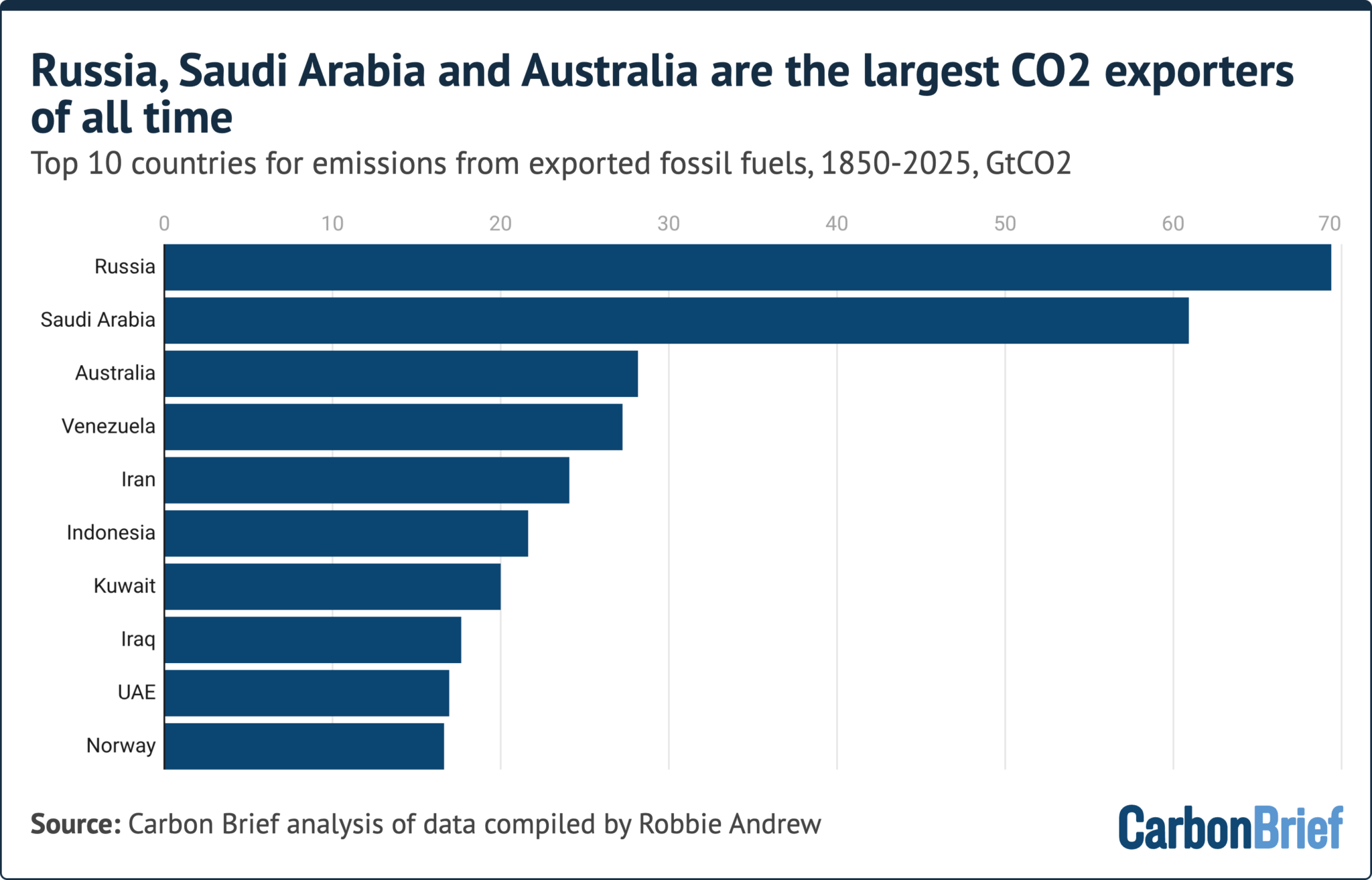
New Carbon Brief analysis found that Russia, Saudi Arabia and Australia have together exported fossil fuels responsible for more than 150bn tonnes of carbon dioxide (CO2) emissions since 1850. Covering the analysis, the Guardian noted that the US and China “still bear greater responsibility for historical emissions” due to their use of domestic supplies.
“Our process must follow the science and meet the challenge…Over many COPs, climate cooperation has delivered vast progress – taking humanity off an unsurvivable path of global heating. But clearly much, much more is needed. The fight continues.”
Simon Stiell, executive secretary of the UN Framework Convention on Climate Change, addressing the closing plenary at COP31.
Spotlight
Climate-science fights take centre stage at UN climate talks
This week, Carbon Brief explains how fights over climate science bled into the COP31 climate talks – and what that could mean for next week’s meeting of the Intergovernmental Panel on Climate Change (IPCC).
Arguments over the proposed timeline of the IPCC’s seventh assessment report (AR7) spilled over into the UN climate summit over the past fortnight.
Governments have repeatedly failed to agree on a timeline for the AR7 reports of the IPCC’s three working groups, which cover the physical science of climate change; impacts and adaptation; and mitigation.
Although neither the IPCC nor AR7 were officially on the agenda in Antalya, Turkey, they were nevertheless the subject of much discussion in the hallways and negotiating rooms of the venue.
Representation question
At the centre of the dispute is whether or not the assessments should be published in time to inform the second “global stocktake”, scheduled to conclude at COP33 in November 2028.
(The global stocktake is the “temperature check” of the Paris Agreement, occurring every five years and drawing on a range of inputs.)
Most nations have argued in favour of a stocktake-aligned timeline, but there is a smaller group of countries – including India, Russia, Saudi Arabia and Kenya – who say that they are concerned about the demands of reviewing all three reports in a row. They also want more time for research on the global south to be produced and included in the report.
Many researchers believe that arguments in favour of a slower timeline are not in good faith. Prof Bethan Davies, a glaciologist at Newcastle University and a Carbon Brief contributing editor, told Carbon Brief:
“My feeling is that this has been a deliberate attempt to weaken the IPCC and to make it harder for us to deliver our reports.”
With the most recent IPCC bureau meeting concluding without even agreeing a budget for 2027, the body now finds itself unable to carry out many of its normal activities, shifting a number of planned in-person meetings to virtual ones.
During a COP31 event launching the second global stocktake on 18 November, several countries expressed messages of concern over the IPCC impasse, Davies told Carbon Brief.
Under cover
The most visible place that discussions around the IPCC arose during the two-week summit was around the “Antalya pact” – a so-called “cover decision”, which is not a mandated agenda item, but has nevertheless become a focal point of many recent climate talks.
The first draft of the pact said that it “recognises the central role of the best available science” – including the IPCC – in implementing the Paris Agreement and “invites” the IPCC to produce all three AR7 working group reports in time for the second global stocktake.
In subsequent iterations of the draft, the role of the IPCC “was really downgraded”, said Davies. She told Carbon Brief:
“There was a lot of hot air spoken about people wanting the IPCC to deliver and the importance of the IPCC, but that didn’t come through and it got really watered down.”
In the end, whether or not the IPCC timeline was laid out in the cover decision was a moot point, as parties failed to reach consensus on the text and it was not adopted.
Dr Stephanie Roe, global climate and energy lead scientist at WWF, told Carbon Brief that the fights over the IPCC are part of a larger, worrying trend. She added:
“It’s really concerning that the credibility of scientific institutions like the IPCC – and, really, the role of science itself – is increasingly being challenged and eroded at these types of international fora…It really is a different world that we’re in, when we can’t all just look at the same facts in the same way.”
The IPCC will resume its 65th session next week – in a three-day meeting held virtually – in an attempt to agree on the 2027 budget and the AR7 timeline.
Preprints to watch
Carbon Brief’s pick of new papers under review
- A new database collects nearly 4,600 datasets that document either the pre-industrial state of, or the human impacts on, marine ecosystems | Earth System Science Data
- Accounting for the unequal vulnerability to climate change across income groups in integrated assessment models “supports stronger climate policy” | Nature Climate Change
- A machine-learning tool is able to replicate future projections of reservoir storage, while adding confidence intervals that can show uncertainty in those projections | Journal of Hydrologic Engineering
Noticeboard
- 30 November: Alexander von Humboldt postdoctoral fellowship in urban climatology at University of Münster | Salary: Unknown. Location: Münster, Germany
- 30 November: Funded PhD in ocean biogeochemistry modelling at University of Otago | Salary: NZ$35,000. Location: Dunedin, New Zealand
- 1-3 December: Resumed session of the 65th session of the IPCC, online
- 1 December: Financial support for European Geosciences Union general assembly, Vienna
- 2 December: Early bird registration for American Meteorological Society annual meeting, Denver, Colorado
- 7-11 December: American Geophysical Union annual meeting, San Francisco
- Unknown: Atmospheric scientist lead for human-centred weather forecasts at Development Innovation Lab-India | Salary: Unknown. Location: New Delhi
This edition of Cited was written by Dr Giuliana Viglione. It was edited by Cecilia Keating. Please send tips, feedback and upcoming climate research to [email protected].