
Cropped 18 November 2026: COP31 special edition
Welcome to Cropped, where Carbon Brief handpicks and explains the most important stories at the intersection of climate, land, food and nature over the past fortnight.
In this edition…
- Countries once again failed to reach consensus on agriculture negotiations.
- COP31 launched new initiatives on food, oceans, peatlands and methane.
- Indigenous advocates called for follow-through on land-rights and funding.
- Carbon Brief examines the new pledges to Brazil’s tropical forest fund.
- A study warned that severe drought increases the extinction risk of cacti.
Key developments
Food, land and ocean negotiations
AG TALKS COLLAPSE: After tenuous talks at COP31 in Antalya, the outcomes and future of the only agriculture track in UN climate negotiations was once again kicked to the intersessional discussions in Bonn. Countries could not find consensus on a text full of political red lines, including trade measures and adaptation finance. Teresa Anderson, global climate-justice lead at ActionAid, told Carbon Brief that the introduction of trade measures to the negotiations “railroaded the whole thing”.
INGREDIENTS ONLY: Despite appearing in the initial “reflections” of a cover decision, there was no mention of “food systems” in the draft cover text published on Monday. It did, however, include “nature-based solutions” and said it “welcomes” the Brazil-led roadmap on deforestation, which has broad support from countries. However, the draft is still only a compilation of outcomes and it remains to be seen what survives in future iterations.
SEAS THE DAY: Oceans, meanwhile, were mentioned 21 times in the draft, including “deep concern” about the impacts of climate change on marine ecosystems and “encourag[ing]” parties to “accelerate” ocean-based action. Canada’s former environment minister, Steven Guilbeault, told Carbon Brief: “We need to have these elements in the cover decision…If you’re serious about fighting climate change, there’s nothing in this text regarding oceans that should be problematic for you.”
COP31 sideline announcements
FOOD FOCUS: Several food system initiatives were announced during COP31. The UN Food and Agriculture Organization launched a platform aiming to help countries align food security, water and climate action, called the “turquoise nexus initiative“. COP32 host Ethiopia joined the Alliance of Champions for Food Systems Transformation, which was launched in 2023 and has eight other members. Elsewhere, Devex examined the focus on food security at COP31.
OCEANS: An initiative aiming to “strengthen ocean protection efforts and catalyse investments” launched on 17 November, reported BusinessGreen. The “blue NDC implementation taskforce…will help participating countries address common barriers” to ocean-climate action, said the World Resources Institute. Climate Home News reported on a “push” from small island states, African countries and others to develop an “ocean roadmap” to inform the next UN climate global stocktake in 2028.
REWETTING: Several organisations collaborated to launch a “peatland breakthrough” initiative aiming to conserve and restore the world’s peatlands. It hopes to gather at least $100bn (£76bn) for peatland action and restore at least 30m hectares of degraded peatland by 2030, said a Wetlands International statement. Germany, Ireland, Peru and Uganda joined the initiative and it was also endorsed by Canada, added the statement.

MIND ON METHANE: Announcements also focused on cutting methane emissions. Seven of the 159 countries who backed a 2021 Global Methane Pledge reaffirmed their aim to reduce methane emissions by at least 30% by 2030. Beef Central said Australian farmers “welcomed” that the nation’s government did not endorse this new declaration. Elsewhere, Barbados prime minister Mia Mottley launched a petition calling to “reduc[e] methane emissions to near zero”.
News and views
- DEEP-SEA DRAMA: A US judge found that the Trump administration “violated the law” by approving the sale of deep-sea mining leases in the Pacific, reported the New York Times. The newspaper said it is now “unclear” if the sale, scheduled for this Thursday, will proceed.
- TRANSITION FUEL: The COP31 venue is being powered by “3m litres of biodiesel”, reported Devex, despite Turkey “positioning electrification as the central pillar” of its agenda as COP co-president. Turkey’s energy regulator chief, Mustafa Yilmaz, defended the use of biodiesel to power the talks.
- BEEF CHIEF: Chief executives of “meat, fertiliser, pesticides and biofuels” trade groups all attended COP31 “in large numbers”, according to a DeSmog investigation. The outlet found “more than a hundred lobbyists participating as part of their country governments, lending them privileged access to negotiations”.
- INDIGENOUS INCLUSION: Indigenous peoples advocates at COP31 want governments to “follow through on their commitments” on securing land rights and providing finance, reported Grist. The Dhaka Tribune also covered the climate-finance demands of Indigenous farmers in Bangladesh.
- PROTECTED AREAS: The Associated Press reported on warnings from Indigenous leaders in Peru that a government decision to “reconsider protections” for an “uncontacted” Indigenous group risks “expos[ing] more of their Amazon rainforest territory to logging”.
- DATA FARMING: The South China Morning Post detailed protests in the Philippines against a planned “technology hub” over “unanswered” questions around power, water and land rights. A separate South China Morning Post article covered European protests over a “€50bn AI hub outside Paris”.
Spotlight
Money for trees
This week, Carbon Brief takes a closer look at the pledges made to Brazil’s flagship tropical forest fund at COP31 – and what that says about the state of forest finance.
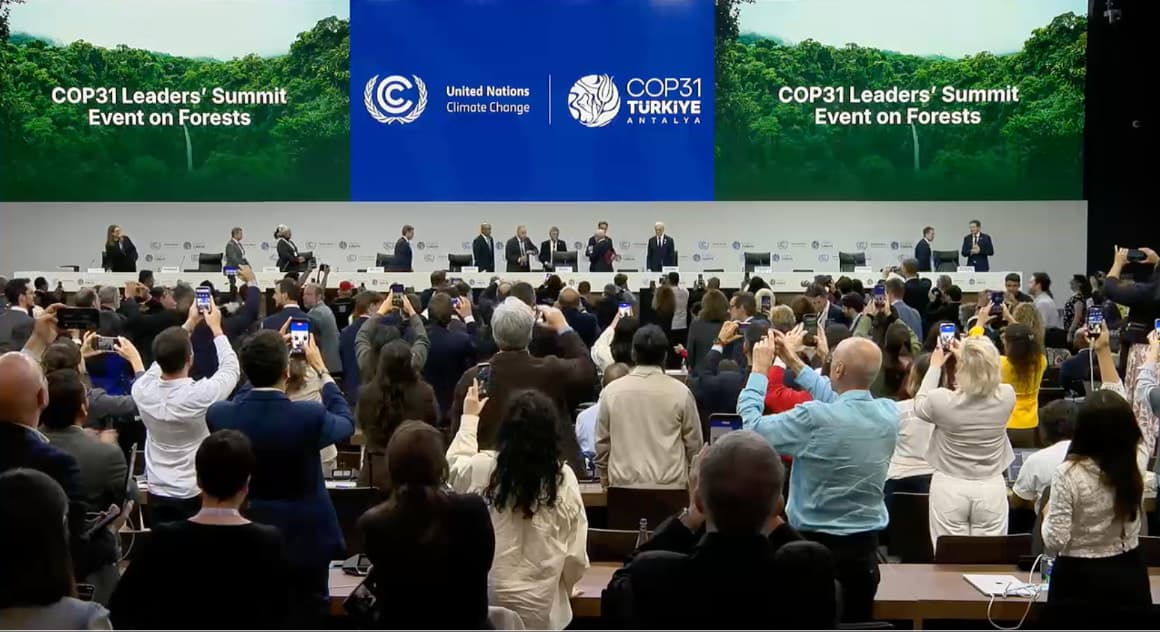
The Akdeniz plenary room was ringing with chants of “Olé, olé, olé, olé, Lula, Lula!” as Brazil’s president approached the stage for the COP31 forest leaders’ summit on 11 November.
Lula’s re-election may have revitalised the talks and given delegates something concrete to cheer for, but the summit dwelled on Brazil’s tropical fund – whose returns are less certain at the moment.
New pledges
There was much speculation among delegates that the summit would yield major new pledges for the Brazil-led Tropical Forest Forever Facility (TFFF).
However, only $88m from philanthropies emerged as new contributions at the event. Several countries reiterated their past and recently made pledges. (See more on the leaders’ summit pledges on CB Connect.)
Speaking at the Association of Southeast Asian Nations summit in Manila on 15 November, Canadian prime minister Mark Carney pledged “an initial contribution of up to” $393m over four years to the TFFF.
This means the fund has – so far – mobilised $8.2bn from different international partners, mostly as conditional loans.
Falling short
This leaves it $1.8bn short of a $10bn target for public and philanthropic capital for this year.
With less capital to invest – spread over 10 rather than four years – the fund claims to be heading in a “safer” direction, with an “acceptable level of risk”. This means taking fewer risks, using less borrowed money and focusing on building equity over 10 years, instead of paying out all the returns to countries and communities.
Political economist Max Alexander Matthey told Carbon Brief that these actions will “lead to a fund that will not be able to deliver on the initially promised $4 per hectare” of protected forest in participating countries, even in a best-case scenario.
At the same time, he said, the costs of the fund are “immensely” underreported. According to Matthey’s Missing Billions newsletter, financial managers “will still get their $100m” in fees, even if communities are kept waiting for their promised rewards. And, if markets turn, the sponsor capital “might even be wiped out”, he added.
‘Only game in town’
At the forest leaders’ summit, biodiverse countries highlighted a few other finance options to keep forests standing.
Guyana outlined that “jurisdictional forest carbon markets” – where carbon offsets are generated at an entire national or subnational scale – are now its “principal pathway”.
Federica Dossi of Carbon Market Watch called Guyana’s approach “very problematic”, pointing to a recent Carbon Pulse investigation where a single error in a spreadsheet led to 3.9m excess credits.
Dossi told Carbon Brief it is “extremely hard” to ensure that forest-based carbon credits deliver lasting carbon removals and do not “cheat nature in the long run”.
With carbon offsets and nature-credit markets under scrutiny – and public climate finance dwindling – the need for “some kind of success story is pretty high”, said Matthey. He concluded:
“The urge to get something big for the forests on the ground is pretty high…All the financial institutions say it’s a fantastic idea, right? And the TFFF is kind of the only game in town. No one has asked the question: how much money is this fund actually expecting to generate?”
Watch, read, listen
NO LINK IN BIO: DeSmog found that industries that “harm the natural world” sent “hundreds of representatives” to COP17, but the UN “stripp[ed]” their company affiliations from its delegates list.
ALL SHOOK UP: Civil Eats looked at how the “blue wave” in the US midterms could “shake up” food and farming policy, given that food prices were “major sticking points” for voters.
SEED CAPITAL: A New York Times photo-essay showed Malawi’s farmers struggling to adapt to the impacts of the ongoing “super El Niño”, where drought-resistant seeds cost more than 14 times what they make in a day.
FREEDOM: Scroll.in spoke to Indian Indigenous activist Pranab Doley, released without charge after spending 117 days in jail on national security charges for protesting against a luxury hotel in the Kaziranga national park.
New science
- El Niño and climate change decreased the intensity of seasonal rainfall in Indonesia this year, which contributed to “widespread fire activity” from August to October | World Weather Attribution
- Limiting global warming to 1.5C this century is “out of reach” without contributions to emissions-cutting efforts from agriculture, forestry and other land use | Nature Sustainability
- Severe drought induced by climate change could cause five “bio-regions” to lose up to one-quarter of their cacti diversity | Nature
- Marine heatwaves recorded at greater depths over coral reefs are “stronger” than those closer to the ocean surface, but they occur less frequently | Geophysical Research Letters
Noticeboard
- 9-20 November: UN climate summit COP31, Antalya, Turkey
- 24 November: Senior attorney for urban wildlands at the Center for Biological Diversity | Salary: $95,000-$140,000. Location: Remote in California
- 27 November: Conservation education officer at Beale Wildlife Park | Salary: £12.71 per hour. Location: Berkshire, England
- 29 November: General election, Spain
This edition of Cropped was written by Aruna Chandrasekhar, Orla Dwyer and Dr Giuliana Viglione.
Cropped is edited by Dr Giuliana Viglione. Please send tips and feedback to [email protected].