Guest post: Why tough methane cuts are crucial for keeping warming ‘well-below’ 2C
Methane is a powerful greenhouse gas and the second-largest contributor to global warming after carbon dioxide (CO2).
Methane traps heat in the atmosphere more efficiently than CO2, but has a significantly shorter lifespan, fading after just a few decades.
Therefore, reducing emissions of methane – a gas primarily produced by agriculture, fossil fuels and waste management – is a powerful option for limiting global warming in the near-term.
Yet climate strategies and models often only focus on CO2, or combine all greenhouse gases into one metric known as “CO2 equivalent”.
The latter approach makes reducing methane emissions dependent on modelling choices and assumptions about the “equivalence” of methane and CO2.
It hides the opportunities and challenges linked to methane’s high warming and short lifetime.
In a new study, published in Communications Earth & Environment, we offer a different perspective that “decouples” CO2 and methane reduction and takes global warming limits as a starting point for determining the required level of methane cuts.
We show that, even under the most ambitious existing national net-zero targets, an absence of methane reduction leads to peak warming that exceeds 1.85C above pre-industrial levels.
The study highlights that, to limit peak warming to well-below 2C, net-zero CO2 targets must be complemented by stringent methane emissions cuts.
CO2 equivalent
How much methane corresponds to one tonne of CO2?
The question is as difficult to answer as: ‘how much spaghetti equals a chicken?’ You could compare the two meals according to their calories, protein content or cost. Each metric can be convenient, but is only valid for that specific comparison – no amount of spaghetti is the same as a chicken.
The same is true for the conversion of emissions of methane and other gases to CO2-equivalent emissions. It can be convenient, as it allows different gases to be compared or combined into a single number. This is why the metric is used in climate targets or evaluating the effectiveness of different mitigation options.
But, because methane and CO2 have different atmospheric lifetimes and warming properties, any conversion is only valid for a chosen time horizon and a chosen baseline.
Depending on the assumptions baked into calculations, methane mitigation can either appear as an immediate priority or framed as almost unnecessary.
There are a number of metrics that scientists use to convert greenhouse gases – whether methane, hydrofluorocarbons or nitrous oxide – into CO2-equivalent emissions:
- “GWP20” measures how much heat a greenhouse gas traps in the atmosphere over a 20-year period, relative to CO2. It emphasises urgent methane mitigation but has been criticised for its implicit discounting of future damages.
- “GWP100” looks at a 100-year timeline. It gives more weight to long-term warming and is used in “integrated assessment models” (IAMs) used by scientists, national emission reporting to the UN and by the GHG Protocol used by companies.
- “GWP*” considers the rate of emissions, rather than warming over a fixed time horizon. Under GWP*, very limited methane reductions bring CO2-equivalent emissions to zero, meaning remaining methane emissions can be designated as causing “no additional warming”. (This interpretation remains controversial as it assumes the continuation of historical levels of warming.)
IAMs are the tools used to generate future emissions scenarios. Because they combine CO2 and methane emissions, the impact of methane emission cuts alone is difficult to isolate in existing emission scenarios.
IAM-generated scenarios also assume mitigation decisions driven by costs. Combinations of CO2 and methane emission pathways that are not purely cost-effective are, therefore, not represented, even though climate policy is messy and emission pathways are rarely cost-effective in the real world.
Only a few countries – including Japan, Mexico and South Korea – specify methane mitigation targets.
A different approach
In our study, we separate CO2 and methane emissions and treat them as independent.
Instead of choosing a conversion method, we suggest that states and organisations set a limit on peak global warming first, then, based on their existing net-zero targets, determine the minimum compatible methane reduction target.
Companies and countries around the world have set net-zero targets focused on CO2, as well as those that include all greenhouse gases. As a result, our research looks at the necessary methane reductions for both types of goal. We consider scenarios where companies or countries deliver linear – in other words, steady – emissions reductions to reach net-zero.
Using a simple climate model, we systematically combined methane and CO2 (or greenhouse gas) mitigation pathways starting in 2025 and calculated peak warming.
The figure below shows how peak warming depends on both the year of reaching net-zero CO2 and the level of methane cuts.
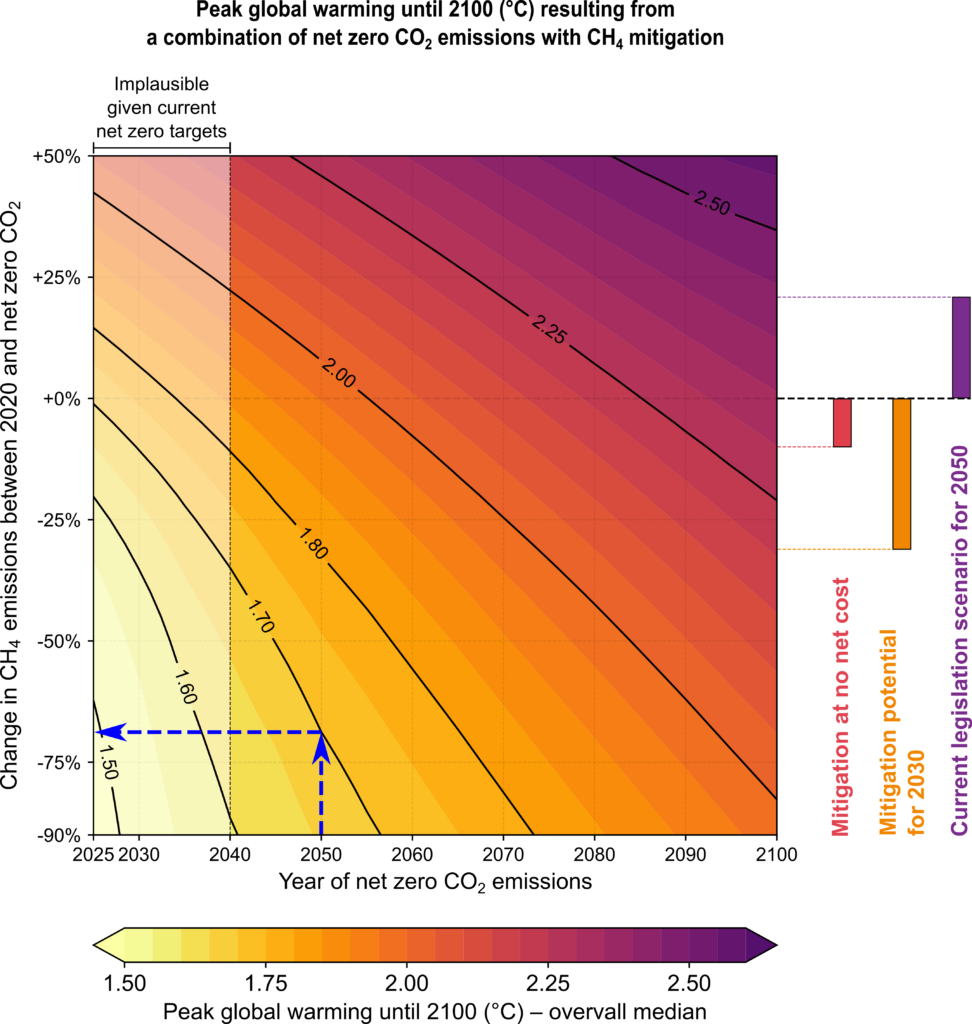
The blue arrows in the figure show that to limit warming to 1.7C under a 2050 net-zero CO2 scenario, methane emissions would need to fall by at least 69% by 2050, relative to 2020.
Our research also finds that, if an organisation or country’s 2050 net zero-target covers all greenhouse gases, its methane emissions would need to fall by 63% instead.
However, under current policies, methane emissions are expected to increase by around 20% by 2050, relative to 2020. We find that this pathway would result in peak warming above 2C by 2050 – even if global CO2 emissions were to reach net-zero by that date (see purple bar on the right-hand side of the figure above).
The figure also shows how, if methane emissions remained at 2020 levels and net-zero CO2 was delivered by 2040 or later, warming would exceed 1.85C. This level of warming is above what has been argued as consistent with the Paris Agreement’s “well-below” 2C limit.
Conversely, cutting methane emissions by around one-third – in line with the Global Methane Pledge target for 2030 – could reduce peak warming by 0.15C, of which 0.05C could be delivered by interventions that come at no net cost. These are shown by the orange and red bars, respectively, on the figure above.
The table below highlights the minimum compatible methane cuts for three different peak warming levels and net-zero CO2 or greenhouse-gas emission targets.
| Peak warming | Year of net-zero CO2 emissions | Year of net-zero greenhouse-gas emissions | ||||
| 2050 | 2060 | 2100 | 2050 | 2060 | 2100 | |
| 1.7C | -69% | – | – | -63% | – | – |
| 1.8C | -32% | -56% | – | -11% | -47% | – |
| 2C | +8% | -8% | -83% | >50% | +33% | -78% |
Minimum methane emission reductions between 2020 and the year of net-zero emissions, consistent with peak warming of 1.7C, 1.8C, and 2.0C at 50% likelihood, assuming linear emission trajectories. For some net-zero targets and peak warming levels, there are no compatible methane mitigation targets (indicated by “–”).
Remaining carbon budget
The global carbon budget refers to the amount of cumulative CO2 emissions allowable while still meeting a particular global warming threshold.
The 2021 climate science report from the Intergovernmental Panel on Climate Change (IPCC) and a 2023 Nature study estimated that, by 2025, the remaining carbon budget for holding warming to 2C would be around 1,000-1,150bn tonnes of CO2 (GtCO2).
We find that these estimates are founded on the assumption of methane reductions of 27-35% by 2050, relative to a 2020 baseline. (A 2024 Communications Earth & Environment study reached similar conclusions.)
Under the GWP* metric, where methane emissions are only cut to maintain “no additional warming”, the remaining carbon budget would be constrained. The best estimate of a 2C budget shrinks by around 30% to approximately 750GtCO2.
Finally, if methane emissions are not cut at all in the future, our findings suggest that the remaining carbon budget for 1.7C of global warming has, in effect, already been exhausted.
Our analysis shows how peak warming depends on both CO2 and methane reduction – and how methane-specific targets can help refine existing net-zero targets.
Crucially, we show that complementing net-zero CO2 targets with stringent methane cuts is necessary to limit peak warming to well-below 2C.
Weber, K. et al. (2026) Limiting warming by CO2 and methane mitigation in an expanded scenario space, Communications Earth & Environment, doi:10.1038/s43247-026-03832-1
related

Guest post: France’s June heatwave caused more than 2,700 heat-related deaths

Guest post: Climate change has caused one-fifth of Pine Island glacier retreat

Q&A: What change of power in Colombia could mean for world’s fossil-fuel transition