
DeBriefed 23 October 2026: Crossing 1.5C ‘unavoidable’ | IPCC talks ‘disappointment’ | Nature COP explained

Welcome to Carbon Brief’s DeBriefed, an essential guide to the week’s key developments relating to climate change.
In this issue…
- A temporary breach of the 1.5C global-warming limit is now “inevitable”.
- A key IPCC meeting ended in “profound disappointment”.
- Carbon Brief reports from Armenia on what is at stake at the COP17 nature summit.
- Key dates for next week and pick of the job vacancies.
This week
Crossing 1.5C ‘inevitable’
‘UNAVOIDABLE’: A temporary breach of the 1.5C global-warming limit is now “inevitable” following “decades of insufficient climate action”, according to an UN Environment Programme (UNEP) report covered by Carbon Brief. In its “sobering” annual assessment of the global “emissions gap”, UNEP said that exceeding the Paris Agreement’s 1.5C limit is “imminent and unavoidable”.
HEADED FOR 2.8C: The report also said that current country policies would cause 2.8C by the end of the century, said the Financial Times. It added that this was with the “US standing out among developed economies with sharply higher energy-related emissions”. UNEP found global emissions would need to fall 18% by 2030 and 45% by 2035, from 2025 levels, to limit the size and duration of “overshoot” above 1.5C, reported the Guardian.
Around the world
- ‘DISAPPOINTMENT’: The Intergovernmental Panel on Climate Change’s 65th session, seen by many as the final opportunity for countries to agree on a report schedule in line with the UN’s second “global stocktake” of climate action, ended in “profound disappointment”, explained Carbon Brief.
- JACKDAW GREENLIT: The UK has approved the Jackdaw gasfield project in the North Sea, said the Times. Sources told the Guardian that the government is “leaning towards” rejecting the Rosebank oil field.
- CHINA SIGNALS: A Chinese environment minister told a conference that the country wants the COP31 climate summit to address the “new problem” of tariffs against its clean-energy exports, said Reuters.
- ‘OIL BOOM’: Climate Home News reported that a Turkish company sponsoring COP31 “cut climate goals then cashed in an oil boom”.
50,000
The estimated heat-related deaths in Europe this summer, “making it the most deadly season for heat mortality in modern records”, according to Nature Health research covered by the Financial Times.
Latest climate research
- Adoption of plant-based meat alternatives could “substantially” reduce agricultural greenhouse gas emissions and land expansion | Nature Food
- Glaciers in Alaska will lose between half and three-quarters of their 2015 mass by the end of the century | Earth’s Future
- Researchers argue that “rare diseases are an overlooked dimension in climate-health adaptation” | Nature Climate Change
(For more, see Carbon Brief’s in-depth daily summaries of the top climate news stories on Monday, Tuesday, Wednesday, Thursday and Friday.)
Captured
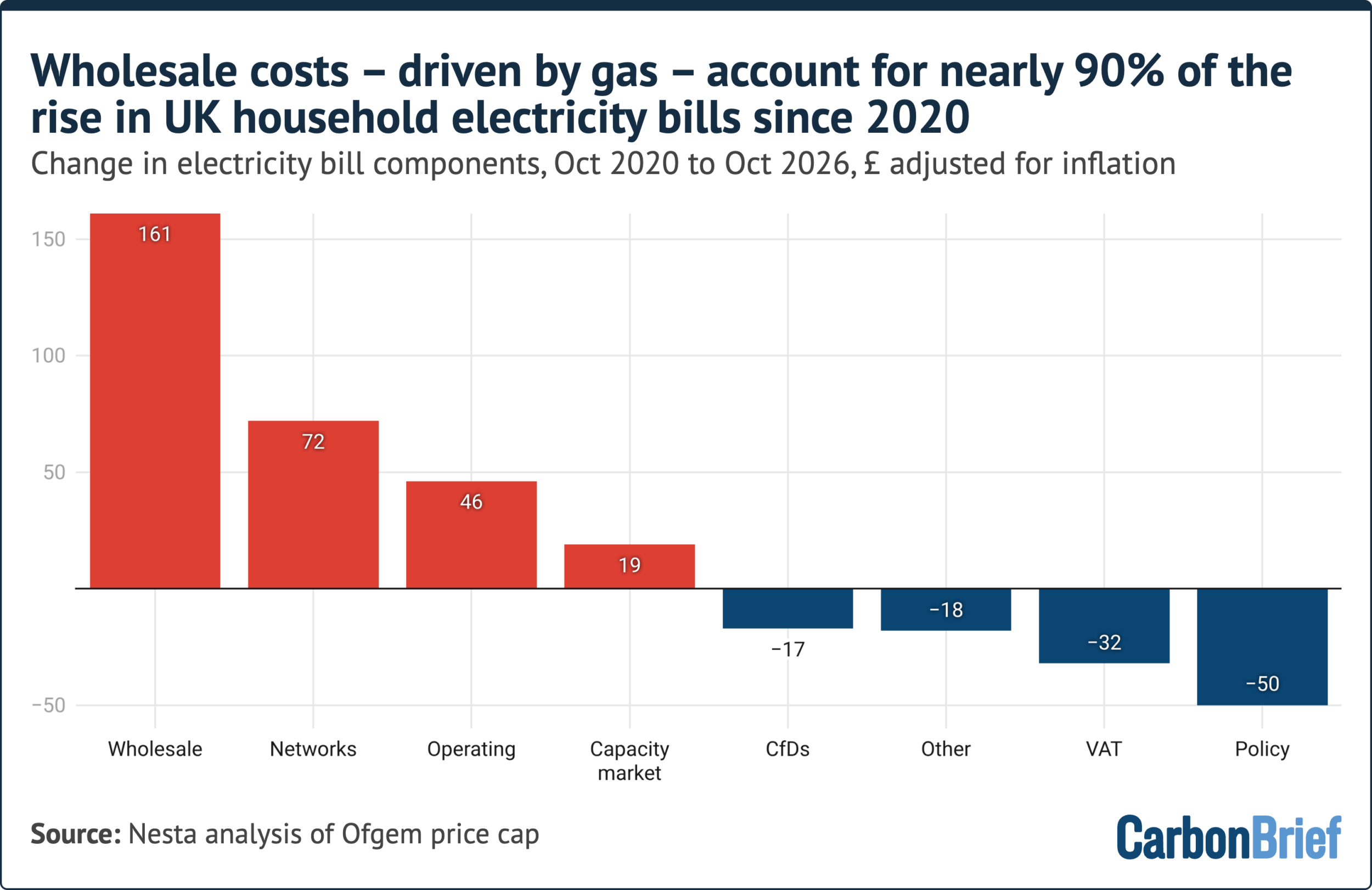
A surge in wholesale costs driven by expensive gas is responsible for nearly 90% of the rise in UK household electricity bills since 2020, according to new analysis for Carbon Brief. The figure above shows that, after accounting for inflation, typical UK annual household electricity bills rose £180 by the fourth quarter of 2026, relative to the same period in 2020. Some 90% of this increase (£161) is due to wholesale costs, driven by the price of gas.
Spotlight
COP17: Four-dimensional Armenian chess
This week, Carbon Brief reports from Yerevan, Armenia, which is currently playing host to the COP17 biodiversity summit.
The halls of Yerevan’s Meridian exhibition centre are slowly filling up. The massive complex, situated in the rocky basalt valley of the Hrazdan river that runs through Armenia’s capital, is now seeing ministers fly in for the second week of the COP17 nature talks.
On the surface, things seem relatively quiet. Biodiversity talks rarely attract the same crowds as climate talks, but draw a dedicated bunch of scientists, activists and Indigenous groups.
Most negotiations up until Thursday were in closed-door “contact groups”, with observers and countries tight-lipped about the state of negotiations.
One exception was a sunset protest on Wednesday, as Indigenous groups rallied to “defend democracy” and Brazil’s ecosystems ahead of the presidential election this weekend.
Global review
COP17 marks the halfway point in the “Paris Agreement” for nature. Countries are negotiating the details of the global review, the first “stocktake” of progress on biodiversity targets for 2030.
A UN report released shortly before the summit showed that the world is falling behind on 22 of 23 of these targets.
Linda Krueger, the director of biodiversity and infrastructure policy at the Nature Conservancy, told Carbon Brief:
“The world right now is not really in geopolitical co-operation mode…so all these things have become a little bit harder.”
COP17 president, Hambardzum Matevosyan, told a small group of journalists, including Carbon Brief, that he is “hopeful” for progress on key issues by the end of the talks.
Finance
Kirsty Leong, a policy expert at WWF, told Carbon Brief that coming up with finance to help developing nations protect nature is a key factor in global review negotiations:
“You have one side wanting to have very strong language and high ambition in what countries should do…and the other side of the room saying the main problem in implementation is that they don’t have the means to do it.”
As Carbon Brief detailed ahead of the talks, developed countries are failing to meet their commitments to raise “at least $20bn a year by 2025” for nature.
Calls to “broaden the contributor base” of who pays – and whether that should include developing economies like China – is now the most fraught element of the talks.
So far, countries have rejected four different ways to phrase this, instead putting forward four alternative options.
They will also have to agree on criteria to shape and resource a new, permanent financial mechanism designed to protect nature beyond 2030.
Science
As countries spar over options, delegates fill up their plates with sheep’s milk cheese and grapes inside Armenia’s giant pavilion.
David Obura, chair of the Intergovernmental Science-Policy Platform on Biodiversity and Ecosystem Services (IPBES), told Carbon Brief that the “framing” of the 2030 nature goals is “fantastic”, but delivery is missing “because we silo targets and goals” from one another.
Obura said that the onus should not be just on governments:
“Companies live from nature, so they need to pay for nature.”
IPBES scientists, meanwhile, are already working on the next set of assessments that will inform conservation goals after 2030. Obura told Carbon Brief:
“I’m a big-picture scientist…How do we have as-good-as-possible a trajectory for 2030, given the current political situation? And how do we make sure that the post-2030 process learns from this [period] and is even stronger?”
Watch, read, listen
‘HEAT STORMS’: Reuters published a special investigative series into the rise of “heat storms”, defined by the newswire as “supersized heatwaves”.
NATURE COP: Guardian biodiversity reporter Patrick Greenfield examined whether countries can get on track to meet their “historic” 2030 nature commitments.
GAS ‘MYTH’: The Drilled podcast tackled “why smart people believe the myth that natural gas is clean”.
Coming up
- 19-30 October: COP17 biodiversity summit, Yerevan, Armenia
- 25 October: Brazil presidential election second round
Pick of the jobs
- Heatmap News, senior editor | Salary: $100,000-$120,000. Location: Remote (US)
- UK Department for Energy Security and Net-Zero, senior ministerial engagement officer | Salary: £47,785-£53,220. Location: London
- Harvard University, tenure-track professor in biodiversity, conservation or land surface processes | Salary: $110,000-$165,000. Location: Cambridge, Massachusetts
DeBriefed is edited by Daisy Dunne. Please send any tips or feedback to [email protected]
This is an online version of Carbon Brief’s weekly DeBriefed email newsletter. Subscribe for free here.