Revealed: Expensive gas behind ‘nearly 90%’ of rise in UK electricity bills

A surge in wholesale costs driven by expensive gas is responsible for nearly 90% of the rise in UK household electricity bills since 2020, reveals new analysis.
The figures, shared with Carbon Brief by thinktank Nesta, show that wholesale gas costs are also behind the vast majority (77%) of the increase in household gas bills.
The analysis firmly contradicts the idea, which has become embedded in UK media and political narratives, that the UK’s net-zero target is to blame for high energy bills.
Andrew Sissons, director for sustainable future at Nesta, tells Carbon Brief that net-zero is, in fact, “helping to shelter Britain from the impact of expensive gas”. He adds:
“Rising gas prices, not net-zero, have driven most of the recent surge in Britain’s energy bills. Britain is particularly exposed, with over 80% of households connected to gas mains, while our electricity system still relies too much on gas as the marginal unit.”
The analysis comes after the UK government gave its approval for the Jackdaw gas field to be developed in the North Sea, despite stating that it “would not…affect prices”.
Another gas crisis
In January 2026, Carbon Brief reported that two-thirds of the rise in electricity bills since before the 2022 global energy crisis was due to high gas prices.
Now, amid ongoing conflict in the Middle East, wholesale gas prices are at their highest levels since Russia’s 2022 invasion of Ukraine.
Indeed, as of 19 October, UK wholesale gas prices stood at 220p per therm (£75 per megawatt hour, MWh), above the average for 2022 of 210p/therm (£72/MWh).
The figure below shows that, after accounting for inflation, typical UK annual household electricity bills had risen £180 by the fourth quarter of 2026, relative to the same period in 2020.
Some 90% of this increase (£161) is due to wholesale costs, driven by the price of gas.
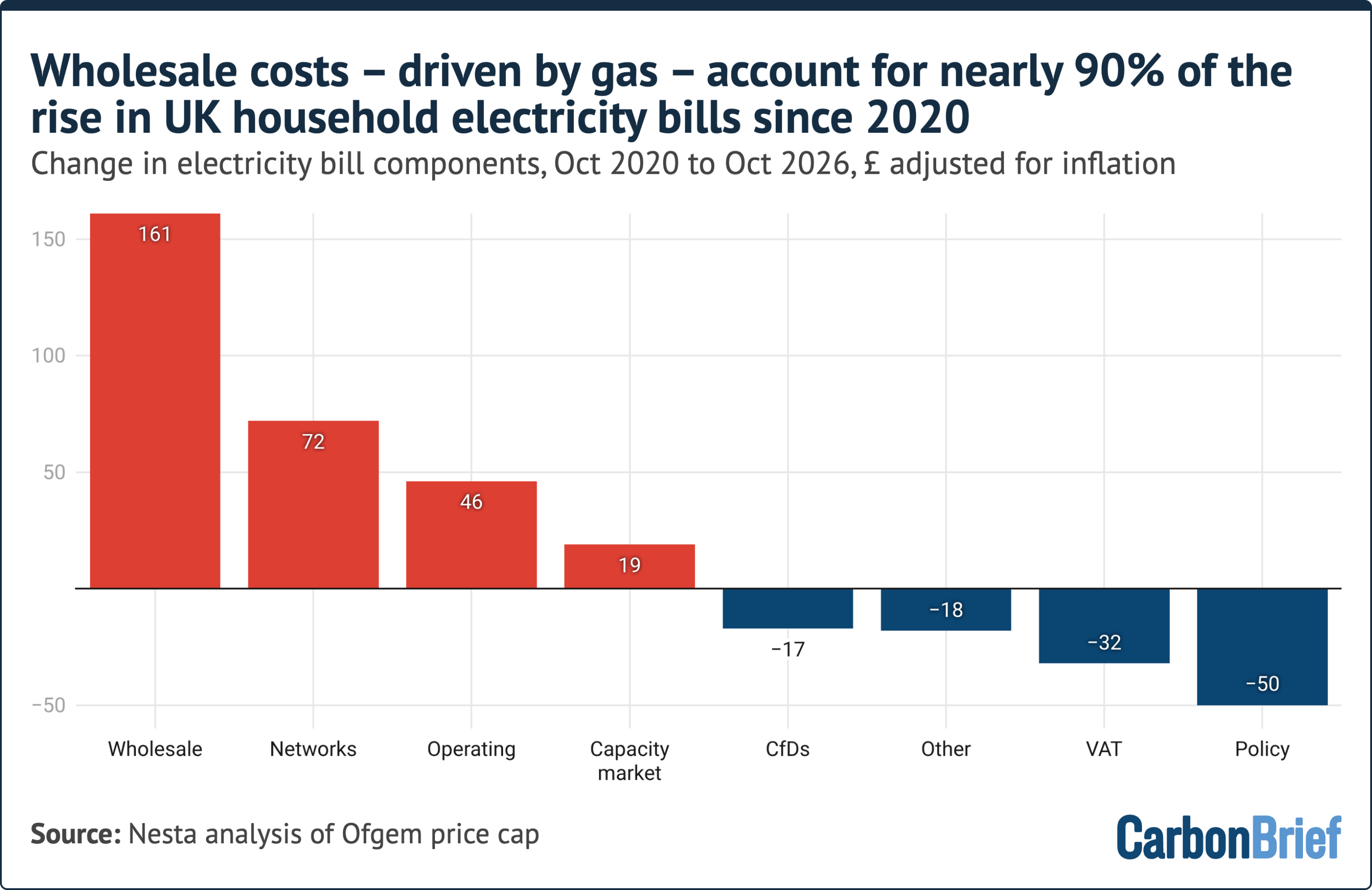
In contrast – and contrary to widespread perceptions – renewable “contracts for difference” (CfDs) are reducing electricity bills by £17 under the current price cap, according to the Nesta analysis.
In addition, the government has cut policy costs for electricity by moving 75% of legacy renewable support onto general taxation, ending the “ECO” efficiency scheme and temporarily removing VAT.
Network costs have added £72 to typical bills since 2020, according to Nesta. Most of this (£46) is for investment in the electricity transmission network, known as the “motorways” of the grid.
Only £21 of the rise in network costs relates to balancing the system, including “constraint payments” for turning off windfarms – and turning on gas plants – due to insufficient grid capacity.
Wind constraint payments regularly receive extensive news coverage, despite balancing costs – in total – making up just £35 (4%) of a typical £858 annual household electricity bill.
The Nesta figures show energy supplier operating costs have gone up by £46 since 2020. These costs are not broken down in the underlying Ofgem figures, but the increase is thought to be driven by the cost of rising household energy debt. Supplier profits are capped at 2.5% of bills.
Breaking the link
Notably, household electricity prices have increased far less rapidly since the Hormuz crisis than gas bills, with higher clean-energy generation helping break the link between the two.
Since 2020, household gas bills have increased by £368 in real terms, according to Nesta’s analysis. Some 77% of this (£283) is due to wholesale gas costs.
After accounting for inflation, total dual-fuel bills for a typical household have increased from £1,175 per year in October 2020 to £1,723 per year in October 2026, a rise of 47%.
The rise in wholesale costs driven by high gas prices accounts for £444 (81%) of this increase in real terms, as shown in the figure below.
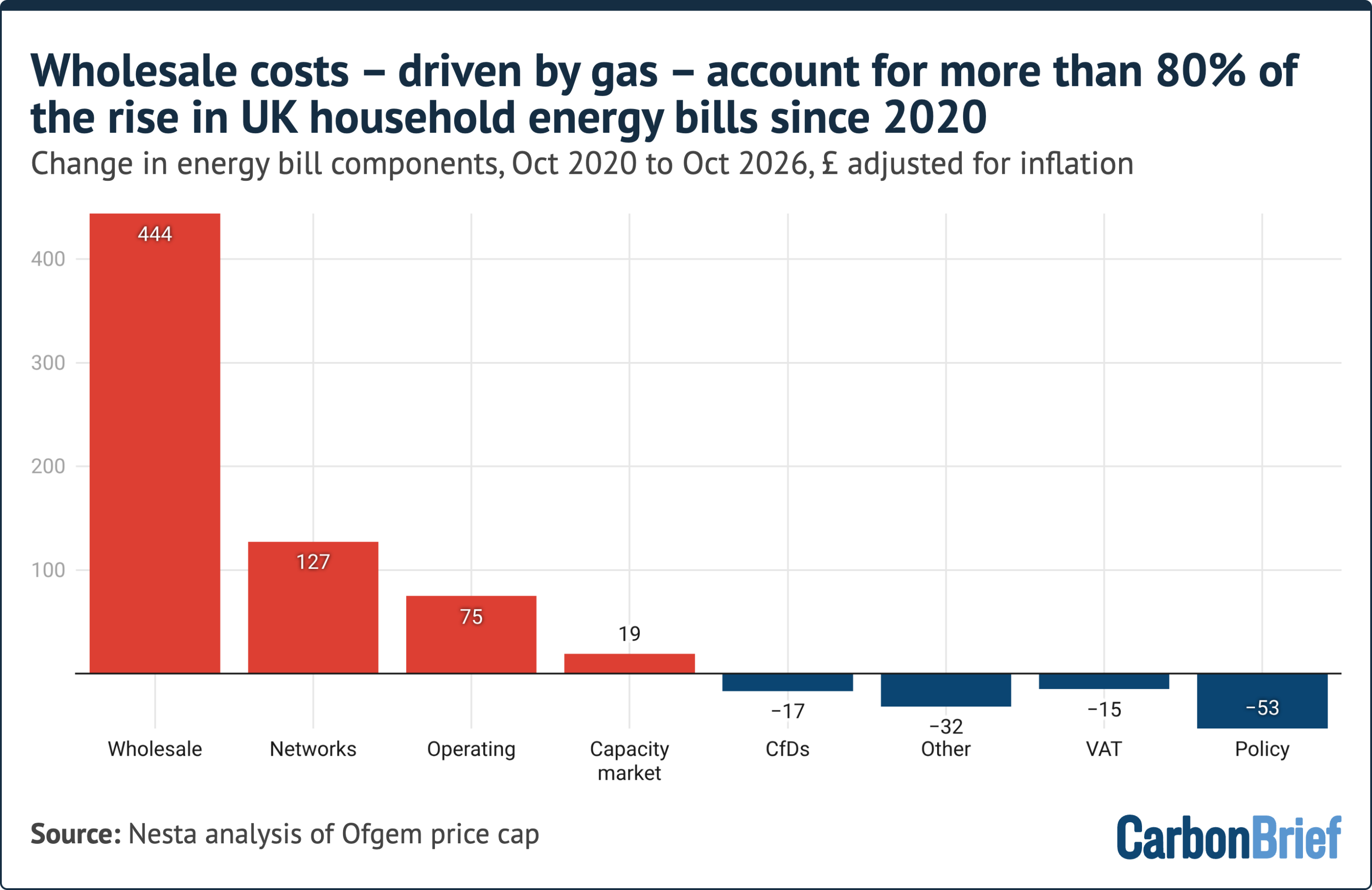
The £127 real-terms rise in network costs includes £72 for electricity transmission, distribution and balancing, as well as £55 for investment in the gas grid.
(According to the Energy Networks Association, up to 80% of the investment in electricity grids is required to maintain existing assets, with the remainder going towards expansion for net-zero.)
In total, the cost of government social and climate policies made up £183 (16%) of typical dual-fuel bills in October 2020. This had fallen to £114 (7%) as of the current October 2026 price cap.
Wholesale costs make up the largest share of the current cap, at £757 (44%). Network costs are the second-largest component of bills, at £417 (24%), followed by operating costs at £291 (17%).
Sissons tells Carbon Brief:
“Upgrading the grid is not cost-neutral, but that price tag is dwarfed by the impact of rising gas prices. In fact, net-zero is helping to shelter Britain from the impact of expensive gas. Since the start of the Iran war, electricity bills have begun to decouple from gas bills, thanks to the UK’s increased renewable power and support from contracts for difference.”
“Going further will require British households to have clean electricity, electric vehicles and heat pumps over fossil-fuel cars and boilers. By focusing on growing electricity demand, the government can spread upgrade costs more widely. This can lock in the consistent investment in electrification that is Britain’s best path to stop global turmoil showing up on winter energy bills.”
Related

Factcheck: UK Conservatives double the ‘cost of net-zero’ after spreadsheet blunder

Analysis: Wind and solar save UK from gas imports worth £5.9bn during Hormuz crisis
Analysis: EVs are now nine times cheaper than petrol or diesel to drive in the UK