UK budget 2026: Key climate and energy announcements
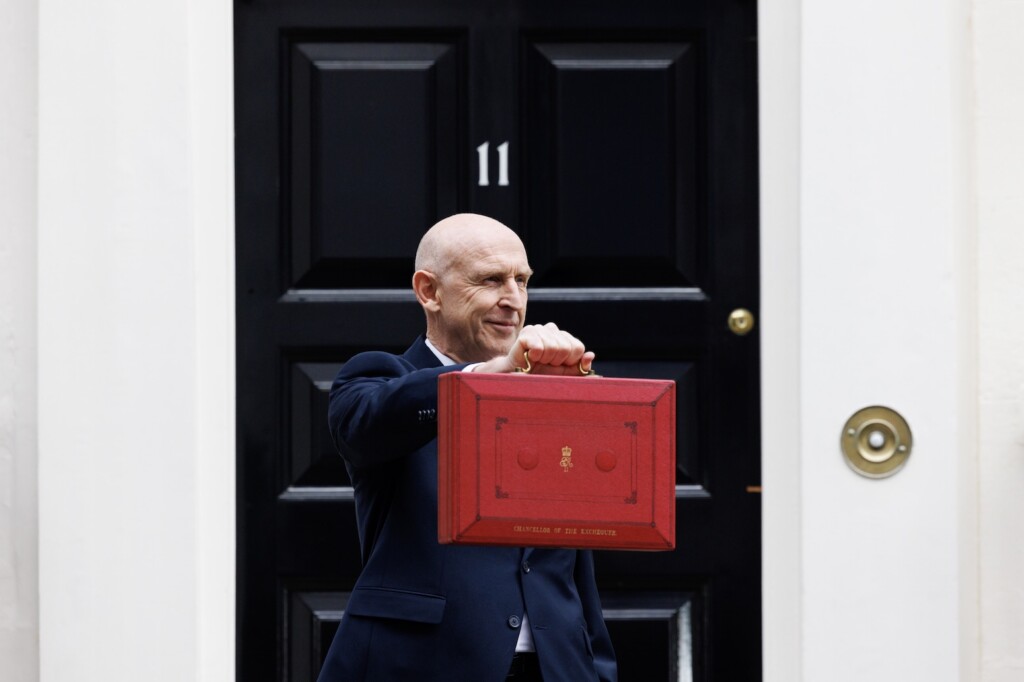
Chancellor John Healey has announced a “new course on energy” for the UK, focused on keeping bills low amid the global crisis triggered by war in the Middle East.
As he laid out his first budget, Healey said the Labour government would still prioritise the expansion of clean power and remain “unshakably committed to net-zero”.
The budget sets out what the chancellor calls a “radical reform of energy”, including a longer-term effort to “break the grip of gas on bills”.
There are also a variety of short-term measures to curb energy bills, including a council-tax rebate and the removal of the gas “standing charge”, though these fell far short of pre-budget calls to tackle high prices.
Moreover, in order to fund defence spending, the government is cutting £1bn from its “warm homes plan” and £700m from hydrogen and carbon capture and storage (CCS) projects.
The budget also appears to cut up to another £4.7bn from the warm homes plan – as well as ending zero-rated VAT for solar panels and extending a “temporary” 5p cut in fuel duty.
Finally, the government set out plans to ensure new data centres meet strict environmental regulations, while leaving the door open to on-site fossil-fuel power generation.
Below, Carbon Brief runs through the key climate- and energy-focused announcements from the budget.
‘New course on energy’
Conflict in the Middle East has driven up energy bills for people in the UK, as the global trade in oil and gas has been thrown into disarray.
In this context, the new budget sets out a “shift in the government’s approach to energy”, focusing on “cheaper energy” as the main priority.
At the same time, Healey was clear that fossil fuels were driving the price increases and that clean power would be essential for the government’s cost-cutting agenda.
In its accompanying analysis, the Office for Budget Responsibility (OBR) notes that “fossil-fuel prices rose by 83% in the year to September 2026”.
In his speech, the chancellor announced a “radical reform of energy to reduce bills”, stating:
“Today, I’m setting a new course on energy. To get UK energy costs down in line with Europe, from this point, our Labour government priority is first and foremost cheaper energy, with clean power key to achieving this. This is possible because of the progress we have made towards clean power over the last two years.”
Conservative and Reform politicians have argued that the UK should abandon its net-zero targets, including Labour’s “clean power by 2030” goal, in order to cut energy prices.
This is despite expensive gas driving most of the recent price increases and renewables saving the UK billions in gas imports since the start of the Hormuz crisis.
The government has not explicitly rolled back any climate targets and Healey stressed in his speech that “this government remains unshakably committed to net-zero by 2050”.
Nevertheless, the budget document speaks of a “new energy pathway” on which the government’s upcoming “10 year plan” will build. It also states:
“Cheaper electricity will boost electrification, increasing the UK’s energy security and helping to decarbonise the whole economy.”
The budget mentions short- and long-term measures to bring costs down, including expansion of the electricity grid. (See sections below for more details.)
Healey also used his speech to welcome the recent approval of the controversial Jackdaw gasfield, which he framed as a “pragmatic” decision that would boost UK “energy security”.
The government is yet to make a decision on the Rosebank oilfield, but OBR forecasts released alongside the budget assume that it will be approved.
Energy bills
The budget offers short-term relief on household and industrial energy bills, as well as promising longer-term sectoral reform.
Nevertheless, it falls far short of proposals for cutting bills that had been set out by industry bodies, thinktanks, charities and energy companies ahead of the budget.
This has stoked expectations that the government may be forced to offer further support on energy bills after the price cap for January 2027 is announced later this year.
Forecasts suggest bills could rise by a quarter – some £470 – to around £2,200 a year.
The only substantive and immediate new bills measure in the budget is a £100 council-tax rebate for English households in bands A-D, which Healey said would cost £2.6bn.
Devolved governments will receive a share of the funding to provide their own support. Meanwhile, local authorities will receive an additional £100m to provide targeted support to households “acutely impacted” by rising energy bills.
In addition, Healey announced that the temporary removal of VAT from household electricity bills – worth around £45 per year – will be extended by three months, from April to July 2027.
Healey also made a commitment that no new policy costs would be added to energy bills until a comprehensive “cost-control framework” is in place. This is expected at the spending review in 2027. The budget says:
“The government will introduce a new comprehensive cost control framework (CCF) at the spending review in 2027 that will set budgets for components of energy costs, including policy costs, to ensure government action drives bills down over the next 10 years.”
“As part of this, the budget specifies that going forward, the government will only procure new clean-power projects that lower bills and can easily connect to the grid.
It specifically notes that the upcoming eighth “contracts for difference” (CfD) auction (AR8) “will lower bills, as well as deliver[ing] a good outcome for energy security and climate”.
Speaking to Carbon Brief, James Dyson, senior researcher at E3G says that an effective framework should “set out a specific, timebound commitment to remove the hidden costs from energy bills which have accumulated over the last two decades”, as well as providing oversight of system costs in the future.
A planned levy on gas bills – a long-term funding mechanism for the low-carbon hydrogen dubbed the “gas shipper obligation” – will be moved into general taxation, so that “government rather than consumers fund the costs of hydrogen projects”.
On the morning of the budget, the government announced that the “unfair and outdated” gas standing charge would be removed for around 23m homes in the UK.
A standing charge is a fixed daily fee paid by households as part of their bill, regardless of how much gas they use. This costs around £108 a year for a typical household.
The government says it will ask energy regulator Ofgem to move the cost of the standing charge onto gas unit rates in 2027, or as soon as possible. It says this will save 60% of households an average of around £45 a year on their gas bill
The change will disproportionately benefit the poorest households, according to analysis from thinktank Nesta shown in the figure below.
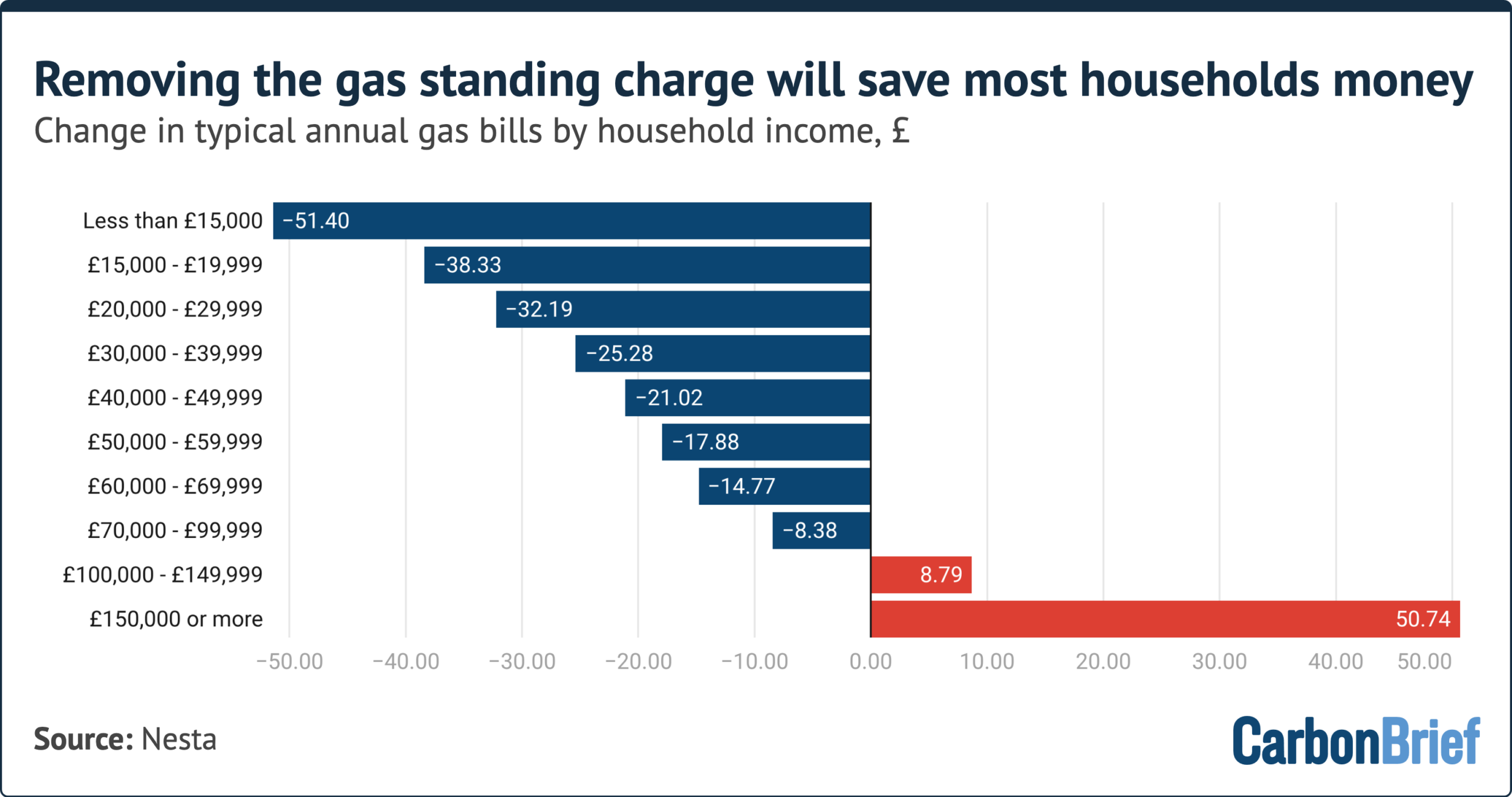
Nesta says the shift will reduce the “spark gap” – the ratio between electricity and gas prices – by around 0.3 points, from 3.3 under the current price cap to 3.0. This could help encourage a shift to electrified technologies, such as heat pumps and electric vehicles (EVs).
The budget also includes a commitment to “reform” standing charges on electricity bills, with further details to be published in 2027.
However, Jess Britton at UKERC tells Carbon Brief that “simply moving [electricity standing] charges on to unit costs risks disincentivising electrification”.
From next year, the government will introduce a new “energy debt circuit breaker”, which will save billpayers £30 by 2030, according to the budget.
This is designed to “tackle the scourge of energy debt”, which currently adds around £60 to typical household energy bills each year, according to Carbon Brief analysis. .
The initiative follows warnings from trade association Energy UK that customer energy debt is on course to hit £7bn by the end of 2026, potentially adding another £10-15 to bills.
The budget also confirmed additional support for business energy bills. It says the “British industrial competitiveness scheme” (BICS) will be expanded to provide a 20-25% electricity discount to 10,000 energy-intensive manufacturing firms from April 2027. This will include back-payments for 2026-27.
In the longer term, the budget includes a commitment to “breaking the grip of gas on bills”.
A consultation published alongside the budget fleshes out the options for a proposed “wholesale contracts for difference” (WCfD) scheme, initially outlined in April. This would offer fixed-price contracts to eligible renewable-energy generators.
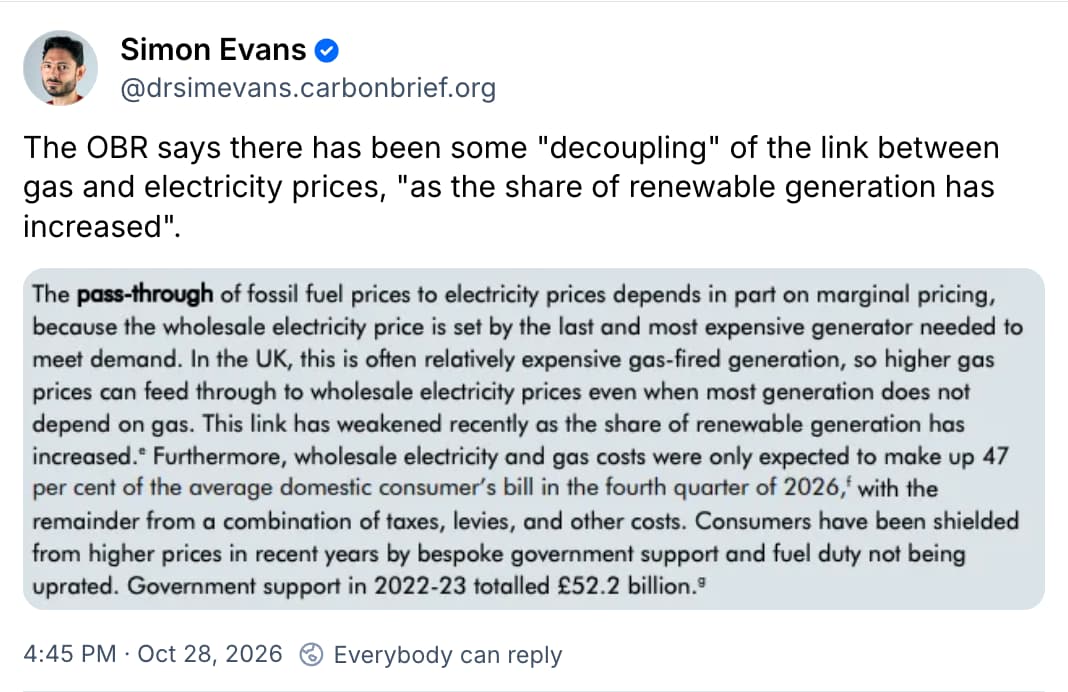
The expansion of renewables is already helping to decouple gas and power prices, with gas setting wholesale electricity prices around 60% of the time in 2025, down from around 90% in the early 2020s.
Warm homes plan
Following speculation in the run-up to the budget, chancellor Healey confirmed a cut to the UK’s flagship energy efficiency programme.
His budget cuts £1bn from the “warm homes plan” to help cover a shortfall in defence spending.
The warm homes plan is supposed to provide up to 5m households with £15bn of grants and loans to support the installation of heat pumps, rooftop solar panels and insulation.
The budget states that the “government remains committed to heat-pump deployment”.
It says it will continue to fund the “boiler upgrade scheme” (BUS) at current funding levels of £400m in 2027‑28, after which it will rise broadly in line with inflation.
However, this represents a significant cut in funding for heat-pump deployment of around £800m, relative to previously announced levels. Analysts tell Carbon Brief that this could lead to around 100,000 heat pumps not being installed over three years.
Andrew Sissons, director in sustainable future at Nesta tells Carbon Brief:
“The chancellor has announced that funding for future heat-pump subsidies will be reduced by nearly £800m over three years. This is a backward step at a time when Britain urgently needs to move away from using gas.”
In addition to the £1bn in lost grants for the warm-homes plan, the budget also suggests that significant additional funding for the scheme has been cut.
It says a new £4.7bn “your first home” scheme is being funded by reallocating “financial transactions” previously allocated to the energy and environment departments.
While the details of this shift remain sparse, this suggests funding for the warm homes plan could end up being reduced from the headline £15bn to as little as £9bn, analysts tell Carbon Brief.
E3G’s Dyson adds:
“An unknown amount of funding has been cut from the ‘financial transactions’ pot, which is money that is used to loan to businesses and households. The cut is between £1.5bn and £5bn.
“The government’s not even tried to spend this money, it only officially launched its [warm-homes] loan scheme today. Businesses and households need certainty to invest in decarbonising homes and this kind of reaction does not support it.”
Ben Westerman, director of policy and advocacy at campaign group Electrify Britain, tells Carbon Brief that “all in all, [the budget is] really disappointing for electrification”.
The budget comes the day after the government launched its “warm homes loan” scheme, which offers households no- and low-interest loans of between £7,500 and £35,000 for installing technologies such as solar panels, batteries and heat pumps.
According to the government, households that install a heat pump, a battery and solar panels could save £550 a year on their energy bills. This could rise to £800 a year when combined with a time-of-use tariff.
Fuel duty and EVs
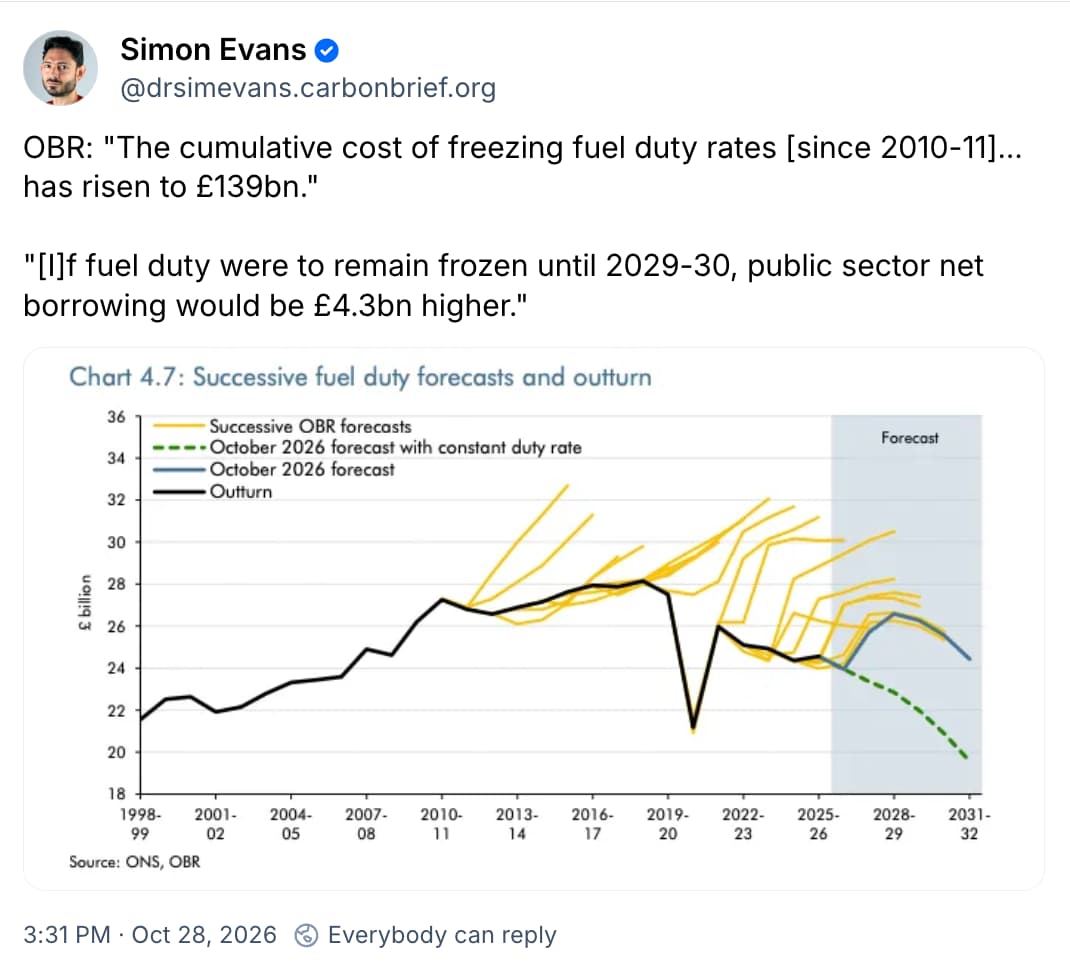
The budget froze fuel duty once again – for the 16th year in a row.
Chancellor Healey also confirmed the extension of the 5p per litre fuel-duty cut announced in 2022 under Conservative then-chancellor Rishi Sunak, in response to the energy crisis triggered by the Russian invasion of Ukraine.
The cumulative cost of these freezes has now reached £139bn since 2010-2011, according to the OBR. If fuel duty continues to be frozen until 2029-30, the OBR says that public-sector net borrowing will rise by £4.3bn.
Alongside the budget, the government published an independent review of the cost of public EV charging. This includes plans to cut prices at local, lower-powered public chargers, saving drivers around £150 a year on average, according to the government.
This will be funded through £100m of government money over two years from spring 2027.
Additionally, the government states that it is “laying the groundwork for a better system in the future” by taking forward a recommendation by the review to launch a “tariff porting” taskforce. This will explore ways to allow drivers to use cheaper domestic tariffs at certain public chargers.
However, the budget also specifies that “electricity supplied through publicly accessible and workplace electric-vehicle charging points is subject to 20% VAT and is not considered domestic use”. This definition will take effect from 1 November 2026, as part of legislation in the finance bill 2026-27.
Industry bodies criticised this categorisation, with Shane Brennan, CEO of ChargeUK, writing in a statement on LinkedIn that it will “do serious damage to the EV transition”. He continues:
“Instead of listening to the call of EV drivers for fairness on VAT, the government has slammed the door shut on ending a rank unfairness between at-home and out-of-home charging…[which] even the courts ruled to be illegal earlier this year.”
Within the budget, the government confirmed some changes to the electric-vehicle excise duty (eVED) pay-per-mile tax, announced in last year’s budget. This includes introducing a mileage estimate tool, developing an opt-in system for connectivity and other changes.
The government will publish its response to the zero-emissions vehicle mandate review by the end of 2026, with a view to changes taking place in 2027.
CCS and hydrogen
The government has confirmed a £200m cut in capital-grant funding for CCS and £500m for low-carbon hydrogen projects.
This is part of the Department for Energy Security and Net Zero (DESNZ) “reprioritising its budget” to contribute more to the UK’s defence spending.
There are four planned CCS “clusters” in the works across the UK – part of a government-backed effort to make the nation an “early leader” in the sector.
The budget says the government will “prioritise” the two “mature” clusters under development on Teesside, and on Merseyside and North Wales. These include “blue-hydrogen” production, gas power with CCS and industrial uses.
It also says the government will “maintain grant funding” for the Viking cluster in the Humber region.
The £200m in removed funding will therefore come from the Acorn cluster, which was planned for north-east Scotland.
At the same time, the government says it is “actively looking at how loan or equity investments can support the continued development of future CCS and hydrogen projects…including for the Acorn cluster”.
While the Labour government has stressed the importance of CCS for reaching the UK’s net-zero targets, the billions in public spending committed to these projects have drawn criticism from both climate activists and climate sceptics.
Details of the cuts remain limited, but Prof Rob Gross, director of the UK Energy Research Centre, tells Carbon Brief:
“The history of CCS investment in the UK is not a happy one and if the government wishes to retain investor confidence and the regional economic benefits that the clusters could bring then a repeat of the precipitous cuts made in 2015 must be avoided. It appears that the government is aware and treading carefully.”
Data centres
As part of efforts to boost the UK’s use of artificial intelligence (AI), the budget sets out a “data-centre covenant”, with “tests” that data centres must meet to gain approval.
These include a stipulation that developers must pay for “any energy costs they create”, while also “support[ing] grid resilience, flexibility and clean power”.
The “covenant” will also require data centres to “adhere to the highest environmental standards”, including protecting nature, curbing water use, publishing energy-use data and using waste heat to heat nearby buildings “wherever practical”.
In return, the government will use new planning powers to accelerate the grid connection of data centres, alongside other “strategically important” projects.
When grid connection is not immediately available, the government says it will set out a framework to allow on-site generation until a grid connection can be secured.
The government stresses that on-site generation will be “tightly controlled” and “only…available for exceptionally strategic projects”.
Nevertheless, NGOs raised the likelihood that “on-site power” would come in the form of gas or diesel generation, rather than clean power, potentially threatening the UK’s climate goals.
Other announcements
There were various other climate- and energy-related announcements in the budget, including:
- The government has not extended zero-rated VAT for “energy saving materials” – including solar panels – when installed on homes beyond the end of March 2027.
- The budget confirms the establishment of an “energy wealth fund”, which was recently announced as a way to invest revenues from North Sea oil and gas into low-carbon energy infrastructure.
- The government is legislating for the “oil and gas revenue levy” to replace the “energy profits levy” when that ends by April 2030 at the latest.
- It freezes the electricity main rates of the “climate-change levy” from April 2028, in order to “reduce electricity costs in real terms for businesses”.
- As part of the government’s efforts to promote housebuilding, it has introduced an exemption from “biodiversity net gain” requirements for residential brownfield developments on sites up to 1.5 hectares in England.
Related

Analysis: How the UK spent more than £11.6bn on climate aid since 2021

Revealed: UK relied on £2bn of ‘questionable accounting’ to hit its climate-aid goal
Q&A: Why are UK energy bills so high – and how could they be lowered?