
Higher beef production could lower Brazil’s emissions, study says
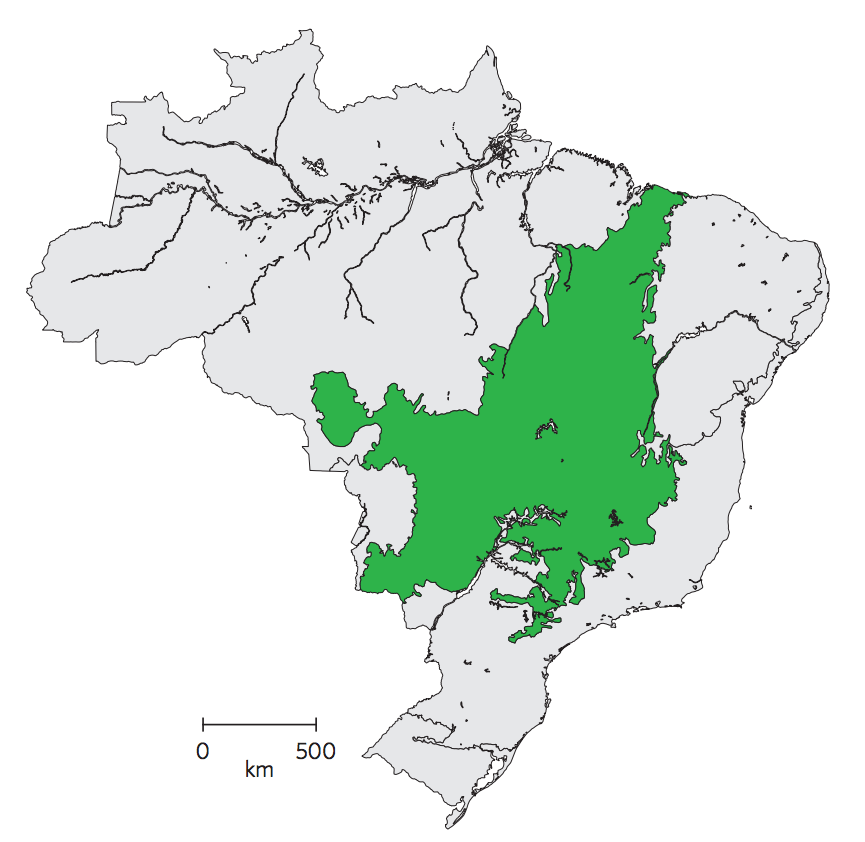
After peaking in 2005, deforestation rates have been on a downward trend in all Brazilian biomes [habitats], while beef production has simultaneously been increasing.If deforestation is no longer a factor, this leaves more scope for the beef industry to reduce its emissions, the researchers say, and these savings could be further propelled by increases in demand. Grass is greener with higher demand The study focuses on the Cerrado region that runs through the centre of Brazil (see map below). Around a third of Brazil’s beef is produced there.
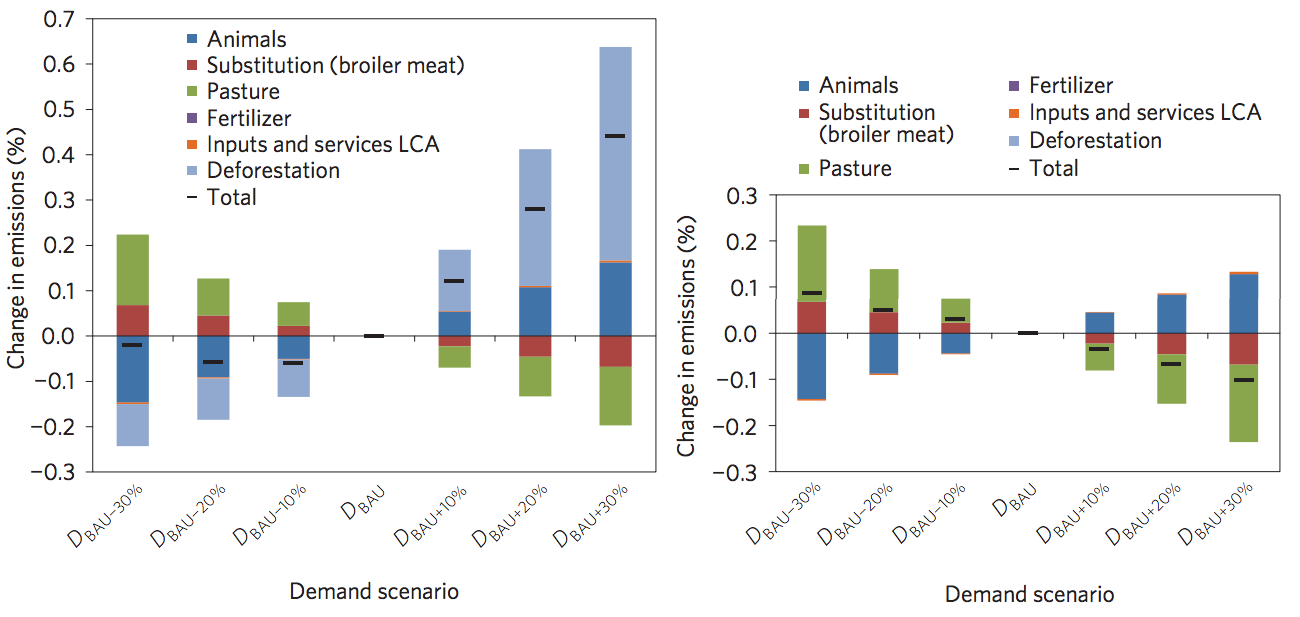
Lower demand and smaller herds require less grass production, reducing the incentive to maintain or increase productivity; pastures then degrade, losing organic matter and soil carbon stocks.The researchers tested this effect by simulating the impact on carbon emissions of a “business-as-usual” scenario of beef demand in 2030 and six scenarios of higher (+10%, +20% and +30%) and lower (-10%, -10% and -30%) than business-as-usual demand in 2030. You can see the results in the charts below, which show the difference in emissions between each scenario and business as usual. If forests are cleared to provide pasture (light blue bars), then overall emissions from higher beef demand are much larger than for business as usual and lower demand (left-hand chart). However, without deforestation, the improvements to pasture (green bars) would mean higher demand brings lower total emissions (right-hand chart). As the researchers explain:
Basically, if deforestation is held constant by effective policy, then any reduction in consumption or demand will likely lead to a reduced incentive to manage or improve carbon-rich grasslands. Emissions could actually go up as a result.
That is a tricky question, but a rough estimate is between 10-20% of Brazil’s total national annual emissions.As Brazil is the world’s twelfth largest emitter of CO2, that’s a sizeable chunk of emissions. The results of the study have already fed into Brazil’s intended nationally determined contribution (INDC), the researchers say. INDCs are the pledges that countries submit to the UN, setting out how far they intend to reduce their greenhouse gas emissions. Brazil’s INDC says it aims to restore an additional 15m hectares of degraded pasture by 2030, and enhance 5m hectares where land use is rotated between crops, livestock and forests – also by 2030. It’s worth noting that the new study’s findings are based on a couple of important assumptions, says Rob Bailey, research director at thinktank Chatham House. Bailey wasn’t involved in the study, but has co-authored recent studies at Chatham House on demand for meat and dairy products. The first assumption is that cattle ranchers will increase the productivity of their pasture when they can’t expand into forests, and the second is that the additional carbon storage by the grasses will be as significant as expected. That aside, the study shows how important the methods of meat production are, says Bailey:
Chopping down trees is bad. Restoring pasture and soil carbon is good. If you avoid the latter and do the former, your emissions intensity will improve and it’s plausible that in the right circumstances you can get more beef for fewer emissions, which is what the authors find in this example.But that doesn’t necessarily mean that we should be firing up our barbecues, Bailey adds:
From the point of view of reducing emissions, however, the best thing to do is to not chop down trees and restore degraded pasture, but have no cows on it at all.
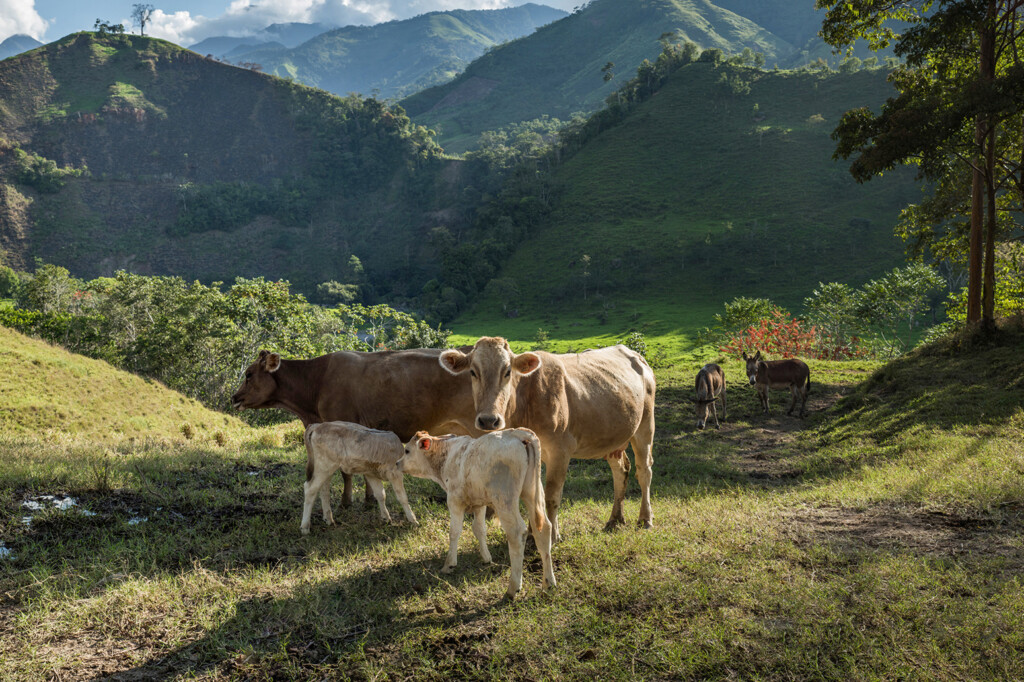
Main image: Cows in Pozuzo, city of the amazon rain forest. © Christian Vinces/Shutterstock.
Article information
de Oliveira Silva, R. et al. (2016) Increasing beef production could lower greenhouse gas emissions in Brazil if decoupled from deforestation, Nature Climate Change, doi:10.1038/nclimate2916.