



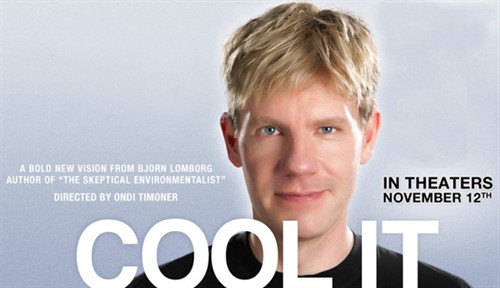
It was with a certain amount of trepidation that Carbon Brief set off to an evening with Bjorn Lomborg at LSE last night. Styling himself as the Skeptical Environmentalist, Lomborg has made a high-profile career as a plausible contrarian on climate science. The author of several best-selling books, he has garnered significant media coverage, been named one of the world’s 100 most influential people by Time magazine and recently produced a film “Cool It” aimed at challenging the received wisdom on how to tackle climate change.
So what did Lomborg have to say, and was it convincing? These days, Lomborg’s brand of climate scepticism involves agreeing that climate change is happening, is real and man-made, but arguing that human society will adapt, and that we shouldn’t bother cutting emissions, because it’s an expensive and inefficient way to make the world a better place.
In his own words, he aims to “remove the myths around climate change” and take a cool, rational look at the best solutions. He argues that we should “cool down” when it comes to climate change – that the consequences have been described in terms which are “vastly exaggerated and one-sided”. His central message is “panic is unlikely to be a good guide to making decisions”.
It’s an attractive argument, and Lomborg certainly comes across as credible and persuasive. He has a polished presentation and is highly articulate. He’s relaxed, funny, and charismatic.
The problems arise when we get to his presentation of the science. Lomborg explains away worries over temperatures rising, for example, largely by arguing that there will be fewer deaths from hot weather than cold weather. Irrespective of the documented errors in this argument, he doesn’t seem to grasp – or doesn’t want to – that there will be other impacts from rising temperatures.
The response of natural systems to climate change – droughts in the Amazon, acidification of the oceans, glacier melt, negative impacts on agriculture, or Arctic sea ice melt – are noticeably absent, glossed over by the slick powerpoint. He keeps stating that there isn’t enough time to get into the details – but the overall subtext is clear enough: ‘Don’t worry, don’t cut emissions, spend the money on something else, everything will be fine.’
Interestingly, Lomborg also doesn’t seem to be responding to criticism – last night’s treatment of sea level rise repeated an earlier error which scientists have already responded to – he takes into account only thermal expansion of the oceans in response to rising temperatures, and ignores the potential impacts of glacial ice melt.
This is typical of Lomborg’s work, where the uncertainties inherent in how the climate will change in the future are a notable absence. As his opponent in the debate, Dimitri Zenghelis put it, in Lomborg’s world “everything is known with definitive certainty” with the risks that climate change poses, and the uncertainty around them, breezily discounted.
Similarly, the work of scientists who work in the relevant areas – the ecologists, geochemists, marine biologists, paleoclimatologists, geologists and a host of other disciplines – are mysteriously absent. Anyone listening to Lomborg’s talk could be forgiven for thinking that the only person who’s on the record as thinking that climate change is a serious problem is Al Gore. The studies on which Lomborg choses to rest his case are remarkably selective – he has a particular fondness for quoting Roger Pielke Jr., and William Nordhaus.
All this should come as little surprise, given that in the past whole books have been written about Lomborg’s scientific errors, websites have been dedicated to the topic and scientists have collobarated to rebut his arguments.
Yet Lomborg’s star continues to rise – the room was packed, and this was the LSE. Perhaps this is because his argument – that we can keep pumping carbon dioxide into the atmosphere indefinitely, but adapt by painting the streets white, using more air conditioning, or pumping sulphur into the atmosphere – seems strangely attractive.
Pithily described by Zhengelis as “like mopping the floor whilst you leave the tap on” these ‘solutions’ require no cuts in emissions; no international agreement on carbon emissions; no shift to alternative energy sources. Packaged up with a bit of charisma and some floppy blond hair, it’s hardly surprising that they gain some traction.
Lomborg remains a cool operator, who will continue to ply his plausible trade with panache. We advise that anyone going to hear him speak listens with genuine scepticism, and takes his arguments with a pinch of salt.
Correction 22 February 2011: In the original version of this article we incorrectly stated that William Nordhaus is a member of the Breakthrough Institute.