
Analysis: The gender, nationality and institution of IPCC AR6 scientists
Nationality
The IPCC lists authors under its three working groups: Working Group I (WG1), “The Physical Science Basis”; Working Group II (WG2), “Impacts, Adaptation, and Vulnerability”; and Working Group III (WG3), “Mitigation of Climate Change”. Leading the pack with 74 authors across all three working groups is the US. Followed by the UK and Germany in joint second place with 45 authors each. Making up the rest of the Top 5 is Australia and China – both with 37. For South America, the country with the largest number of authors is Brazil with 21, followed by Argentina with 11 and Chile with eight. The highest placed African country is South Africa with 14 authors. It is followed by Morocco and Nigeria with seven, and Algeria, Senegal and Tanzania on six. Overall, the most-represented continent is Europe with 229 authors, with Asia in second with 173 and North America in third with 128. Africa, Oceania and South America follow with 82, 55 and 54 authors, respectively. Looking at the working groups individually, the US comes out with the most authors in all three, following by the UK and China for WG1, Australia and Germany for WG2, and Germany and Japan for WG3. The map below shows the number of authors per country and continent – the bigger the bubble, the more authors that country has. Toggle between working groups and all authors using the dropdown selector in the top left-hand corner. Data visualisation by Rosamund Pearce for Carbon Brief. According to the IPCC, 44% of AR6 authors are citizens of developing countries and countries with “economies in transition”. This compares with 37% for AR5. While, according to Climate Analytics, 7% and 4% of AR6 authors are from – or were nominated by – least developed countries and small island states, respectively. (Authors lists for AR5 are still available for WG1, WG2 and WG3.) On a per capita basis, small nations are – unsurprisingly – the most well-represented. Even with just one author each, the Cook Islands, Palau and Tonga come out on top. At the other end of the scale, Bangladesh, India and Turkey have the fewest authors relative to their population. Using the UN’s classification of “Annex I” and “Non-Annex I” countries, 58% of AR6 authors (420) are from the former and 42% (301) are from the latter. Agreed in 1992, Annex I countries are industrialised countries that agreed to binding targets to cut emissions under the Kyoto Protocol, while Non-Annex I countries are mainly developing nations that were not expected to make significant emissions cuts.Gender balance
The IPCC provides binary male/female data for all the AR6 authors. Across all 721 authors of AR6, 67% are male and 33% female. This compares with 79% vs. 21% for AR5. For the individual working groups, WG2 has the most even balance of gender for its authors (59% male vs. 41% female), followed by WG3 (69% vs. 31%) and then WG1 (73% vs. 27%). This gender balance is largely reflected across the different types of IPCC scientists – coordinating lead authors, lead authors and review editors. The most male-dominated group is the review editors for WG1, with 31 men (84%) to six women (16%). Twenty-six countries have only male authors represented in AR6, although 14 of these only have one author in total. The country with the most male-only authors is Cuba with six. In contrast, there are 10 countries with only female authors – however, all but the Dominican Republic have just the one author.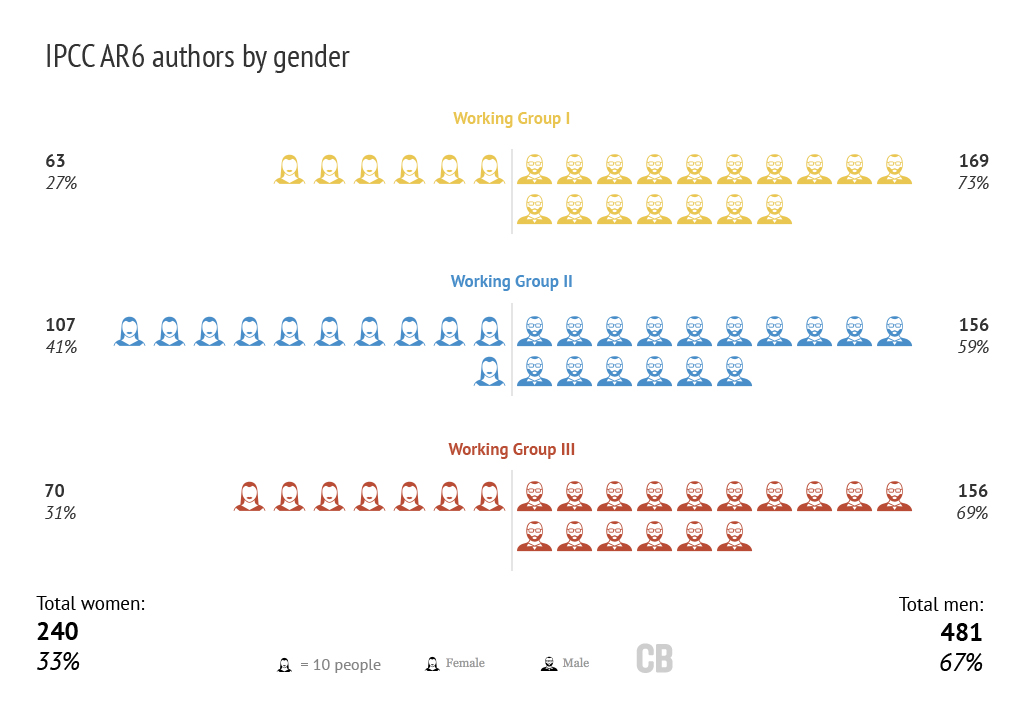
Institutions
It is worth remembering that authors are not paid for the time they commit to the IPCC, so contributors will also have a day job that pays their salary. Therefore, apart from a handful of independent or retired scientists, each AR6 author will be affiliated to at least one institution. The graphic below shows the organisations represented by at least four authors across all three working groups. Three organisations come out on top with nine authors each: the International Institute for Applied Systems Analysis (IIASA) in Vienna, the University of Tokyo and the National Center for Scientific Research (CNRS) in France. Then, there are two organisations with eight authors each: the National Oceanic and Atmospheric Administration (NOAA) in the US and the University of Cape Town in South Africa. The highest-placed UK institution is the University of Reading with seven authors. It sits alongside the Commonwealth Scientific and Industrial Research Organisation (CSIRO) in Australia and the Federal University of Rio de Janeiro in Brazil.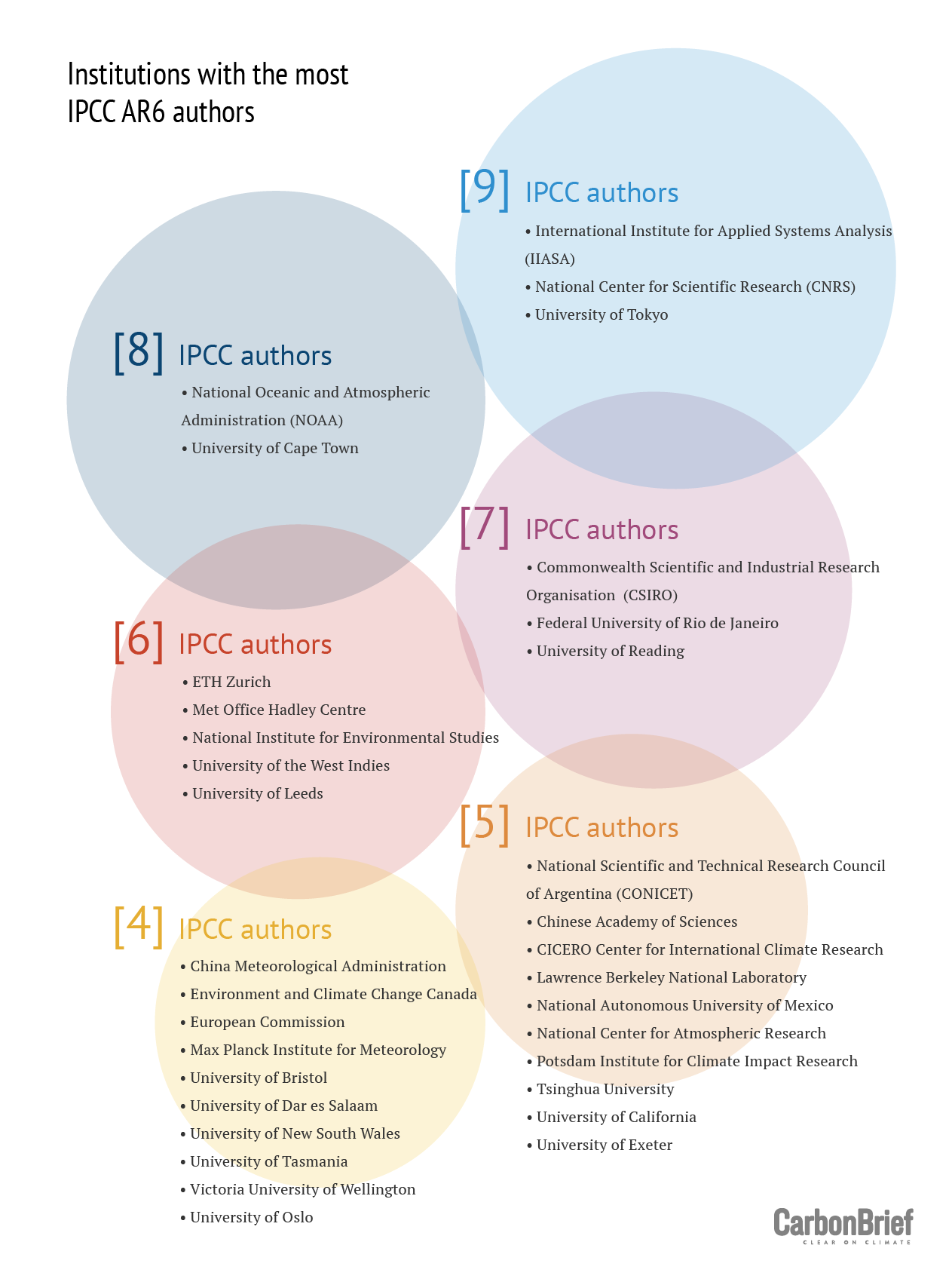
Article information
Update: This article was updated on 07/02/2019 to reinstate some weblinks that had broken when the IPCC launched their new website.