

DeBriefed 12 December: EU under ‘pressure’; ‘Unusual warmth’ explained; Rise of climate boardgames



Tom Pearson
12.12.25Tom Pearson
12.12.2025 | 12:39pmWelcome to Carbon Brief’s DeBriefed.
An essential guide to the week’s key developments relating to climate change.
This week
EU sets 2040 goal
CUT CRUNCHED: The EU agreed on a legally binding target to reduce greenhouse gas emissions by 90% from 1990 levels by 2040, reported the EU Observer. The publication said that this agreement is “weaker” than the European Commission’s original proposal as it allows for up to five percentage points of a country’s cuts to be achieved by the use of foreign carbon credits. Even in its weakened form, the goal is “more ambitious than most other major economies’ pledges”, according to Reuters.
PETROL CAR U-TURN: Commission president Ursula von der Leyen has agreed to “roll back an imminent ban on the sale of new internal combustion-engined cars and vans after late-night negotiations with the leader of the conservative European People’s Party,” reported Euractiv. Car makers will be able to continue selling models with internal combustion engines as long as they reduce emissions on average by 90% by 2035, down from a previously mandated 100% cut. Bloomberg reported that the EU is “weighing a five-year reprieve” to “allow an extension of the use of the combustion engine until 2040 in plug-in hybrids and electric vehicles that include a fuel-powered range extender”.
CORPORATE PRESSURE: Reuters reported that EU countries and the European parliament struck a deal to “cut corporate sustainability laws, after months of pressure from companies and governments”. It noted that the changes exempt businesses with fewer than 1,000 employees from reporting their environmental and social impact under the corporate sustainability reporting directive. The Guardian wrote that the commission is also considering a rollback of environment rules that could see datacentres, artificial intelligence (AI) gigafactories and affordable housing become exempt from mandatory environmental impact assessments.
Around the world
- EXXON BACKPEDALS: The Financial Times reported on ExxonMobil’s plans to “slash low-carbon spending by a third”, amounting to a reduction of $10bn over the next 5 years.
- VERY HOT: 2025 is “virtually certain” to be the second or third-hottest year on record, according to data from the EU’s Copernicus Climate Change Service, covered by the Guardian. It reported that global temperatures from January-November were, on average, 1.48C hotter than preindustrial levels.
- WEBSITE WIPE: Grist reported that the US Environmental Protection Agency has erased references to the human causes of climate change from its website, focusing instead on “natural processes”, such as variations in the Earth’s orbit. On BlueSky, Carbon Brief contributing editor Dr Zack Labe described the removal as “absolutely awful”.
- UN REPORT: The latest global environment outlook, a largest-of-its-kind UN environment report, “calls for a new approach to jointly tackle the most pressing environmental issues including climate change and biodiversity loss”, according to the Associated Press. However, report co-chair Sir Robert Watson told BBC News that a “small number of countries…hijacked the process”, diluting its potential impact.
$80bn
The amount that Chinese firms have committed to clean technology investments overseas in the past year, according to Reuters.
Latest climate research
- Increases in heavy rainfall and flooding driven by fossil-fuelled climate change worsened recent floods in Asia | World Weather Attribution
- Human-caused climate change played a “substantial role” in driving wildfires and subsequent smoke concentrations in the western US between 1992-2020 | Proceedings of the National Academy of Sciences
- Thousands of land vertebrate species over the coming decades will face extreme heat and “unsuitable habitats” throughout “most, or even all” of their current ranges | Global Change Biology
(For more, see Carbon Brief’s in-depth daily summaries of the top climate news stories on Monday, Tuesday, Wednesday, Thursday and Friday.)
Captured
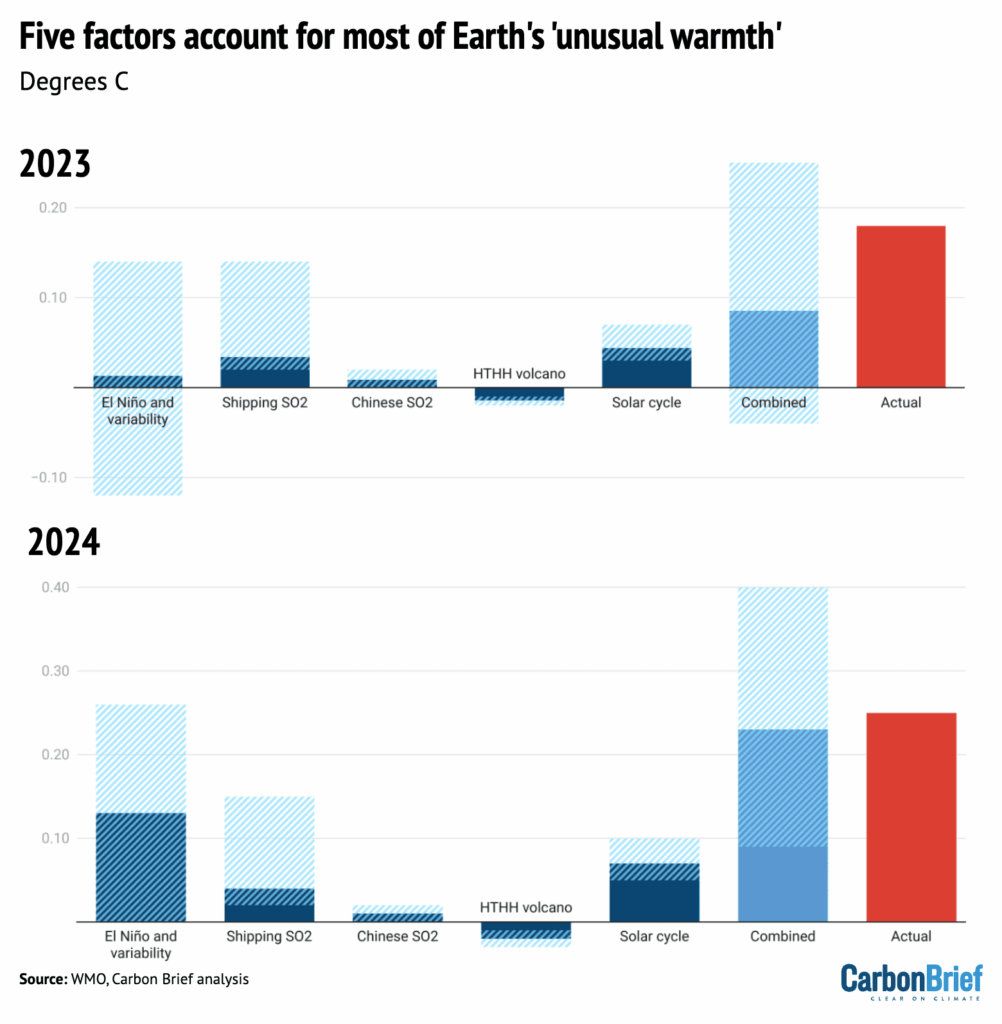
The years 2023 and 2024 were the warmest on record – and 2025 looks set to join them in the top three. The causes of this apparent acceleration in global warming have been subject to a lot of attention in both the media and the scientific community. The charts above, drawn from a new Carbon Brief analysis, show how the natural weather phenomenon El Niño, sulphur dioxide (SO2) emissions from shipping, Chinese SO2, an eruption from the Hunga Tonga-Hunga Ha’apai volcano and solar cycle changes account for most of the “unusual warmth” of recent years. Dark blue bars represent the contribution of individual factors and their uncertainties (hatched areas), the light blue bar shows the combined effects and combination of uncertainties and the red bar shows the actual warming, compared with expectations.
Spotlight
Climate change boardgames
This week, Carbon Brief reports on the rise of climate boardgames.
Boardgames have always made political arguments. Perhaps the most notorious example is the Landlord’s Game published by US game designer and writer Lizzie Magie in 1906, which was designed to persuade people of the need for a land tax.
This game was later “adapted” by US salesman Charles Darrow into the game Monopoly, which articulates a very different set of values.
In this century, game designers have turned to the challenge of climate change.
Best-selling boardgame franchise Catan has spawned a New Energies edition, where players may choose to “invest in clean energy resources or opt for cheaper fossil fuels, potentially causing disastrous effects for the island”.
But perhaps the most notable recent release is 2024’s Daybreak, which won the prestigious Kennerspiel des Jahre award (the boardgaming world’s equivalent of the Oscars).
Rolling the dice
Designed by gamemakers Matteo Menapace and Matt Leacock, Daybreak sees four players take on the role of global powers: China, the US, Europe and “the majority world”, each with their own strengths and weaknesses.
Through playing cards representing policy decisions and technologies, players attempt to reach “drawdown”, a state where they are collectively producing less CO2 than they are removing from the atmosphere.
“Games are good at modelling systems and the climate crisis is a systemic crisis,” Daybreak co-designer Menapace told Carbon Brief.
In his view, boardgames can be a powerful tool for getting people to think about climate change. He said:
“In a video game, the rules are often hidden or opaque and strictly enforced by the machine’s code. In contrast, a boardgame requires players to collectively learn, understand and constantly negotiate the rules. The players are the ‘game engine’. While videogames tend to operate on a subconscious level through immersion, boardgames maintain a conscious distance between players and the material objects they manipulate.
“Whereas videogames often involve atomised or heavily mediated social interactions, boardgames are inherently social experiences. This suggests that playing boardgames may be more conducive to the exploration of conscious, collective, systemic action in response to the climate crisis.”
Daybreak to Dawn
Menapace added that he is currently developing “Dawn”, a successor to Daybreak, building on lessons he learned from developing the first game, telling Carbon Brief:
“I want the next game to be more accessible, especially for schools. We learned that there’s a lot of interest in using Daybreak in an educational context, but it’s often difficult to bring it to a classroom because it takes quite some time to set up and to learn and to play.
“Something that can be set up quickly and that can be played in half the time, 30 to 45 minutes rather than an hour [to] an hour and a half, is what I’m currently aiming for.”
Dawn might also introduce a new twist that explores whether countries are truly willing to cooperate on solving climate change – and whether “rogue” actors are capable of derailing progress, he continued:
“Daybreak makes this big assumption that the world powers are cooperating, or at least they’re not competing, when it comes to climate action. [And] that there are no other forces that get in the way. So, with Dawn, I’m trying to explore that a bit more.
“Once the core game is working, I’d like to build on top of that some tensions, maybe not perfect cooperation, [with] some rogue players.”
Watch, read, listen
WELL WATCHERS: Mother Jones reported on TikTok creators helping to hold oil companies to account for cleaning up abandoned oil wells in Texas.
RUNNING SHORT: Wired chronicled the failure of carbon removal startup Running Tide, which was backed by Microsoft and other tech giants.
PARIS IS 10: To mark the 10th anniversary of the Paris Agreement, climate scientist Prof Piers Forster explained in Climate Home News “why it worked” and “what it needs to do to survive”.
Coming up
- 15-19 December: American Geophysical Union (AGU) annual meeting, New Orleans
- 15-19 December: 70th Meeting of the Global Environment Facility (Gef) Council, online
- 16 December: International Energy Agency: Future of electricity in the Middle East and North Africa webinar, online
Pick of the jobs
- Natural Resources Wales, senior strategic environmental policy specialist | Salary: Unknown. Location: Wales (hybrid)
- The Nature Conservancy, director of conservation – Mata Atlântica | Salary: Unknown. Location: São Paulo, Belo Horizonte, Rio de Janeiro and nearby cities, Brazil
- Barcelona Supercomputing Centre, postdoctoral researcher – downscaling for climate services | Salary: Unknown. Location: Barcelona, Spain
DeBriefed is edited by Daisy Dunne. Please send any tips or feedback to [email protected].
This is an online version of Carbon Brief’s weekly DeBriefed email newsletter. Subscribe for free here.