

Explainer: Why ‘differentiation’ is key to unlocking Paris climate deal


Multiple Authors
12.07.15Multiple Authors
07.12.2015 | 1:40pmThose wondering why a UN climate deal has been so slow to emerge might look towards the issue of differentiation.
Differentiation is UN jargon for the thorny issue of how to recognise the differences between developed and developing countries in the new UN agreement that nations hope to sign by the end of this week in Paris.
The topic is controversial because it affects the level of responsibility that rich and poor nations will have to take on in the global fight against climate change.
It means developing countries could have to take on additional actions, including contributing climate finance, as well as taking on more stringent requirements when it comes to reporting on their progress.
The issue filters through every element of the text and has been responsible for stirring up heated words and distrust in the negotiations for years. A compromise will be crucial for sealing the deal, but so far countries have been unable to shrug off their entrenched positions on the issue.
Background
Back in 1992, the issue was far more simple.
The original UN climate treaty (the United Nations Framework Convention on Climate Change) divided countries into two groups, according to their level of development, set out in its annexes.
Until recently, only the developed nations were obliged to take on new commitments under the UN to tackle their emissions. The Kyoto Protocol, the only climate change agreement with legally binding targets to date, adopted this approach, with rich countries alone forced to reduce their emissions.
The Convention also says that countries should act “in accordance with their common but differentiated responsibilities and respective capabilities”, and recognises that, historically, developed countries have emitted more carbon dioxide than developing countries.
All change in Durban
Still reeling from a failed attempt to sign a new deal at Copenhagen in 2009, countries agreed at the Durban COP in 2011 to launch a new process which would lead to nations signing a legally binding deal in Paris in 2015.
This deal was to be different to the Kyoto Protocol. While it was still to be “under the Convention” — including its annexes and notions of differentiated responsibilities and capabilities — it was also to be “applicable to all”.
This has led to a tension in the four-year process. One week before the deal is due to be signed, countries are still far from a solution.
The problem seems almost intractable: how to write a deal that includes obligations for all parties, without erasing the responsibility on developed nations to take on the largest burden?
“Outdated”
Developed countries have emphasised that the binary split between developed and developing countries is no longer a credible way to organise a climate treaty, as far as they are concerned.
The EU’s lead negotiator, Elina Bardram, neatly summed up why many countries are now rejecting the strict division between developed and developing nations at a recent round of negotiations in Bonn. She said:
We consider it somewhat unfortunate to see that some countries are reverting to rigid and somewhat outdated rhetoric that divides the world into developed and developing countries according to income levels as they were in the 1990s. And this is at the same time as we know that all parties, and indeed the world outside of the negotiations, are well and fully aware that to be effective the new agreement must reflect today’s reality and evolve as the world does.
But this does not mean that the EU is somehow attempting to “rewrite the Convention”, she explained — a common accusation from some developed nations. She added:
We have together decided to negotiate an agreement that will be ‘applicable to all’. That was done in Durban. What I just said does not mean that the EU wouldn’t respect or adhere to the principles of the Convention. We will and we do. But we do insist that the application of the differentiation principle becomes more nuanced.
Developing nations have found this argument hard to accept. In a press briefing in Paris, Gurdial Singh Nijar, head of the Malaysian delegation and representing a negotiating alliance called the Like-Minded Developing Countries, said:
The Convention has very clearly set out the principles and we work within the Convention. You cannot use extraneous factors to change what has already been agreed and which is binding — that is very important… There are processes for amending the Convention. Follow the amendment process if you want to do that.
Wealth and emissions
In the UN climate regime, countries are divided according to a mixture of wealth, per-capita emissions and cumulative contributions to greenhouse gas levels in the atmosphere.
In income terms, countries currently expected to provide climate finance make up 15 of the 25 richest per capita. The split was the same in 1992 when the Convention was agreed.
On average, donor nations remain more than five times richer than recipients, despite outliers such as Greece or Portugal being much poorer than “developing” Qatar or Saudi Arabia.
In terms of emissions, however, the picture has shifted significantly. The chart below shows how cumulative CO2 emissions from China, the US, EU and India have evolved since 1850, and how they will continue to change if countries follow their climate pledges.

Millions of tonnes of cumulative CO2 emissions from the US, EU, China and India between 1850 and 2030. Sources: Carbon Brief analysis of countries’ climate pledges (see methodology below) and figures from the World Resources Institute CAIT climate data explorer and the BP Statistical Review of World Energy 2015. Chart by Carbon Brief.
While the US and EU have historically contributed far more to the climate problem, China is catching up. China’s emissions, already on par with the EU’s per capita, continue to grow. India’s contribution is also rising, yet it will remain a comparably small contributor — particularly on a per-capita basis.
“Countries in a position to do so”
In Paris this week, the debate around differentiation has centered upon a seven-word phrase: “countries in a position to do so”.
In the text that will be negotiated by ministers throughout the course of the week, the phrase appears in various contexts.
In the section on mitigation — how countries should tackle their emissions — it differentiates parties by suggesting that developed countries and “those in a position to do so” should be obliged to submit economy-wide targets.

Source: UNFCCC draft negotiating text of 5 December
In the section on finance, it says that developed countries and “those in a position to do so” should provide money to help poor nations deal with climate change.

Source: UNFCCC draft negotiating text of 5 December.
The latter application, on finance, has been the most controversial. On the face of it, it can be difficult to understand why this has caused such an uproar from developing countries.
While the majority of climate finance so far has been provided by developed countries, some poorer nations have already stepped forward to provide climate finance.
Mexico, Mongolia and South Korea are among the developing nations to have voluntarily put money into the Green Climate Fund, the UN-backed bank designed to help poor countries tackle climate change. In September, China announced it would provide $2bn to other countries in the global south to help them to tackle climate change.
Lead US negotiator Todd Stern stressed in a press conference in Paris that allowing countries “in a position to do so” to contribute to the pot of climate finance merely recognised shifts that were already taking place, and that their contributions would continue to be on an entirely voluntary basis.
But responding to a press conference question from Carbon Brief, UNFCCC executive secretary Christiana Figueres said:
China has been pellucidly clear about the fact that this is not meant to substitute the obligations, certainly the financial obligations of the developed countries, but rather to be much more considered a supplementary measure of some countries that can do that.
Anger
So why are developing countries upset?
While Stern may have said that contributions from developing countries would remain voluntary, the phrase “countries in a position to do so” is vague — and many see that as a sign of danger in a process where trust is notoriously fragile.
In 2009, rich nations promised to provide $100bn a year by 2020 in climate finance to poor countries. Allowing vague phrasing regarding this into the new agreement could raise doubts about whether the obligation to provide this would still rest wholly on developed countries’ shoulders — or whether an unspecified amount would now have to be provided by unspecified countries.
There is also concern over who gets to decide which countries would be considered “in a position to do so”. Would countries decide this themselves, or would there be a set of metrics to determine it? A negotiator from the small islands negotiating alliance (AOSIS) suggested that countries would be left to decide themselves, but that it would open up the possibility of countries with no legal obligation being “nudged” to provide cash.
US negotiator Todd Stern has stressed that any additional financial contributions from developing countries would be “voluntary”, but EU climate commissioner Miguel Arias Cañete told Carbon Brief that he envisaged a compulsory requirement on countries in “a position to do so”. He said:
We would like it to be compulsory. It is our position. Probably we will have to negotiate…The world has changed, so countries who are in a position to do so should also come along and support other people… ‘In a position to do so’, it means they are at the same level of economic development as the other countries who are called developed.
Nozipho Mxakato-Diseko, chair of the G77+China negotiating group, responding to a question from Carbon Brief, summarised some of the issues with an allegory to life in her South African home:
How do you put in a legally binding instrument ‘countries in a position to do so’? In my family, with the children, I tell them you will clean, so-and-so, you will clean the room. I do not say that someone will clean the room. I say you, John, will clean the room. You, Grace, will do the dishes. There is no ‘someone in a position to do so’ will wipe the floor. I need accountability, I really do need accountability. And I need to know, above all, that the floor has been cleaned.
More problems
But the problem does not end with the lack of accountability.
There is also the concern that placing extra burdens on developing nations now would mean rich countries would be allowed to evade their historical responsibility for causing climate change.
There is a sense among developing countries that the rich nations must take on more burdens today to make up for the decades they spent developing on the back on polluting energy.
Su Wei, China’s lead negotiator, told journalists in Paris:
I think it’s not the matter whether parties would have the capacity or are ‘in a position to do so’. Rather, what matters in these negotiations on the financial issues is the historical responsibility for causing climate change problem. It is very clear in the provisions of the Convention that developed country parties committed to provide financial technology and capacity to poor developing countries.
This is further aggravated by a general lack of trust between developed and developing countries. The $100bn a year promised by developed countries has been slow to arrive and there is still no clear plan on how to scale money up to this level by 2020.
A recent report by the OECD, suggesting cash flows were now at around $60bn a year, vexed developing countries even further, with a contentious definition on the meaning of “climate finance”, on which they had not been consulted.
Conclusion
Differentiation is difficult. Since 1992, many of the world’s poorest economies have grown significantly, both in terms of wealth and emissions. China, South Korea and Singapore, all developing nations as far as the UNFCCC is concerned, are considered by the IMF as advanced economies.
As one German negotiator said in November, “If we keep up the separation of the 1992 convention, this would mean that Greece has to support Qatar.”
Meanwhile, developed countries have sworn that they are serious about their commitments. In a press conference in Paris, EU climate commissioner Miguel Arias Cañete told journalists:
The developed countries, we are committed to our commitments, so we will fulfil the $100bn commitment fully by 2020, and, post-2020, developed countries will assume their responsibilities. We are not hiding anywhere.
But for every China, Singapore and South Korea, there is also a Gambia, Bhutan or Nauru — small developing countries that still have low emissions and low capacity. While the new deal must be “applicable to all”, it is clear that some economies are still on the lower rungs of development, and the new deal must take account of this.
Meanwhile, others will continue to get richer and grow their emissions. The deal that countries sign in Paris is not just for today, but for the decades ahead.
Negotiators effectively now have a week to sign a binding treaty that accounts for both the history and future of human development.
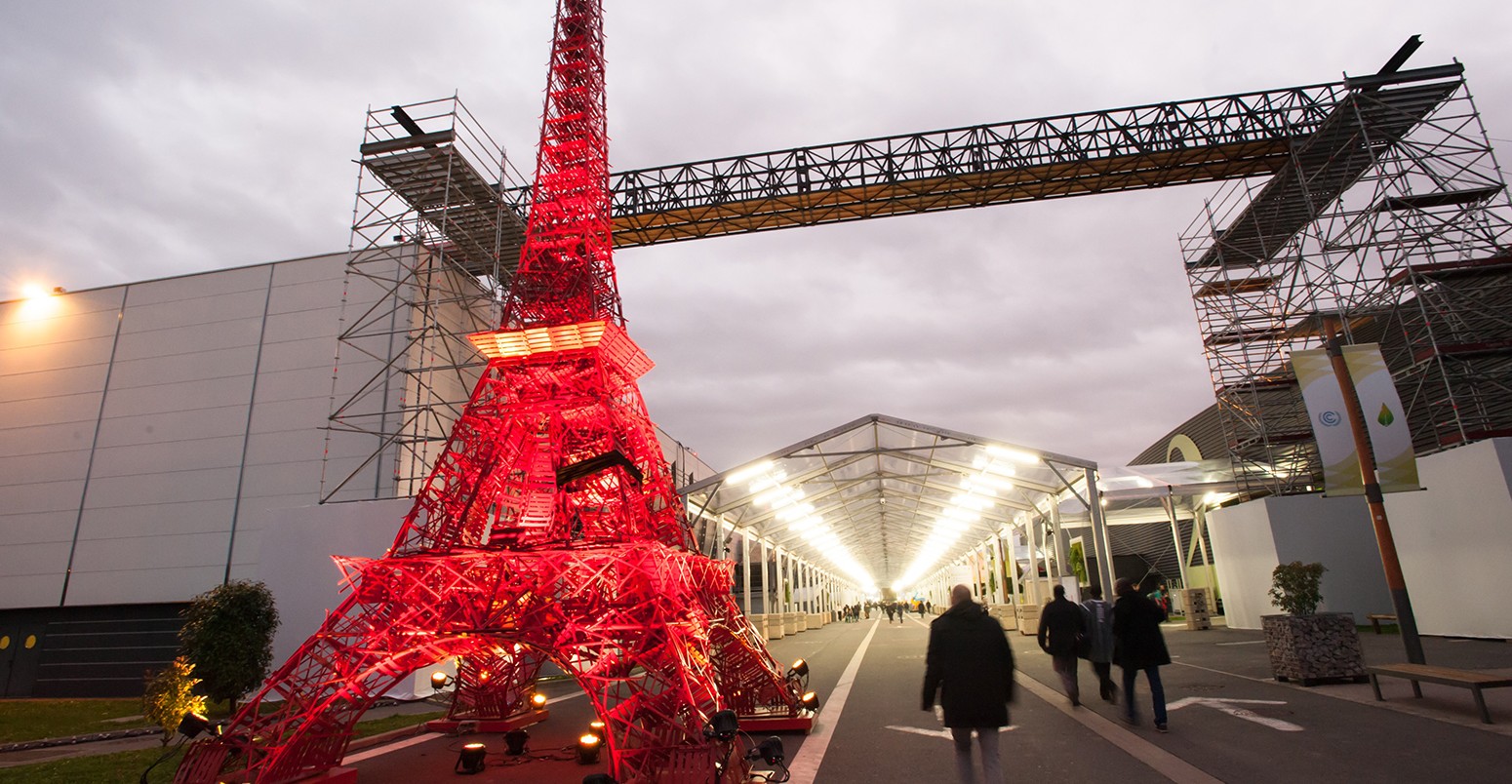
Main image: A model of the Eiffel Tower made from recycled folding chairs stands at an entrance to the COP21 United Nations climate summit in Le Bourget near Paris, France. Credit: © Ryan Rodrick Beiler/Demotix/Corbis.
9/12 – we “CO2 levels in the atmosphere” to “greenhouse gas levels”.
Note on the chart: Carbon Brief plotted cumulative historical CO2 emissions data from the World Resources Institute's CAIT database, spanning 1850 to 2012. Figures for 2013 and 2014 are from the BP Statistical Review of World Energy 2015; this covers only energy-related emissions. Future cumulative emissions are Carbon Brief estimates based on countries' climate pledges. For China and India, figures are based on previous Carbon Brief analysis that used GDP growth estimates to convert carbon intensity pledges into emissions projections. For the EU, the chart assumes linear progress towards the 2030 target. For the US, linear progress to the 2025 target is assumed to be followed by a continued, linear trend. For all countries, the chart assumes CO2's share of total greenhouse gas emissions remains constant.
-
Explainer: Why 'differentiation' is key to unlocking Paris climate deal #COP21
-
What is 'differentiation'? And why is it a thorny issue at the Paris Climate Conference? #COP21