
Media reaction: How climate change intensified Europe’s record-breaking June heat

For the second time in two months, western and central Europe has been hit by a record-breaking heatwave.
Temperature records have toppled in multiple countries, with France seeing its “hottest day ever” for two days running and the UK, Spain and Switzerland breaking records for June.
A rapid-response attribution study has concluded that “climate change is unequivocally to blame”, noting that the scorching temperatures would have been “virtually impossible” 50 years ago.
The research also found that the sweltering overnight temperatures seen this week are “100 times” more likely today than they were in 2003 when Europe was hit by a deadly summer heatwave.
The extreme conditions come on the 50th anniversary of a historic 1976 heatwave in the UK, prompting many comparisons of the two events from scientists and the media.
In this article, Carbon Brief looks at how the heatwave developed and the role climate change played.
- How did the heatwave develop?
- What have the impacts been so far?
- What role has climate change played?
- How does the UK heatwave compare to 1976?
- How has the media responded?
- Why has media coverage been criticised?
How did the heatwave develop?
The “very intense and widespread” heat began to develop in the south of France as early as 13 June, reported Le Monde, before it began to “intensify and move northward” in the following days.
The heatwave was caused by a phenomenon known as an “omega block”, which is a “rare weather pattern” that can trap intense heat over a particular area “for extended periods”, said the Independent.
The Daily Telegraph explained the pattern’s development as a four-step process.
First, it said, the jet stream moves across the Atlantic Ocean, creating a high pressure ridge to the south. The “omega” shape is created by low pressure systems on either side of the meander. This “stalls” the normal flow of weather systems from west to east and “pulls hot air from Africa northward over Europe”, creating a “lid” that traps the heat. This leads to the development of a heat dome, “driving temperatures higher”, it added.
This heat dome “originated in the hot and humid sub-tropics” and has been “centred” over France, said BBC News.
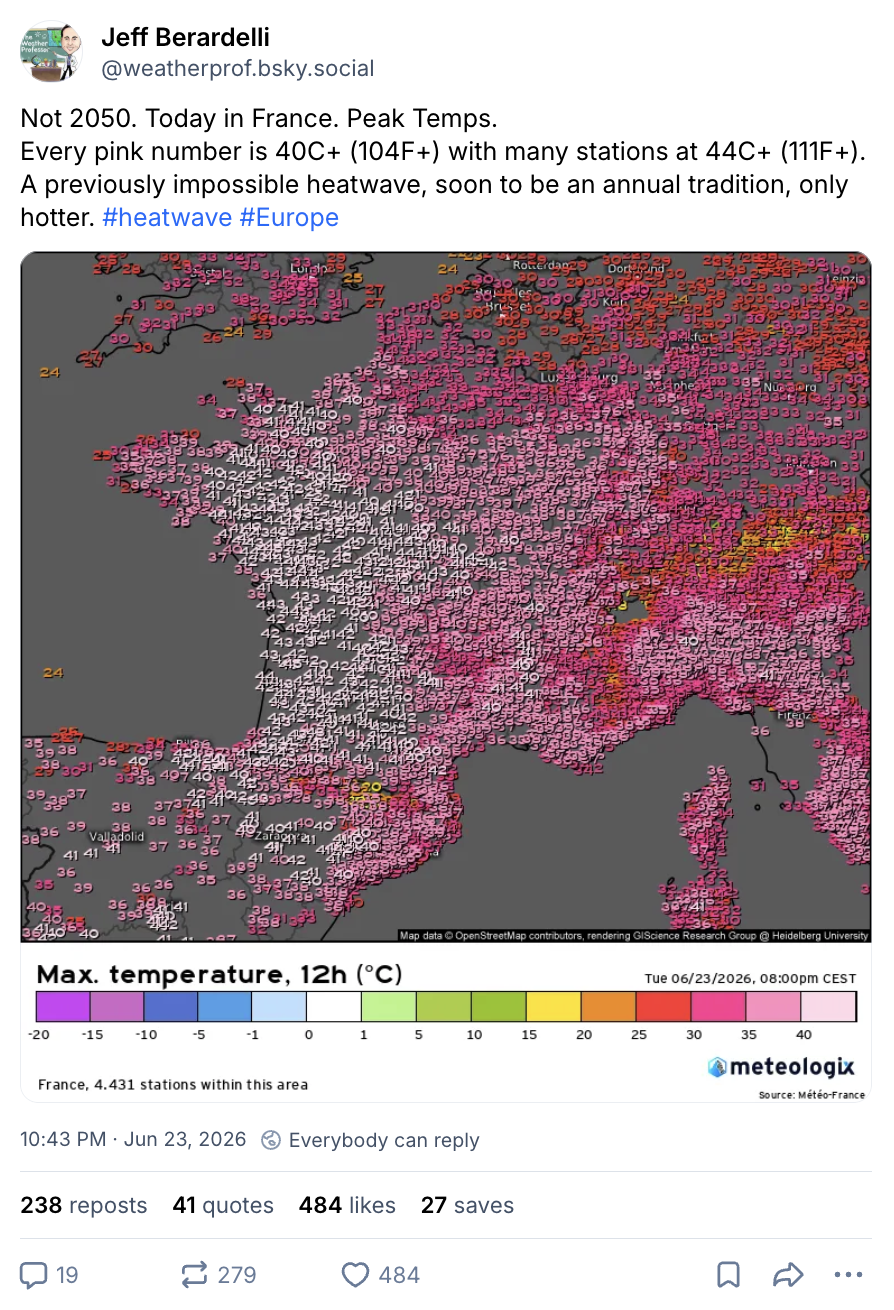
France experienced its “hottest day ever” on two consecutive days, with its “national heat index” – an average of day- and night-time high temperatures from 30 weather stations across the country – reaching 30C on 24 June, according to Le Monde.
On 25 June, Méteo-France announced that 72 of France’s 96 mainland administrative districts had been placed under a red heatwave alert.
The heatwave “spread to other parts of western Europe” as the week progressed, said BBC News.
Spain recorded a daily average of 28.2C on 23 June – a record temperature for that month, the outlet reported.
The UK surpassed its long-standing temperature record for June of 35.6C multiple times on 24, 25 and 26 June, with a new record set on 24 June at 36.1C in Gosport, Hampshire, which was subsequently exceeded on 25 June with 36.7C at Merryfield, Somerset and on 26 June with 37.3C at Santon Downham in Suffolk.
On Monday 29 June, the Met Office said an “update received over the weekend” showed that temperatures in Lingwood, Norfolk had, in fact, reached 37.7C on 26 June. On social media, it confirmed that this was the “provisional record” for the UK’s hottest June day.
A few days later, the Met Office confirmed that June had been the warmest on record in England and the second warmest in the UK, reported BBC News.
[Update: On 29 July, the Met Office said it had verified a new UK and England daily temperature record for June of 38C after a “rigorous validation process”. The temperature record, set on 26 June, was reported from the same station – Lingwood, Norfolk –- as the previously announced provisional record, it said. It also confirmed a string of new “verified” daily temperature records for June across the UK.]
Meanwhile, Switzerland’s national weather agency declared on 25 June that temperatures had exceeded 38C for the first time in June, breaking a record set in 1947, according to RTS.
On 28 June, the Guardian documented a string of records broken in central Europe as the heatwave moved eastward. Czechia saw an “all-time high” of 41.9C, Germany an “all-time” record of 41.7C and Poland a new “all-time heat record” of 40.5C, it said.
The heatwave is the “longest-ever recorded” in Germany in June, said Deutsche Welle.
Dauphiné Libéré rounded up the various records broken across France, noting that night-time, monthly and all-time records had tumbled across the country.
It said that, with the exception of some areas in France’s south-east, every administrative “department” had set new records, with “more than a thousand” local records broken. The highest temperature recorded was 44.7C in Herbiers, Vendeé in western France, it said.
On 29 June, Italy’s Corriere della Sella noted that 22 cities in the country had been placed under “red alert”, with the figure set to rise to 25 on 30 June. Temperatures in the northern city of Milan hit a new record of 40C, it said.
[For more on temperature records across Europe, see Carbon Brief’s Daily Briefing newsletters on 26 June and 29 June.]
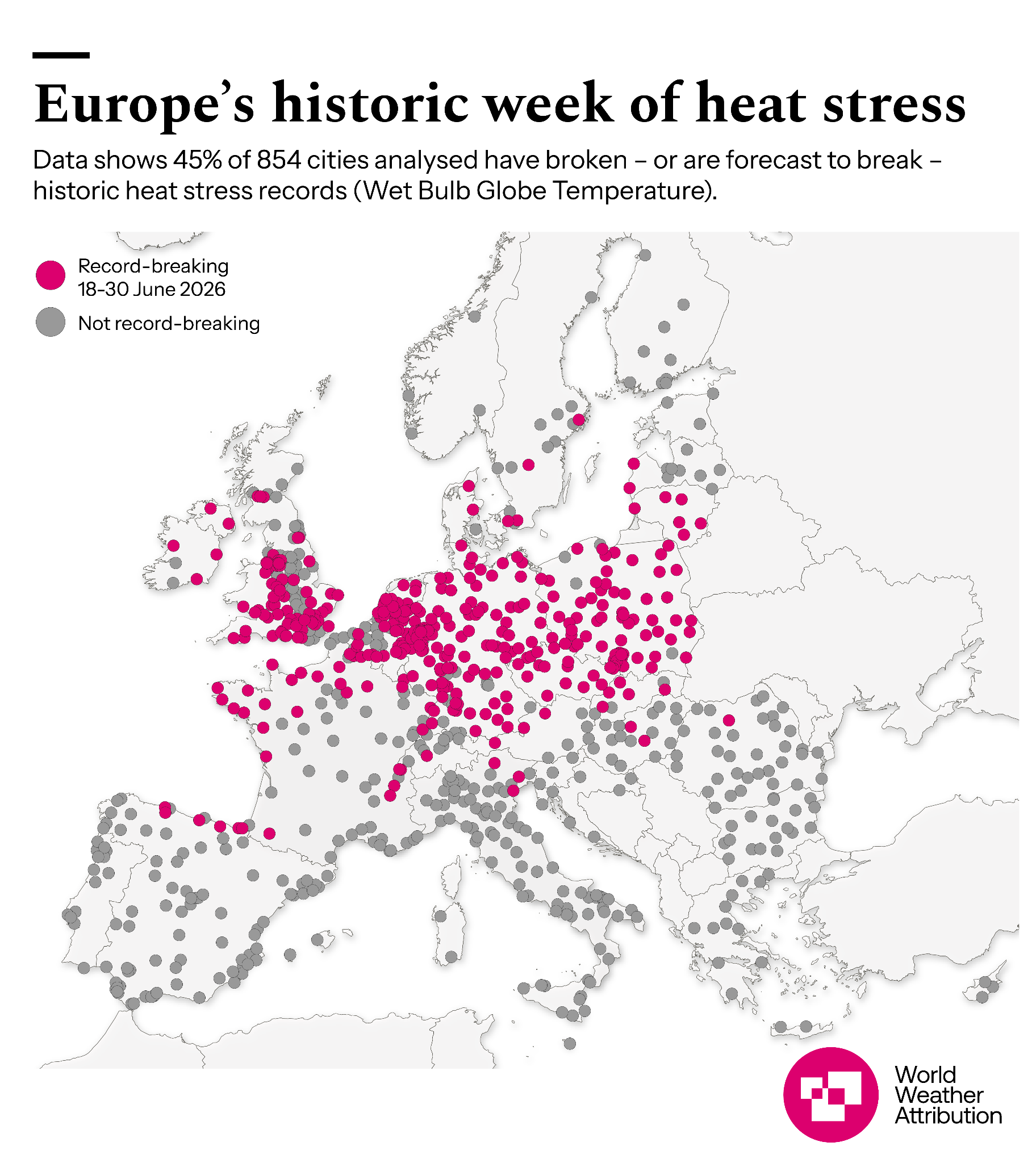
Scientists from the World Weather Attribution service analysed the wet-bulb globe temperature in 854 cities across 30 European countries and found that 45% have broken, or are expected to break, their June heat-stress record since 18 June.
(Wet-bulb globe temperature is a heat-stress index that combines temperature, humidity, wind speed and direct sunlight.)
These record-breaking cities are shown in pink on the map below.
While temperatures are expected to “gradually decline” across western Europe from 26 June onwards, “countries in eastern Europe were bracing for a scorching weekend”, according to the New York Times.
A separate New York Times article noted that “local factors” – such as melting sea ice, lower air pollution and less snow cover – mean that “for the past three decades, Europe has been warming faster than any other continent”.
The outlet added that these factors can also impact atmospheric conditions “in ways that could be making searing heatwaves like the one this week more frequent”.
What have the impacts been so far?
France
As temperatures climbed on Sunday 21 June, several cities and towns – including Paris – introduced restrictions for the nationwide “fête de la musique” celebration, reported the Guardian. This included bans on performances before 7pm and outdoor drinking, it said.
Le Parisien reported that the government announced that more than 845 schools would not open on Monday 22 June, while another 1,800 were rescheduling classes.
On 23 June, as average temperatures in France reached an all-time high, prime minister Sébastien Lecornu announced that more than 40 people had drowned as they sought relief from the heat, reported Libération.
Analysis from Agence France-Presse covered by the Guardian on 24 June showed that 54 of France’s administrative departments had recorded temperatures of 40C and higher since the heatwave began.
France24 reported that a power cut caused by the heat had left 68,000 households in Brittany, north-west France, without electricity. Meanwhile, Le Monde reported a jump of 15-20% in calls to the French emergency health services.
On 25 June, Ouest-France reported that 25 cardiac arrests had been reported over a 24-hour period in Paris – a significant increase on the typical number of “around 10”.
The Financial Times said temperatures reached 41C in Paris on 25 June, noting that “heat-absorbing zinc rooftops” had caused temperatures in apartment buildings to “soar”.
It added that nighttime temperatures had been most extreme in France, with some areas enduring 30C heat.
UK
The UK Met Office issued a “red warning” for extreme heat on 24 June, 25 June and 26 June – noting that this was the “first time in the history of the current weather warnings system” that it had issued red heat warnings on three consecutive days.
The UK Health Security Agency also issued red alerts – indicating that “severe impacts are expected across health and social care services due to the high temperatures” – for much of the country.
Schools, hospitals, transport networks and water companies were all left “struggling to cope” with the high temperatures, wrote the Guardian. Schools across southern England and Wales closed, while rail services were cut and speeds lowered, it said.
Temperatures on the London Underground’s Central line reached nearly 40C, according to the Independent, which took readings on several lines. It noted that “only around 40%” of the network’s trains are air-conditioned.
Several events at London Climate Action Week were cancelled or moved online, giving a “textbook example of how the world is being forced to adapt to increasingly extreme heat”, wrote Wired.
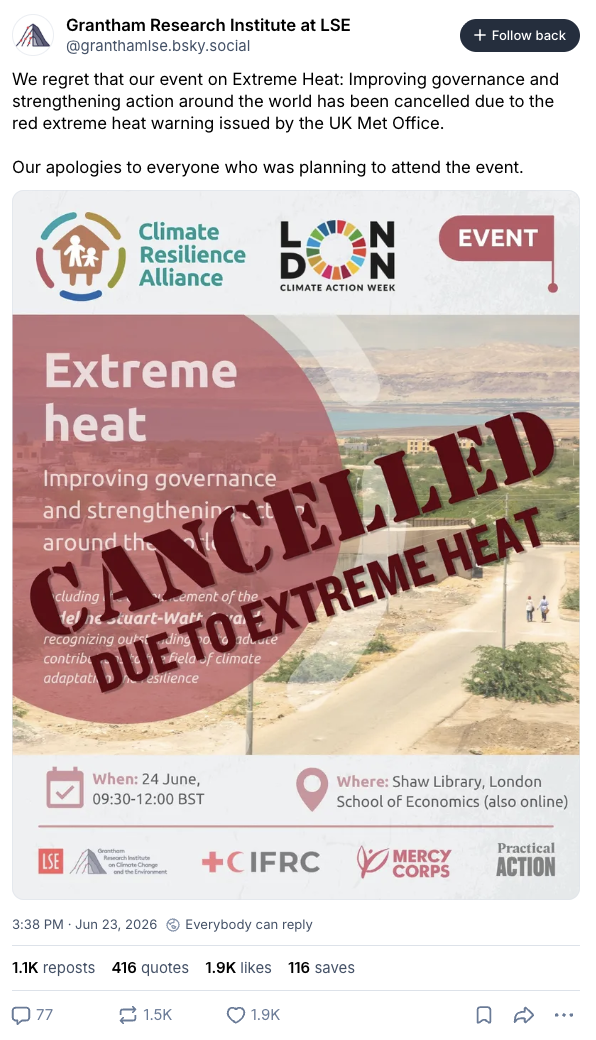
On 26 June, the i newspaper reported that 1,200 schools in the UK had been closed and six hospitals had declared “critical incidents”.
BBC News said that the London Ambulance Service had responded to a record number of call outs for life-threatening emergencies”, while the Guardian detailed reports from doctors of “radiotherapy machines and MRI scanners failing, critical IT systems stalling and cooling units that serve entire hospitals breaking down”.
Rest of Europe
The extreme heat has also swept through other European countries.
Euronews reported that 22 and 23 June were the hottest June days on record in mainland Spain since at least 1950. It added that “the current heatwave is bringing temperatures to between 5-10C above normal across much of the country”.
Separately, Euronews reported that across Spain, many municipalities had called off their San Juan celebrations, which usually involve lighting bonfires.
France24 reported that extreme heat between 21 and 24 June had been linked to an estimated 212 excess deaths across Spain, according to the country’s “mortalidad y modelos” monitoring system.
Reuters reported that “an extreme heat warning was in place across the Netherlands, where outdoor sports were cancelled, public transport was scaled down and schools shortened classes or closed as temperatures were expected to soar to 36C”.
It added that, in Switzerland, local authorities opened air-conditioned theatres for free daytime cinema screenings.
Meanwhile, Agence France-Presse reported that Belgium’s national train operator had removed “some” non-air-conditioned trains from service, while France’s SNCF had cancelled 10% of trains in the Paris region to avoid overheating the tracks.
On 28 June, BBC News reported that the head of the World Health Organization said on social media that more than 1,300 excess deaths linked to the high temperatures had been recorded since 21 June.
France’s national health ministry said there had been around “1,000 more deaths than expected in the country” since 24 June, the outlet added.
[For more on impacts felt across Europe, see Carbon Brief’s Daily Briefing newsletters on 26 June and 29 June.]
What role has climate change played?
The record-breaking temperatures recorded over Europe this week would have been “virtually impossible” 50 years ago, according to a rapid analysis from the World Weather Attribution service.
The study, published on 26 June, found that “climate change is unequivocally to blame”.
To identify the fingerprint of human-caused climate change on the extreme heat, the study authors used climate models to compare the world as it is today to a cooler “counterfactual” world. This is called an attribution study.
The analysis focuses on a large area of Europe encompassing Belgium, Denmark, France, Luxembourg, the Netherlands and the UK, as well as parts of Italy, Norway, Spain and Sweden.
The authors simulated the three-day maximum June daytime temperatures and three-day minimum June night-time temperatures over the study area in today’s climate, which has already warmed by 1.4C due to human-caused climate change.
They then simulated the same June heatwave in a climate 1.1C and 0.6C cooler than today. These global warming levels approximate the average global temperatures in 1976 and 2003, respectively.
The study authors said they chose these two years because both saw record-breaking summer heatwaves hit Europe which were linked to devastating impacts including thousands of deaths.
If the atmospheric conditions that drove this week’s heatwave had hit Europe in 1976 and 2003, the resulting heatwaves would have been 3.5C and 2C cooler, respectively, the researchers found. Meanwhile, night-time temperatures would have been 2.4C and 1.3C cooler in June 1976 and 2003, respectively.
The study added:
“The sweltering overnight temperatures keeping many people awake this week are about 100 times more likely today than they were just 23 years ago during the infamous 2003 European heatwave. The daytime peaks are about 10 times more likely.”
Study author Prof Fredi Otto, WWA co-founder and professor in climate science at Imperial College London, told a press briefing:
“It is in our hands…If we transition away rapidly from fossil fuels, this [heatwave] could still be an average summer and not a cool summer.”
Other experts have linked the intense heat to human-caused climate change.
For example, Dr Akshay Deoras, a senior research scientist at the University of Reading, told the Science Media Centre:
“Human-driven climate change has provided the springboard for this event, loading the atmosphere with extra heat and making extreme temperatures far more intense than they would have been in the past”.
How does the UK heatwave compare to 1976?
This year’s June heatwave has fallen on the 50th anniversary of the UK’s summer of 1976, a historic heat and drought event that saw water restrictions, crop failures and thousands of deaths.
With an average temperature of 15.7C, the summer of 1976 was the hottest on record at the time. That record stood for more than 25 years, before being surpassed by the summer of 2003 and then also 2006, 2018, 2022 and 2025.
The duration of the 1976 heatwave made the event extraordinary, including 15 consecutive days where temperatures of at least 32.2C were recorded somewhere in the country.
The heatwave arrived towards the end of a record-breaking drought that started the year before. The period from May 1975 to August 1976 holds the record for the lowest 16-month total rainfall in England and Wales.
This period also saw the lowest flows on record for the majority of UK rivers.
At the time, the 1976 heatwave tied the record – with 1957 – for the maximum June temperature in the UK. A temperature of 35.6C was recorded at Mayflower Park in Southampton on 28 June.
That record remained until it was beaten on three consecutive days this year, with 36.1C recorded in Gosport, Hampshire on 24 June, then 36.7C at Merryfield, Somerset on 25 June and 37.3C at Santon Downham, Suffolk on 26 June.
June 1976 also held the record for the UK’s highest minimum temperature – that is, how warm conditions remain overnight – of 22.7C in Ventnor Park on the Isle of Wight. That has now been surpassed with a recorded temperature of 23.5C in Bute Park in Cardiff.
To mark the 50th anniversary of the 1976 heatwave, the Met Office and University of Reading analysed what a comparable event would look like in today’s climate.
Shown in the maps below, the findings show that a similar event to 1976 (left-hand map) would already be around 3C hotter today (right–hand map), with peak temperatures of 38C or 39C.
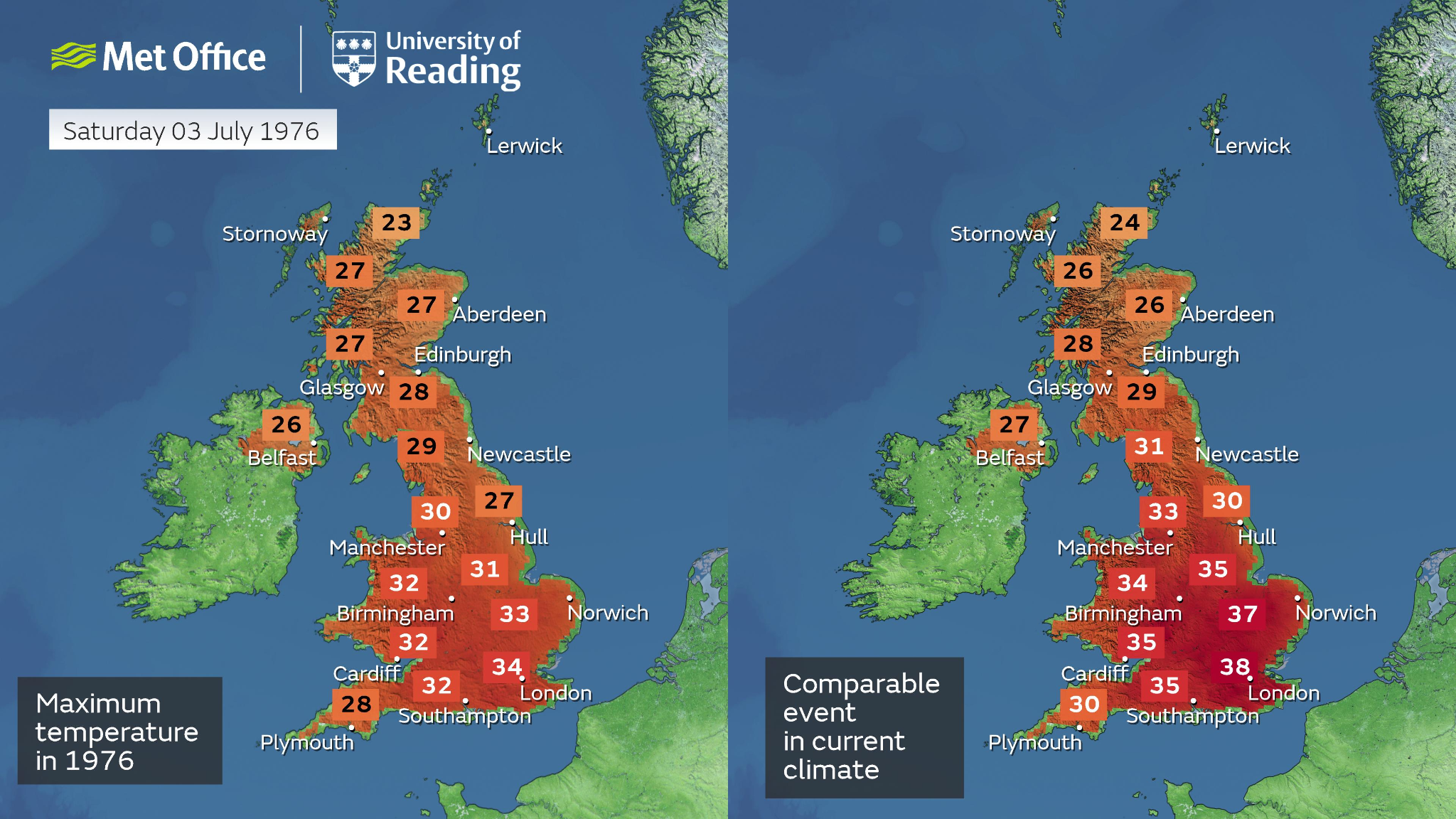
As climate change continues, “1976-style events will become increasingly common over the next two decades”, said Prof Ed Hawkins in a University of Reading press release:
“What felt like a freak weather event to grandparents in 1976 will become the new normal for their grandchildren.”
Hawkins also noted on social media that the heat in 1976 was “less humid”, with “much cooler nights”, adding that “peak night time temperatures were around 16C back then”.
The summer of 1976 became a benchmark for later periods of extreme heat and drought, both for contingency planning and in popular culture.
In recent days, for example, commentary in climate-sceptic newspapers has often referred back to 1976 as a time without “heatwave hysterics” and “nanny state warnings”, or when the heat was taken “in our stride”,.
Much of this commentary has been critical of school closures – for example, arguing that it is “defeatist”.
Yet, although hundreds of schools have announced full or partial closures this week, the summer of 1976 also saw schools close early or allow parents to keep their children home.

How has the media responded?
Many outlets in the UK and France have been dominated by news about the heatwave and temperature records being repeatedly broken.
The story appeared on various frontpages, including the Times, i newspaper and Daily Telegraph in the UK, and Le Monde, Libération and Ouest-France in France.
There was also prominent coverage in other countries that have seen extreme heat, such as on the frontpages of El País in Spain and Die Welt in Germany.
Some outlets were clear about the dangers of extreme heat, as well as the role of climate change in driving it. They led their coverage with public health warnings and details of how the heat was negatively impacting people’s lives.
A Daily Express editorial urged readers to “stay safe” and to shelter indoors with fans, while Ouest-France had a frontpage story about how the heat “threatens our health”. A Guardian frontpage asked if such extremes, “driven by [the] climate crisis”, were “the new normal”.
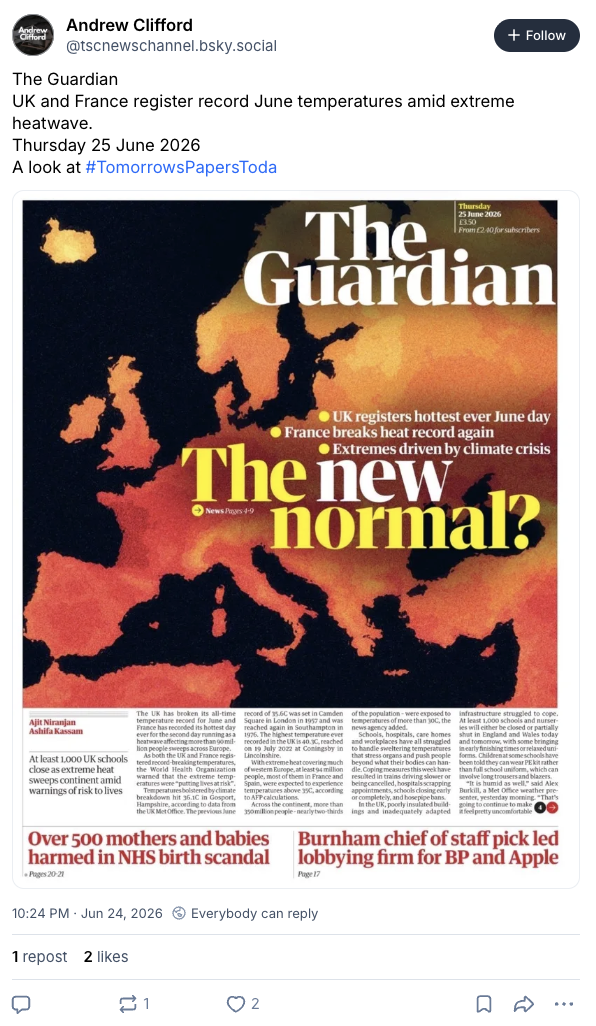
Noting the “muted response” from the UK government to recent warnings about the need for climate adaptation, a Guardian editorial said it hoped “this week’s heat will focus minds”. It added:
“A strong adaptation plan – to run in parallel with the green transition – cannot wait.”
The Independent also argued via an editorial that climate change must be treated with “the urgency the moment demands”, given the “all-too-obvious need to increase resilience”.
Similarly, an editorial in Le Monde criticised the French government’s “flagrant unpreparedness” for heatwaves. It, too, stressed the need for adaptation and said:
“The fight against global warming must be seen as a new paradigm, within which a broad range of public policies must be considered. Simply reacting to events is no longer enough.”
Yet, even amid warnings of “killer heat” approaching 40C, much of the news coverage in UK media was relatively frivolous, often focusing on the positive aspects of the heat.
The Times published stories about “what the fashion A-list are wearing in the heatwave” and “surprising positives to a British heatwave”. On the day after the UK reached its highest-ever June temperature, the Daily Mail featured a story about King Charles using an electric handheld fan on its frontpage.
Often, alongside warnings of “red alerts” and “meltdown”, news outlets illustrated their stories with photos of people relaxing on the beach and children playing in fountains.
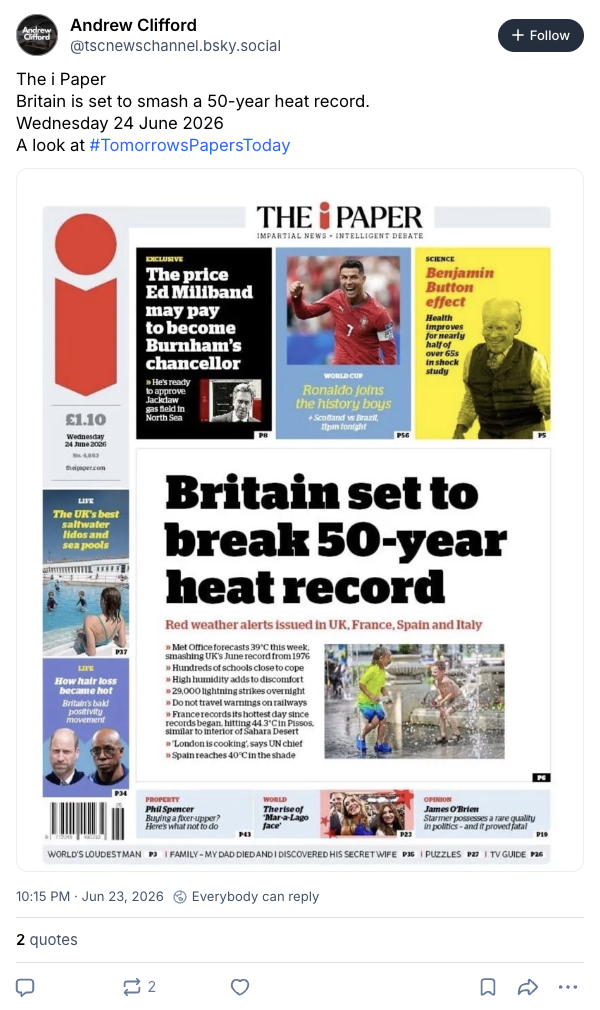
As the news was filled with heat-related disruption at hospitals, train cancellations and school closures, many outlets in the UK also criticised official responses to the heat.
Some writers misleadingly compared the heatwave to similar events in 1957 and 1976. In the Evening Standard, one writer said this year’s heat has “got nothing on the summer of 1976”. A Daily Mail article claimed that in 1957 “the sunshine was greeted by national rejoicing”.
In contrast, a comment piece in the Daily Express erroneously stated that the UK was facing “Covid-like shutdown” due to the heat and the Sun took aim at the “nannying, alarmist state”. A Daily Telegraph editorial said the government was “treat[ing] the public like children”. It said:
“It may well be that the country will have to learn to live with higher temperatures in future. Britain cannot close its schools, cancel its trains and shut down its offices every time the sun comes out.”
Why has media coverage been criticised?
Media coverage of the heatwave in the UK has been criticised for failing to mention climate change and for using imagery that does not convey the health risks associated with the extreme weather.
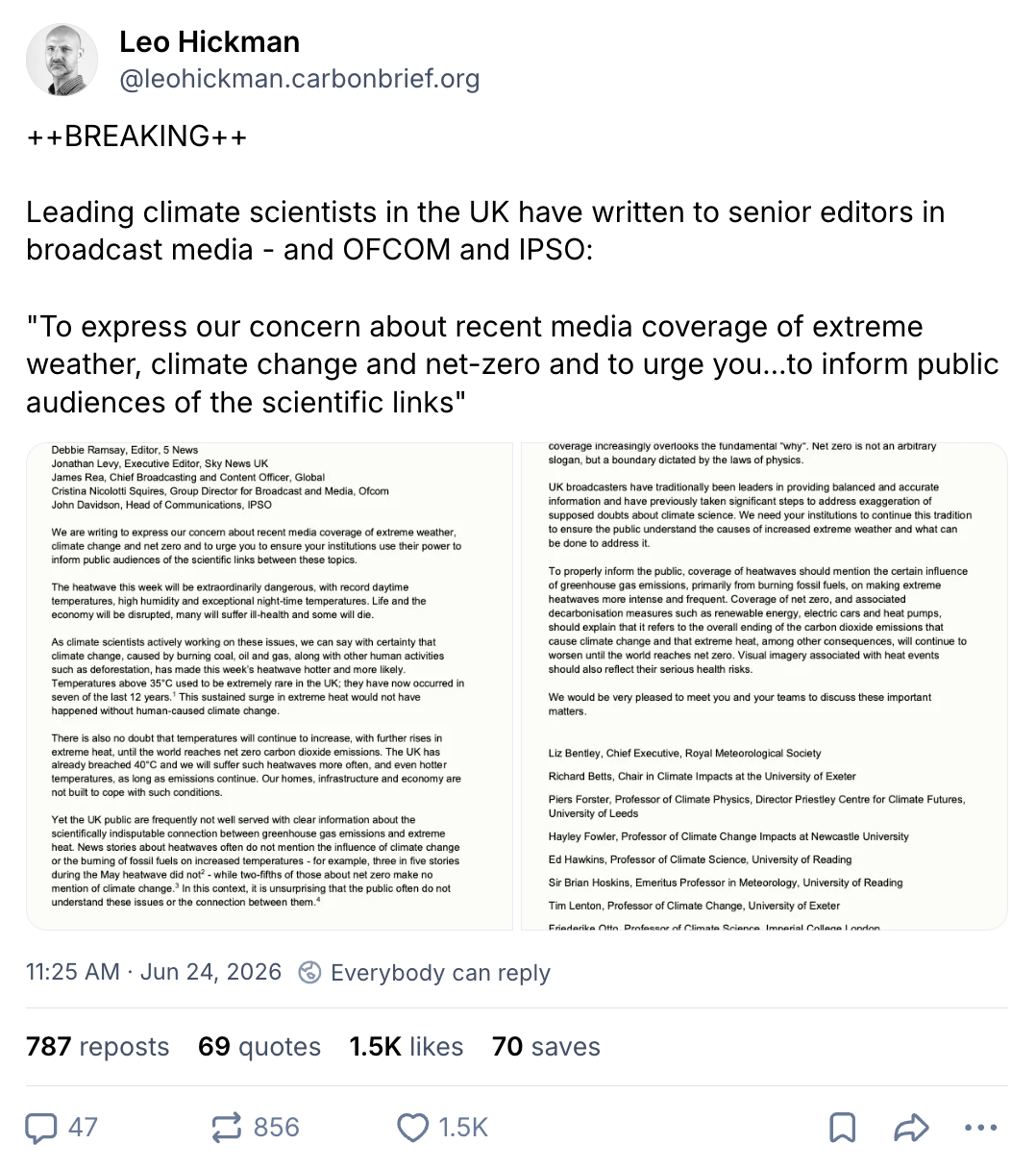
On 23 June, a group of climate scientists wrote to senior editors at BBC News, ITV News, Channel 4 News, 5 News, Sky News and LBC owner Global, as well as to media regulators Ofcom and IPSO, to urge them to “use their power to inform public audiences of the scientific links between extreme weather, climate change and net-zero”.
In a letter, reproduced in the Press Gazette, the scientists said they wanted to express their concern about recent coverage of extreme heat. They argued that the UK public was “frequently not well served with clear information about the scientifically indisputable connection between greenhouse gas emissions and extreme heat”.
Prof Mark Hannon from the University of Strathclyde was among a number of academics on Bluesky to note how some parts of the UK media had failed to explain that climate change was causing the extreme heat. He said:
“Amazing how much coverage the heat – and the symptoms of climate change – is getting on outlets like the BBC, but how little coverage is typically given over to the causes of climate change.”
Others pointed to a disconnect between discussions around net-zero policies and the recent weather.
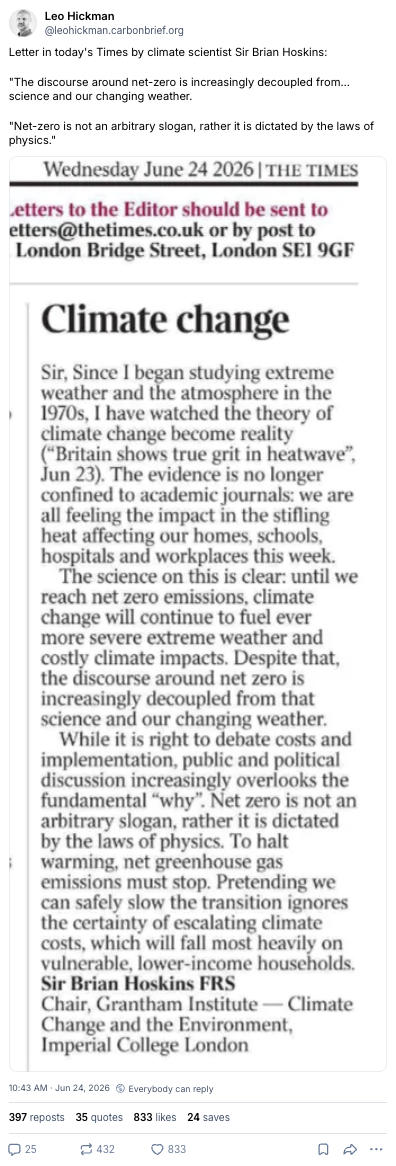
In a letter published in the Times, Prof Brian Hoskins – the founding director of Imperial College London’s Grantham Institute for Climate Change and the Environment – noted that “the discourse around net-zero is increasingly decoupled from that science and our changing weather”.
Other researchers – including University College London’s Prof Bill McGuire and Cardiff University’s Prof Ian Hall – criticised national newspapers’ choice of beach photos to illustrate articles about the UK’s “red weather warning”.
Wolfgang Blau, co-founder of the Oxford Climate Journalism Network, wrote on Bluesky:
“Your happy and clickable ‘kids in lido’‚ ‘dogs playing in fountain’‚ ‘family eats ice cream’ photos to illustrate news reports about the heatwave are journalistic malpractice.”
Article information
Update: This article was updated on 26 June to include further new record-high June temperatures for the UK, on 29 June to add temperature records across Europe and on 31 July to include information about UK records verified by the Met Office.