
Q&A: How the UK government aims to ‘break link between gas and electricity prices’
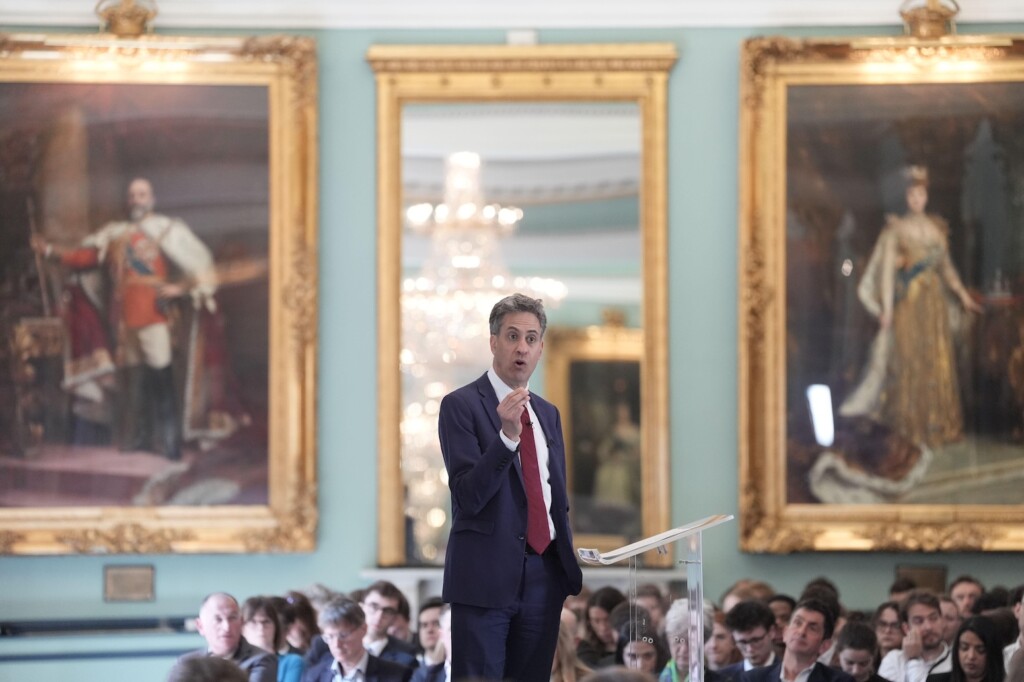
The UK government has announced a series of measures to “double down on clean power” in response to the energy crisis sparked by the Iran war.
The conflict has caused a spike in fossil-fuel prices – and the high cost of gas is already causing electricity prices to increase, particularly in countries such as the UK.
In response, alongside plans to speed the expansion of renewables and electric vehicles, the UK government says it will “move…to break [the] link between gas and electricity prices”.
Ahead of the announcement, there had been speculation that this could mean a radical change to the way the UK electricity market operates, such as moving gas plants into a strategic reserve.
However, the government is taking a more measured approach with two steps that will weaken – but not completely sever – the link between gas and electricity prices.
- From 1 July 2026, the government will increase the “electricity generator levy”, a windfall tax on older renewable energy and nuclear plants, using part of the revenue to limit energy bills.
- The government will encourage older renewable projects to sign fixed-price contracts, which it says will “help protect families and businesses from higher bills when gas prices spike”.
There has been a cautious response to the plans, with one researcher telling Carbon Brief that it is a “big step in the right direction in policy terms”, but that the impact might be “relatively modest”.
Another says that, while the headlines around the government plans “suggest a decisive shift” in terms of “breaking the link” between gas and power, “the reality is more incremental”.
- Why are electricity prices linked to gas?
- What is the government proposing?
- What is not being proposed?
- What will the impact be?
Why are electricity prices linked to gas?
The price of electricity is usually set by the price of gas-fired power plants in the UK, Italy and many other European markets.
This is due to the “marginal pricing” system used in most electricity markets globally.
(For more details of what “marginal pricing” means and how it works, see the recent Carbon Brief explainer on why gas usually sets the price of electricity and what the alternatives are.)
As a result, whenever there is a spike in the cost of gas, electricity prices go up too.
This has been illustrated twice in recent years: during the global energy crisis after Russia invaded Ukraine in 2022; and since the US and Israel attacked Iran in February 2026.
Notably, however, the expansion of clean energy is already weakening the link between gas and electricity, a trend that will strengthen as more renewables and nuclear plants are built.
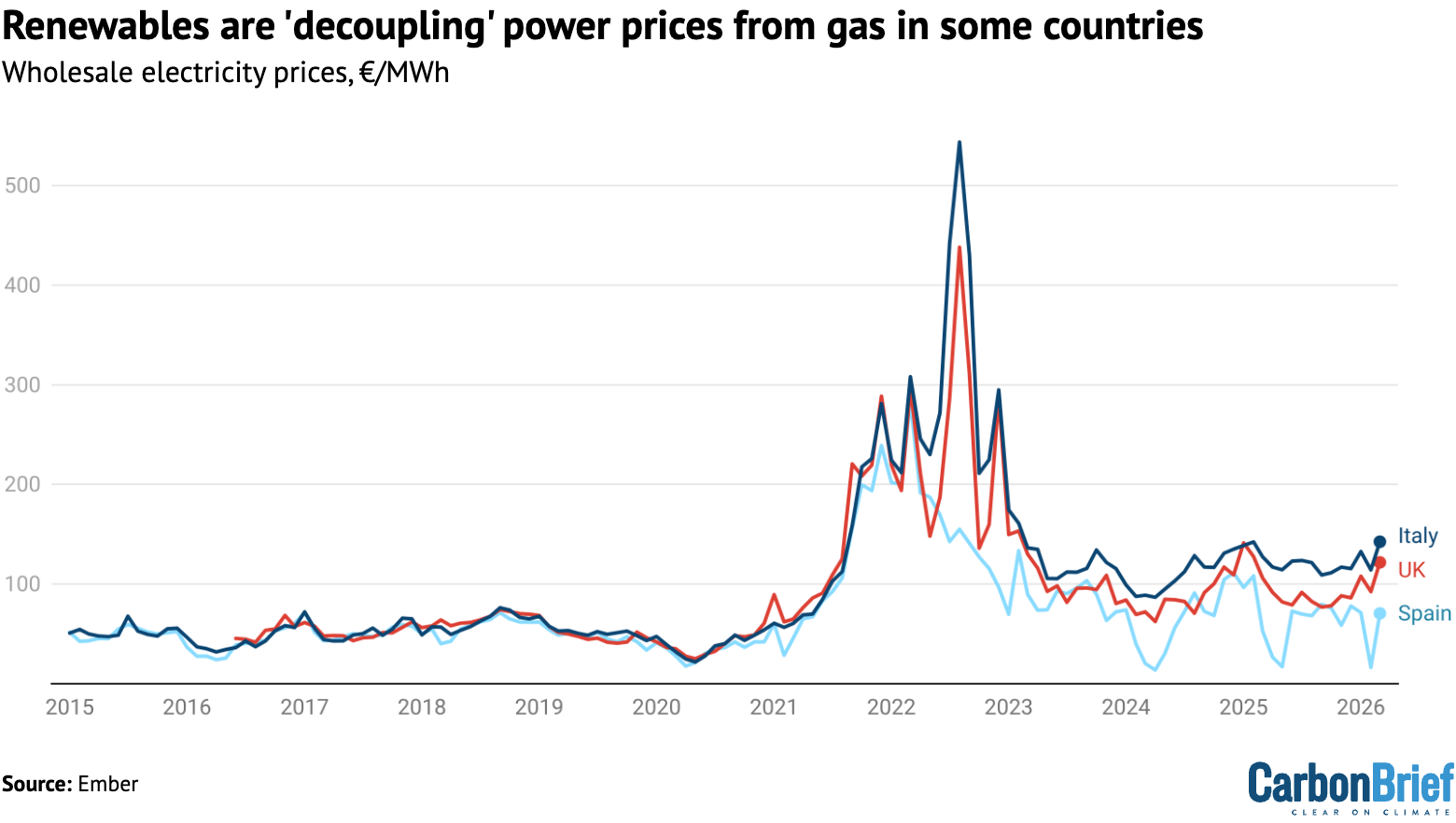
The figure below shows that recent UK wholesale electricity prices have been lower than those in Italy, as a result of the expansion of renewable sources.
The contrast with prices in Spain is even larger, where thinktank Ember says “strong solar and wind growth [has] reduced the influence of expensive coal and gas power”.
The share of hours where gas sets the price of power on the island of Great Britain (namely, England, Scotland and Wales) has fallen from more than 90% in 2021 to around 60% today, according to the Department of Energy Security and Net Zero (DESNZ). (Northern Ireland is part of the separate grid on the island of Ireland.)
This is largely because an increasing share of generation is coming from renewables with “contracts for difference” (CfDs), which offer a fixed price for each unit of electricity.
CfD projects are paid this fixed price for the electricity they generate, regardless of the wholesale price of power. As such, they dilute the impact of gas on consumer bills.
The rise of CfD projects means that the weeks since the Iran war broke out have coincided with the first-ever extended periods without gas-fired power stations in the wholesale market.
This shows how, in the longer term, the shift to clean energy backed by fixed-price CfDs will almost completely sever the link between gas and electricity prices.
The National Energy System Operator (NESO) estimated that the government’s target for clean power by 2030 could see the share of hours with prices set by gas falling to just 15%.
What is the government proposing?
For now, however, about one-third of UK electricity generation comes from renewable projects with an older type of contract under the “renewables obligation” scheme (RO).
It is these projects that the new government proposals are targeting.
The government hopes to move some of these projects onto fixed-price contracts, which would no longer be tied to gas prices, further weakening the link between gas and electricity prices overall.
When RO projects generate electricity, they earn the wholesale price, which is usually set by gas power. In addition, they are paid a fixed subsidy via “renewable obligation certificates” (ROCs).
This means that the cost of a significant proportion of renewable electricity is linked to gas prices. Moreover, it means that, when gas prices are high, these projects earn windfall profits.
In recognition of this, the Conservative government introduced the “electricity generator levy” (EGL) in 2022. Under the EGL, certain generators pay a 45% tax on earnings above a benchmark price, which rises with inflation and currently sits at £82 per megawatt hour (MWh).
The tax applies to renewables obligation projects and to old nuclear plants.
The current government will now increase the rate of the windfall tax to 55% from 1 July 2026, as well as extending the levy beyond its previously planned end date in 2028.
It says it will use some of the additional revenue to “support businesses and households with the impacts of the conflict in the Middle East on the cost of living”. Chancellor Rachel Reeves said:
“This ensures that a larger proportion of any exceptional revenues from high gas prices are passed back to government, providing a vital revenue stream so that money is available for government to support businesses and families with the impacts of the conflict in the Middle East.”
The increase in the windfall tax may also help to achieve the government’s second aim, which is to persuade older renewable projects to accept new fixed-price contracts.
Reeves made this aim explicit in her comments to MPs, saying the higher levy “will encourage older, low-carbon electricity generators, which supply about a third of our power, to move from market pricing to fixed-price contracts for difference”.
(This is an adaptation of a proposal for “pot zero” fixed-price contracts, made by the UK Energy Research Centre (UKERC) in 2022, see below for more details.)
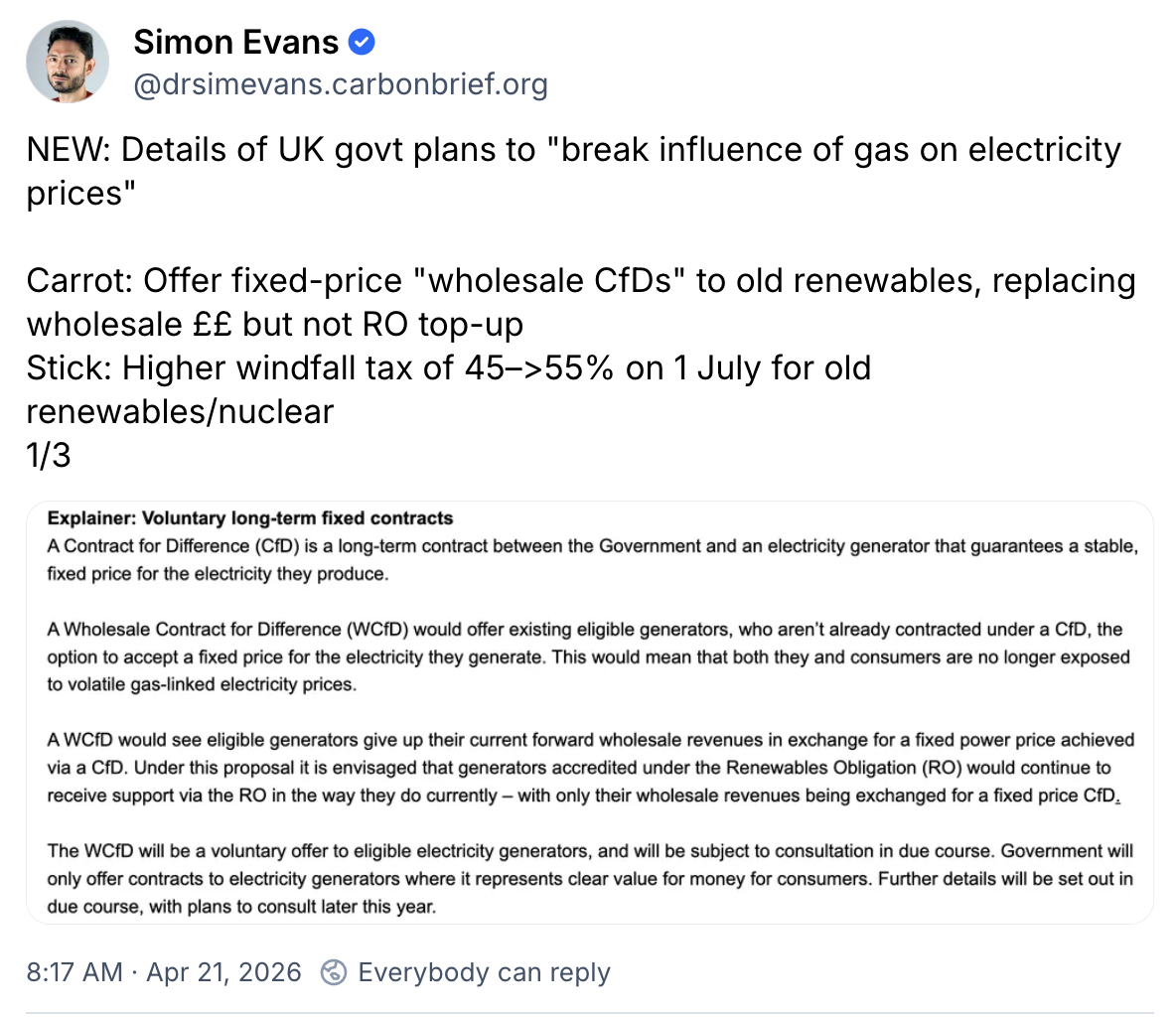
As with traditional CfDs, the new fixed-price contracts would not be tied to the price of gas power. Instead of earning money on the wholesale electricity market, these generators would take a fixed-price “wholesale CfD”. In addition, they would be exempted from the windfall tax and would continue to receive their fixed subsidy via ROCs.
The government says this will be voluntary. It will offer further details “in due course” and will then consult on the plans “later this year”, with a view to running an auction for such contracts next year.
It adds: “Government will only offer contracts to electricity generators where it represents clear value for money for consumers.”
(It is currently unclear if the proposals for new fixed-price contracts would also apply to older nuclear plants. Last month, the government said it intended to “enable existing nuclear generating stations to become eligible for CfD support for lifetime-extension activities”.)
What is not being proposed?
Contrary to speculation ahead of today’s announcement, the government is not taking forward any of the more radical ideas for breaking the link between gas and electricity prices.
Many of these ideas had already been considered in detail – and rejected – during the government’s “review of electricity market arrangements” (REMA) process.
This includes the idea of creating two separate markets, one “green power pool” for renewables and another for conventional sources of electricity.
It also includes the idea of operating the market under “pay as bid” pricing. This has been promoted as a way to ensure that each power plant is only paid the amount that it bid to supply electricity, rather than the higher price of the “marginal” unit, which is usually gas.
However, “pay as bid” would have been expected to change bidding behaviour rather than cutting bills, with generators guessing what the marginal unit would have been and bidding at that level.
Finally, the government has also not taken forward the idea of putting gas-fired power stations in a strategic reserve that sits outside the electricity market.
Last year, this had been proposed jointly by consultancy Stonehaven and NGO Greenpeace. In March, they shared updated figures with Carbon Brief showing that – according to their analysis – this could have cut bills by a total of around £6bn per year, or about £80 per household.
However, some analysts argued that it would have distorted the electricity market, removing incentives to build batteries and for consumers to use power more flexibly.
What will the impact be?
The government’s plan for voluntary fixed-price contracts has received a cautious response.
UKERC had put forward a similar proposal in 2022, under which older nuclear and renewable projects would have received a fixed-price “pot zero” CfD.
(This name refers to the fact that CfDs are given to new onshore wind and solar under “pot one”, with technologies such as offshore wind bidding into a separate “pot two”.)
In April 2026, UKERC published updated analysis suggesting that its “pot zero” reforms could have saved consumers as much as £10bn a year – roughly £120 per household.
Callum McIver, research fellow at the University of Strathclyde and a member of the UKERC, tells Carbon Brief that the government proposals are a “big step in the right direction in policy terms”.
However, he says the “bill impact potential is lower” than UKERC’s “pot zero” idea, because it would leave renewables obligation projects still earning their top-up subsidy via ROCs.
As such, McIver tells Carbon Brief that, in his view, the near-term impact “could be relatively modest”. Still, he says that the idea could “insulate electricity prices” from gas:
“The measures are very welcome and, with good take-up, they have the potential to insulate electricity prices further from the impact of continued or future gas price shocks, which should be regarded as a win in its own right.”
In a statement, UKERC said the government plan “stops short of the full pot-zero proposal, since it will leave the RO subsidy in place”. It adds:
“This makes the potential savings smaller, but it will break the link with gas prices. The devil will be in the detail, but provided the majority of generators join the scheme, most of the UK’s power generation fleet will have a price that is not related to the global price of gas.”
Marc Hedin, head of research for Western Europe and Africa at consultancy Aurora Energy Research, tells Carbon Brief that, while the headlines “suggest a decisive shift” in terms of “breaking the link” between gas and power, “the reality is more incremental”. He adds:
“In principle, moving a larger share of generation onto fixed prices would reduce consumers’ exposure to gas‑driven price spikes and aligns well with the direction already taken for new build [generators receiving a CfD].”
However, he cautioned that “poorly calibrated [fixed] prices would transfer value to generators at consumers’ expense, while overly aggressive pricing could result in low participation”.
In an emailed statement, Sam Hollister, head of UK market strategy for consultancy LCP, says that the principle of the government’s approach is to “bring stability to the wholesale market and avoid some of the disruption that a more radical break might have caused”.
However, he adds that the reforms will not “fundamentally reduce residential energy bills today”.
Johnny Gowdy, a director of thinktank Regen, writes in a response to the plans that while both the increased windfall tax and the fixed-price contracts “have merit and could save consumers money”, there were also “pitfalls and risks” that the government will need to consider.
These include that a higher windfall tax could “spook investors”. He writes:
“A challenge for policymakers is that, while the EGL carries an investment risk downside, unless there is a very significant increase in wholesale prices, the tax revenue made by the current EGL could be quite modest.”
Gowdy says that the proposed fixed-price contracts for older renewables “is not a new idea, but its time may have come”. He writes:
“It would offer a practical way to hedge consumers and generators against volatile wholesale prices. The key challenge, however, is to come up with a strike price that is fair for consumers and does not lock future consumers into higher prices, given that we expect wholesale prices to fall over the coming decade.”
Gowdy adds that it might be possible to use the scheme as a way to support “repowering”, where old windfarms replace ageing equipment with new turbines.
On LinkedIn, Adam Bell, partner at Stonehaven and former head of government energy policy, welcomes the principle of the government’s approach, saying: “The right response to yet another fossil fuel crisis is to make our economy less dependent on fossil fuels.”
However, he adds on Bluesky that the proposals were “unlikely to reduce consumer bills”. He says this is because they offered a weak incentive for generators to accept fixed-price contracts.