
Shifting tropical cyclones increases threat to sinking Mekong delta

Delta force
As a river approaches a body of water, such as an ocean or lake, it slows down and deposits much of the sediment it is carrying. Over many years, enough sediment can accrue that new land is formed – this is a delta. Some of the world’s largest rivers have created huge deltas, such as the Mississippi in the US, the Ganges-Brahmaputra in Bangladesh and India, and – the subject of the new study – the Mekong in southeast Asia. In total, approximately half a billion people around the world live on or near river deltas.
“Perhaps the most significant factor is the substantial increase in large dams, especially in the developing world, often for hydropower. This is probably the biggest factor responsible for a global decline in fluvial sediment loads in recent years.”
Overall, more than 70% of the world’s large deltas are under severe threat from rising sea levels – in part down to a decline in supply of sediment.
And the new study says that tropical cyclones also play an important – but diminishing – role in supplying sediment to the Mekong.
Rainfall runoff
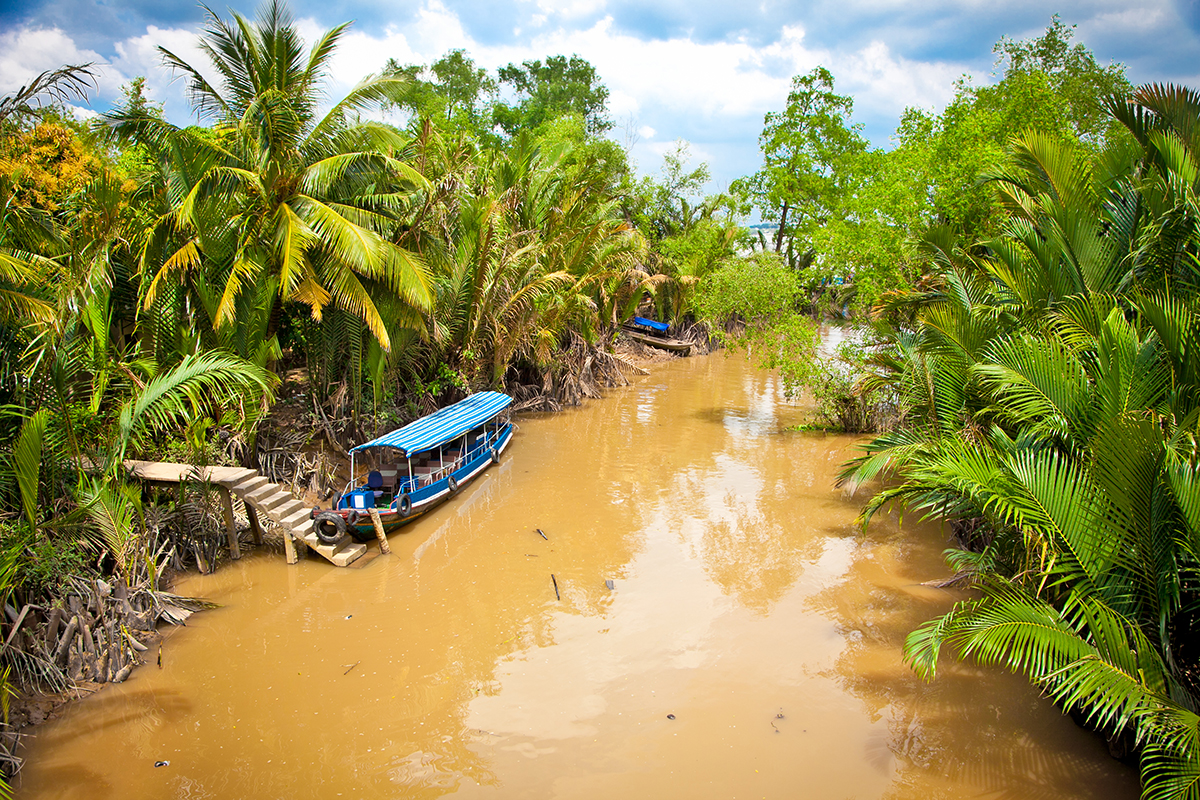
Scientists know that heavy rainfall helps deliver sediment downstream to a delta. As rain falls on the land, it saturates the soil. Once the rainwater can no longer soak into the ground, it forms “runoff” – rainwater that collects on the land surface and runs into rivers – carrying sediment with it. In September 2013, Darby and his colleagues were in the Mekong collecting data to investigate how the monsoon rains affect the supply of sediment to the delta. Then, during their fieldwork, two tropical cyclones crossed over the Mekong basin further upstream. This caused a large flood, Darby says:“Being there on the river, with a complete suite of measuring equipment, during an exceptional flood, made us realise that the sediment loads forced by such events could be a very significant aspect.”
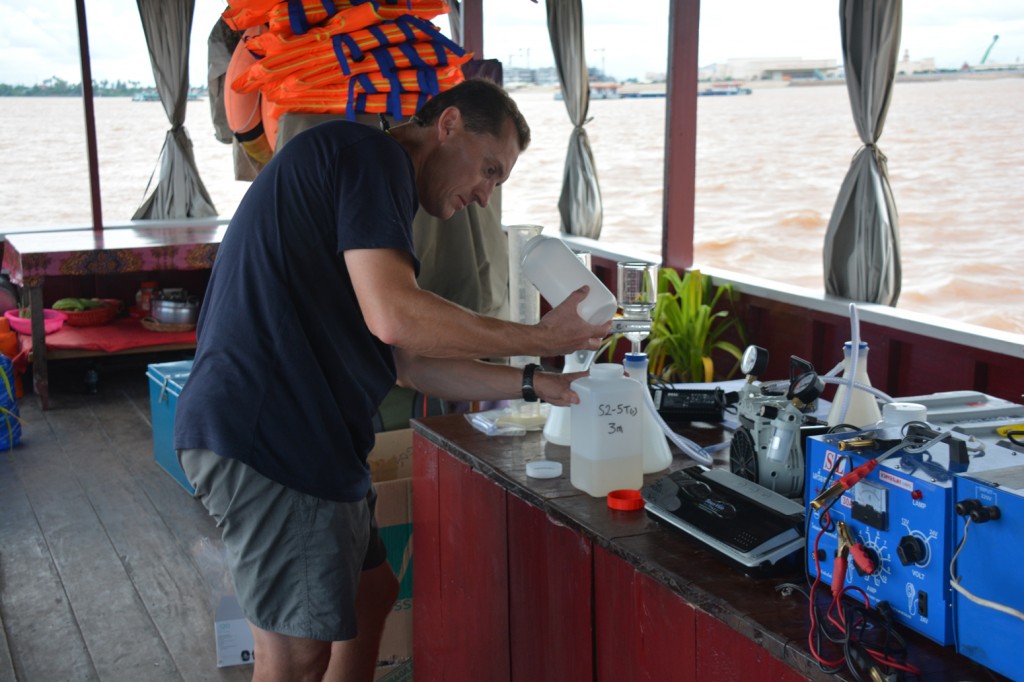
“We found that a significant fraction – about a third – of the total sediment load reaching the coast is transmitted in this way.”
The results may have been surprising because tropical cyclones deliver just 2-5% of the Mekong’s annual rainfall. But this translates into 14-29% of its annual runoff, the paper notes. This is partly because tropical cyclones tend to occur during, or just after, the monsoon season. This means the ground is already very wet, and so additional rainfall is more likely to generate runoff.
Sediment load
However, the data did not only reveal the importance of tropical cyclones to sediment supply to the delta – it also showed that their impact was diminishing. Of the 56m tonne decline in overall sediment load in the Mekong between 1981 and 2015, 33m tonnes – 61% – was down to a reducing contribution from tropical cyclones. You can see this in the chart below, which shows overall sediment load of the Mekong (circles) and the amount caused by tropical cyclones (squares).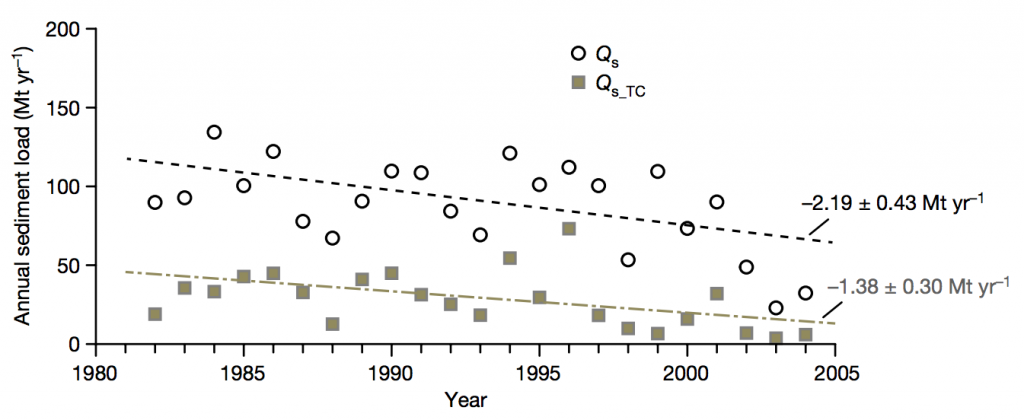
“I think it would be fair to say that it could be either or both of these potential causes.”
But a lessening impact of tropical cyclones on the Mekong is consistent with what models project under a warming climate, Darby notes:
“In the future, most climate models suggest that tropical cyclones striking southeast Asia are likely to intensify and, perhaps, become more frequent. However, these models also project significant changes in the [storm] track locations. This means that, for the Mekong, it is possible that storms will shift away from the basin and closer to south China.”
This means that the influence of tropical cyclones is likely to contribute to further declines in sediment supply in the Mekong, Darby adds:
“The storm effect represents one part of a ‘triple whammy’ of pressures, with damming and sand mining, placing the delta at even greater risk.”
Beyond the Mekong
The findings have “profound implications” for the 20 million people that live on the Mekong delta, Darby says:“Without a continuing supply of river sediment, the rate at which the Mekong delta will sink into the sea will accelerate, compromising existing agriculture (due to flooding and saline intrusion).”
But the Mekong isn’t the only river delta that’s in the path of tropical cyclones, notes Darby, other major deltas, such as the Ganges, Yangtze, and Mississippi, are, too.
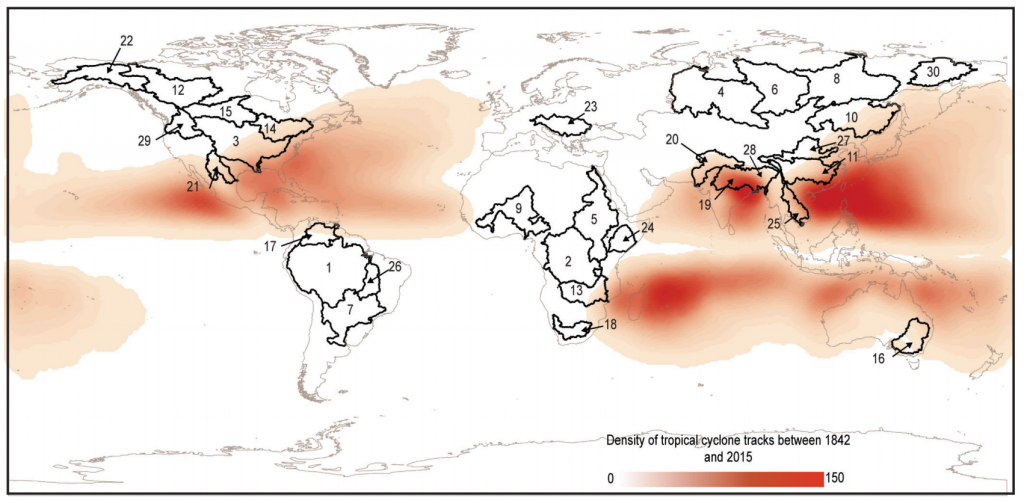
“Millions of people inhabit these other delta systems and they deserve to have a better understanding of the environmental pressures that will affect their lives in the coming decades.”
Article information
Darby, S. E. et al. (2016) Fluvial sediment supply to a mega-delta reduced by shifting tropical-cyclone activity, Nature, doi:10.1038/nature19809