

China Briefing 9 July 2026: Guangxi floods | ‘Beautiful China’ plan | New EU-China mechanism



Anika Patel
07.09.26Anika Patel
09.07.2026 | 4:01pmWelcome to Carbon Brief’s China Briefing.
China Briefing handpicks and explains the most important climate and energy stories from China over the past fortnight. Subscribe for free here.
Key developments
Rain, typhoons and heat
GUANGXI FLOODS: Severe floods hit south-western China’s Guangxi province after heavy rains, killing 39 people and leaving another nine missing, reported the state-run newspaper China Daily. “Torrential rain” caused by Typhoon Maysak overwhelmed rivers and reservoirs in the province, said the New York Times. The Southern Weekly reported that several villages in Guangxi’s Hengzhou city were submerged. An unnamed researcher told the outlet that “small and medium-sized reservoirs”, not just in Guangxi but nationwide, are “severely aged, making it difficult for them to effectively withstand floods caused by extreme weather events against the backdrop of global [climate] change”.
TORNADOES AND 50C HEAT: At least 11 people were killed by two “extremely rare” tornadoes in central China’s Hubei province also linked to Maysak, according to Reuters. Typhoon Bavi is “on course to hit China’s eastern coast” in the coming days, said BBC News. Meanwhile, Xinjiang province in the north-west and Hainan province in the south both experienced “prolonged and intense heatwaves” in June, reported finance outlet National Business Daily. It added that temperatures in Xinjiang reached 50C.
‘MORE FREQUENT AND SEVERE’: China is “warming faster than the global average”, reported state-run newspaper China Daily. It said the China Meteorological Administration’s 2026 “blue book” on climate change in China found that from 1961 to 2025, China’s “annual average temperature increased by 0.31C per decade”. The blue book also found that “extreme weather and climate events in China have become more frequent and severe”, said China National Radio. The outlet said this included extreme heat, precipitation events and typhoons.
New five-year plans and action plans
‘BEAUTIFUL CHINA’ PLAN: The full text of the 15th five-year plan for building a “Beautiful China” outlines “seven key tasks”, including “actively addressing climate change”, reported Xinhua. The plan, re-published by BJX News, set quantitative targets for 2030. These included a 3% cut in carbon emissions per unit of production at industries included in China’s national carbon market. It added that the plan also called for “controlling and reducing coal use” and “reasonably controlling” the scale of coal-power capacity. Meanwhile, the outlet says, the government will “accelerate efforts” to ensure new electricity demand is met by clean energy. It also reported that the plan notes the need to “improve the capacity to respond to climate change” and to “actively participate and lead in” global climate governance. An op-ed attributed to a “commentator from this newspaper” in the environment ministry-run China Environment News said that the next five years are “pivotal” for the “Beautiful China” initiative.
OTHER FIVE-YEAR PLANS: The government also published a 15th five-year plan on “meteorological development”, calling for “enhanced” support for addressing climate change, said BJX News. It added that the plan emphasises the need to “participate deeply” in the work of the Intergovernmental Panel on Climate Change and “actively participate” in the World Meteorological Organization’s work on greenhouse gas monitoring. A third 15th five-year plan on developing a circular economy pledges to “address the shortcomings” in the recycling of clean-tech, reported finance outlet EastMoney. In a Q&A, a government official noted that used batteries, solar and wind power equipment “currently present particularly prominent challenges”, according to BJX News. The five-year plan for tourism encourages the use of carbon offsets and promotes “low-carbon travel”, said industry outlet China Travel News.
PEAKING ‘ACTION PLAN’: China released an “action plan” for peaking its carbon emissions “by 2030”, reported state news agency Xinhua. It added that the action plan reiterated China’s existing targets for carbon intensity and share of non-fossil energy in energy consumption. The plan calls on officials to “vigorously promote” non-fossil energy development and to accelerate efforts to improve “absorption” of new energy into the grid, according to International Energy Net. The plan “doesn’t seek to rein in the country’s fast-growing coal-to-chemicals industry”, said Bloomberg. It noted that the focus instead is on “low-carbon retrofits, reductions in coal consumption per unit of output and a gradual substitution of some fossil-based feedstocks and energy inputs”.
Dialogue deadline
EU-CHINA TALKS: The EU and China have set an October deadline to “reset trade ties” as tensions over cleantech exports and other economic matters “rise”, reported Bloomberg. In a joint statement, the two sides established a “trade and investment consultation mechanism” with four workstreams, including trade and investment balancing and export controls, reported state news agency Xinhua. A joint statement, released by the European Commission, said the two sides agreed to “strengthen” dialogue and to “maintain…the stability of global industrial supply chains”.
AVENUES OF COOPERATION: A Chinese state-affiliated consulting firm and several European certification bodies have established a consortium to coordinate on “green electricity certificates”, aiming to “establish a network for mutual recognition of green power”, reported financial outlet Yicai. Meanwhile, China’s foreign ministry described increasing air-conditioner and fan exports to Europe during a record heatwave as a sign of the “complementary advantages” of EU-China trade, said Xinhua. This message was echoed in several articles by Chinese state-backed outlets. The People’s Daily noted that “as climate change drives more frequent and intense heatwaves…China’s industrial and energy capabilities are…helping address rising demand in Europe”.
PRESSURE ON COMPETITION: Meanwhile, China issued strict mandatory energy consumption and efficiency standards for the solar power industry in efforts to “curb overcapacity”, said financial news outlet Caixin. The country is “rolling back” tax exemptions for plug-in hybrids and electric commercial trucks, Caixin also reported, adding that fully electric passenger cars will not be affected.
More China news
- US FRICTION: The US is “drafting a ban on imports of foreign inverters…over concerns China could use them to disrupt power supplies”, reported Reuters.
- ‘ZERO-CARBON CORRIDORS’: China called for developing “zero-carbon transport corridors” and vehicle hubs, including the promotion of low-carbon vehicles and vessels, says power news outlet BJX News.
- ‘SCALE UP SUPPORT’: At a climate meeting in Bangkok, climate envoy Liu Zhenmin advocated “scaling up support to developing countries” and creating an “inclusive, just transition mechanism”, said Earth Negotiations Bulletin.
- BRICS MEETING: The BRICS grouping will “emphasise the continued role of fossil fuels” in providing energy security, according to a joint communiqué. China will act as chair of BRICS in 2027, noted industry outlet International Energy Net.
- VENTURING NORTH: China has launched its 16th Arctic Ocean expedition, said state broadcaster CGTN. It added that “climate change and its impacts” is a key focus of the mission.
Captured
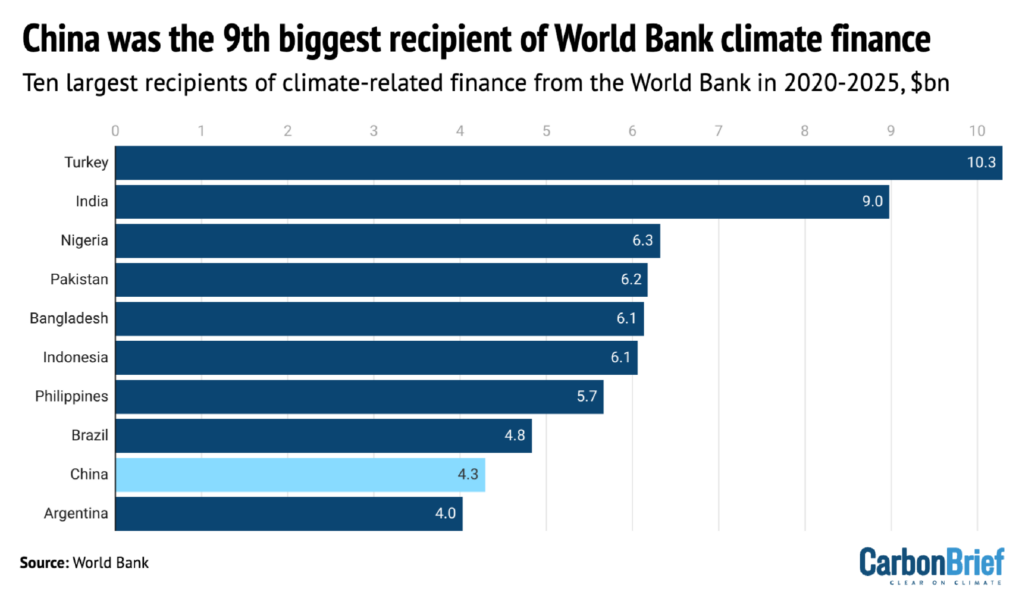
China received $4.3bn in climate finance from the World Bank in 2020-2025, according to Carbon Brief analysis. The World Bank has dropped a pledge on climate-related lending, reported the Financial Times. The newspaper also reported that the bank will also “phase out its lending to China by 2031”. (China is estimated to have provided $3-4.5bn of climate finance annually to other countries, according to estimates by different thinktanks.)
Spotlight
Interview: Dr Sun Yixian on his new database tracking Chinese climate ‘leadership’
A new database has mapped every climate initiative launched or run by China.
In this issue, Carbon Brief interviewed Dr Sun Yixian, professor of sustainability governance at the University of Bath, on what this data shows about China’s approach to climate “leadership”.
Below are highlights from the conversation. The full interview is published on the Carbon Brief website.
Carbon Brief: Your team has compiled a database of China’s “environmental leadership”. What do you mean by leadership?
Sun Yixian: In this project, what we are trying to look at is China’s role in global environmental governance – China’s shifting role, especially from a more passive participant in global governance processes to play a more proactive role in developing or managing its own initiatives on transnational or cross-border environmental governance.
So, [this includes] different environmental issues, but, of course, we found that climate change is a very important issue area. We have come up with a typology of different governance functions, trying to look at what specific activities Chinese actors are doing, or what kind of public goods Chinese actors are delivering, to the audiences of different initiatives.
CB: Could you explain what some of these climate initiatives look like in practice?
SY: In practical terms, there are all different kinds of initiatives. [The majority focus on] sharing information and building platforms, or developing capacity – capacity building activities, which can be training delivered by China to other countries.
Or also by providing funding, for example, China has created this south-south climate fund. It can also include research collaboration.
It can be traditional leadership activities, in the sense of developing certain international regulatory frameworks or rules or standards. It can also be pilot projects. China sometimes can start to work directly with some international partners to trial new ideas and new practices.
CB: The database stops at 2024 – just before the current administration withdrew the US from the Paris Agreement. Have you noticed any changes in China’s global climate engagements following this?
SY: I would say the trend is a continuous one, even [before] the withdrawal of the US…Over the past 10 years, we have seen an upward trend, with more and more new initiatives created by Chinese actors.
But I think the shift will probably help Chinese initiatives get more traction from their international partners – or countries or actors that haven’t been engaged very closely with China – to work more closely with China.
Whether or not this will translate into new initiatives or strengthen existing initiatives, I think that’s an open question.
CB: The theme of the data set is environmental leadership, but…Chinese officials have eschewed being called a climate leader. Would you say that China wants to be seen as a climate leader?
SY: We are entering into the implementation phase for the Paris Agreement. That means it is very difficult to create new agendas at this stage. [Instead the focus is] trying to see if countries can deliver.
If we want to see whether China is becoming a leader, we have to look at how fast, for example, China is accelerating its energy transition and how fast China can reduce its emissions.
Then, in terms of international engagement, what our data is trying to show is that China has become more proactive in that space.
When I was in China a few months ago, [leading experts] said the government…[is] not ready to become a global leader. But, at the same time, I think…in climate governance, but also in clean-energy supply chains – China is playing a leading role.
So, I think the question is whether this…will translate into the understanding, or mindsets, of policymakers or decision-makers.
This interview was conducted by Anika Patel via Zoom on 1 July 2026.
Watch, read, listen
ENVOY INTERVIEW: Climate envoy Liu Zhenmin spoke to state broadcasting station CGTN about climate finance, expectations for China to “lead climate action” and trade tensions.
VIEW FROM THE US: The Atlas Live podcast hosted a debate on “what it will take” for the US to match China’s strength in manufacturing clean-energy technologies.
‘ELECTROSTATE’ EXPLORED: The state media-affiliated WeChat blog Yuyuan Tantian discussed how becoming an “electrostate” would boost China’s “resilience against external risks”.
HYDROGEN TARGETS: The Switched On podcast explored what China’s new targets for “green hydrogen” mean for the development of the industry.
New science
- Offshore wind could provide 3-18% of China’s electricity by 2050 | Communications Earth and Environment
- A new “environmental and nutritional database” of the eight major cuisines of China, including Sichuan, Cantonese and Hunan, reveals “significant variability” in carbon dioxide (CO2) emissions and nutrient content | Scientific Data
Recently published on WeChat
China Briefing is written by Anika Patel, with contributions from Lekai Liu. It is edited by Simon Evans. Please send tips and feedback to [email protected]
