

DeBriefed 29 May 2026: Europe’s ‘mind-boggling’ May | Indian heat deaths | Nigeria’s solar mini-grids


Solomon Elusoji
05.29.26Solomon Elusoji
29.05.2026 | 3:00pmWelcome to Carbon Brief’s DeBriefed.
An essential guide to the week’s key developments relating to climate change.
This week
UK, Europe and India battle heatwaves
‘MIND-BOGGLING’ MAY: The UK and continental Europe have set “mind-boggingly crazy” temperature records for May amid a deadly heatwave, reported the Financial Times. According to the Associated Press, the UK “smashed a century-old temperature record for the second time in 24 hours on Tuesday”. The newswire added that records “also fell in France, where temperatures reached 36C on Monday in the country’s south-west”. On Wednesday, Portugal hit a record May temperature of 40.3C, said BBC News.
‘BRUTAL REMINDER’: In parts of Italy, the heatwave triggered blackouts, reported Reuters. The heatwave has also been linked to more than a dozen deaths in the UK and France, including from people drowning and suffering heat-related deaths while competing in sporting events, said ABC News. Simon Stiell, the executive secretary of UN Climate Change, said the intense heatwaves were a “brutal reminder” of the cost of global warming, reported Politico. Carbon Brief has in-depth coverage of the record-shattering heatwave.
INDIA’S DEADLY HEAT: In the southern Indian states of Andhra Pradesh and Telangana, more than 100 people died within three days following an intense heatwave, reported the Khaleej Times. The publication noted that authorities urged people to stay indoors and avoid direct exposure to the heat. Meanwhile, some parts of India are “grappling with power cuts as record-breaking heat has pushed electricity demand to an all-time high”, reported Reuters.
Around the world
- CRUDE DIPS: The International Energy Agency (IEA) said global investments in oil projects will fall below $500bn in 2026, continuing a three-year decline, reported Bloomberg. Carbon Brief’s analysis of the data shows the US’s “data-centre boom” means it is now investing more in fossil-fuel power than China.
- DODGING NET-ZERO: The world’s biggest miner, Australian giant BHP, has backtracked on climate action by halting or delaying projects to cut “vast” amounts of emissions, according to a Guardian investigation.
- SOLAR SLIP: China’s new solar installations dropped for a fourth straight month, reflecting weakening domestic demand, said Bloomberg.
- NO LOGGING: Deforestation in the Brazilian Amazon fell last year to its lowest level since 2019, according to a new report, said Agence France-Presse.
- EXECUTIVE ACTION: Puerto Rico’s governor announced a state of emergency to fight a surge in coastal erosion, citing the need to protect natural resources and vulnerable communities, reported the Associated Press.
Four million
The number of homes in the UK with air conditioning, double the figure from three years ago, reported the Guardian. There are 29m households in the UK.
Latest climate research
- Carbon Brief will soon be launching a new fortnightly newsletter focused on climate research. Sign up for free today.
- LGBTQ+ households in the US are “significantly more likely” to face energy poverty and insecurity than the general population | Energy Research & Social Science
- Global rice-paddy greenhouse gas emissions have doubled over the past six decades | Nature Food
- Vegetation greening and human-caused warming are the “main drivers” of a surge in flash floods over the last decade | Science Advances
(For more, see Carbon Brief’s in-depth daily summaries of the top climate news stories on Tuesday, Wednesday, Thursday and Friday.)
Captured
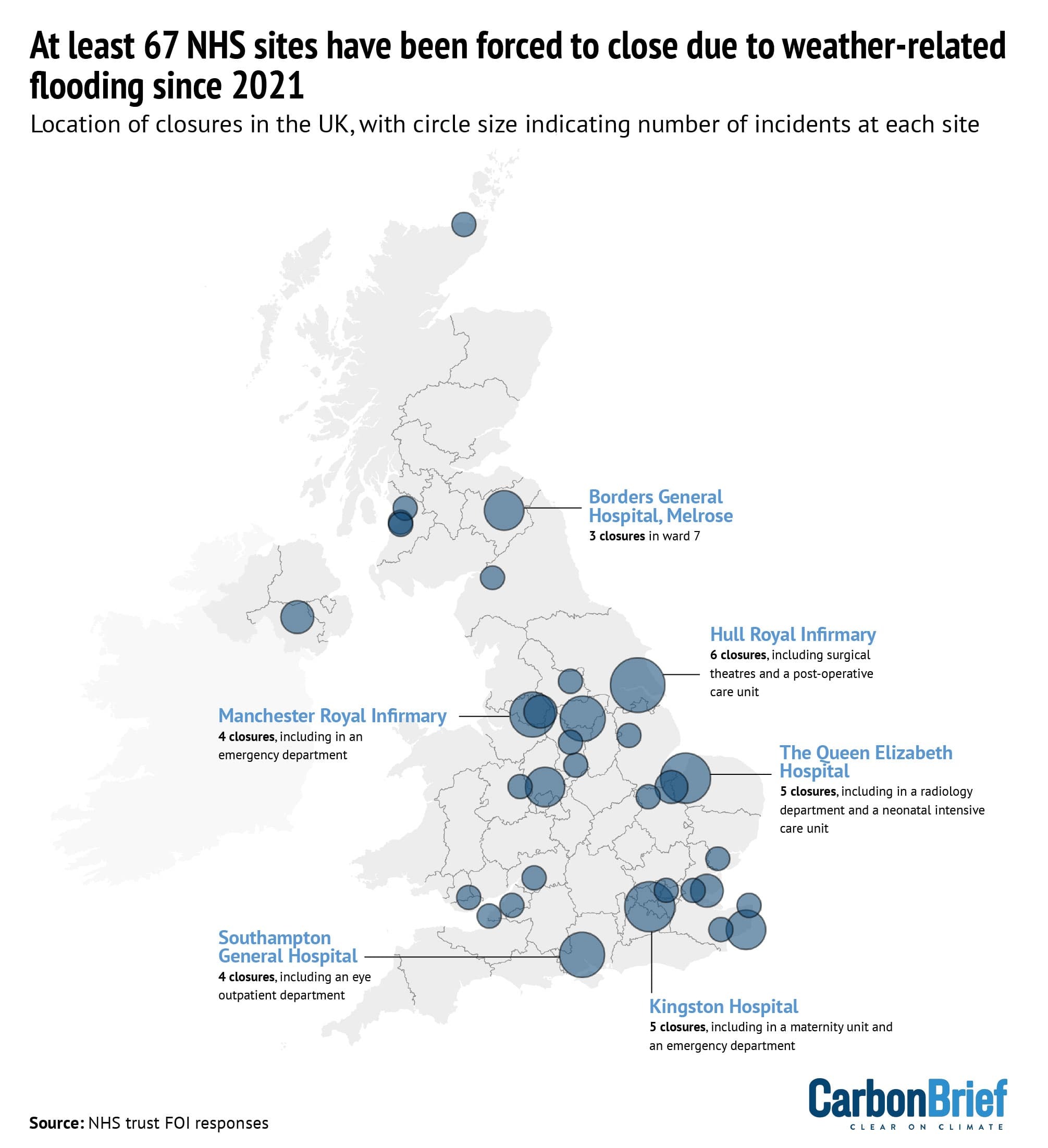
A Carbon Brief investigation has shed light on the impact of weather-related flooding on National Health Service (NHS) facilities across the UK. At least 67 NHS hospital wards, departments and other sites have been forced to temporarily close or relocate due to weather-related flooding. The chart above shows sites of weather-related flooding incidents at NHS facilities. The size of the circles indicates the number of incidents reported at each site.
Spotlight
How solar mini-grids can ‘help boost’ Nigeria’s economy
This week, Carbon Brief covers a new report on Nigeria’s solar mini-grid industry.
Amid the impact of the US-Iran war on the Nigerian economy, a new report has argued that solar-mini grids can help to reduce the country’s reliance on fossil fuels and create more than 200,000 jobs.
In Nigeria, Africa’s third-largest economy, the war has led to an increase in energy prices and a decrease in petrol consumption. Petrol is one of the country’s main sources of transport and household fuel. According to one estimate, prices have surged by up to 40% since the conflict commenced in February.
Although the Nigerian treasury has benefited from rising crude oil prices – the country is a major exporter of oil and gas – the impact has been most visible on the wider population.
Rising energy prices “have affected the purchasing power of workers”, Agnes Funmi Sessi, a labour union leader in Lagos, told Carbon Brief.
However, scaling the deployment of solar “mini-grids” could help the country move away from fossil fuels, stimulate rural economies and improve livelihoods, according to the new report authored by the thinktank, the Africa Policy Research Institute.
“We estimate that, by deploying over 10,000 mini-grids, the sector could create 212,688 direct full-time informal and productive-use jobs across the off-grid and under-grid market segments,” the report said.
A nascent industry
Solar “mini-grids” are small-scale, localised electricity generation and distribution systems powered by solar panels.
The report positioned Nigeria’s mini-grid sector as one of the fastest-growing in Africa, with the country having just 11 mini-grids in 2015 and 155 by 2024, along with at least 42 active developers.
Many of the companies within the sector are young and apply novel local techniques in their deployment of solar technology, the report said.
However, access to finance remains a huge barrier. According to the report, the sector may require up to $8bn to connect 35.4 million people to mini-grids.
“Most Nigerians want solar power in their homes, but it is a capital intensive business for vendors and customers,” Dr Ben Iheagwara, a renewable energy entrepreneur and policy analyst, told Carbon Brief.
The report urged the Nigerian government and its international partners to “attract private capital by de-risking investments and ensuring regulatory clarity and long-term planning”.
Other key recommendations for policymakers and stakeholders include investment in skills development and paying attention to the gender gap.
Powering rural communities
Many rural communities, which make up about 37% of the country, are disconnected from the national grid system, so often have to generate their own electricity through mini-grid systems.
According to Nigeria’s electricity regulator, NERC, a mini-grid is defined as a power generating system with an installed capacity of up to 10 megawatts.
A mini-grid can be powered by fossil fuels such as diesel or petrol, but solar power is now considered a cheaper and cleaner source.
With more than 80 million people lacking access to electricity in Nigeria, solar mini-grids are increasingly viewed as the lowest-cost electrification solution, the report said.
Watch, read, listen
MOVING FORWARD: The Energy Transition Show dug into electricity reform in South Africa, discussing the country’s coal legacy and the role of renewables.
ENERGY POVERTY: In an opinion article for Project Syndicate, executive director of the African Climate Foundation, Saliem Fakir, argued that the energy transition in emerging and developing economies is driven by economics and security rather than emissions targets.
VANISHING CITY: BBC News reported on a coastal community in Nigeria where the ocean has “already swallowed more than half of the town”.
Coming up
- 31 May: Colombia presidential elections
- 31 May-5 June: Global Environment Facility council meeting, Samarkand, Uzbekistan
- 2-5 June: The Venice Agreement for Peatlands workshop, Kisumu, Kenya
Pick of the jobs
- National Oceanography Centre, engagement assistant (external communications) | Salary: £28,254. Location: Southampton, UK
- Dangote Industries, decarbonisation specialist | Salary: Unknown. Location: Lagos, Nigeria
- City of New York, chief decarbonization officer | Salary: $261,469. Location: New York City
- Climate Central, writer and associate editor | Salary: $72,000-$75,000. Location: US (Remote)
DeBriefed is edited by Daisy Dunne. Please send any tips or feedback to [email protected].
This is an online version of Carbon Brief’s weekly DeBriefed email newsletter. Subscribe for free here.