
‘Foehn winds’ causing Antarctica’s Larsen C ice shelf to melt in winter
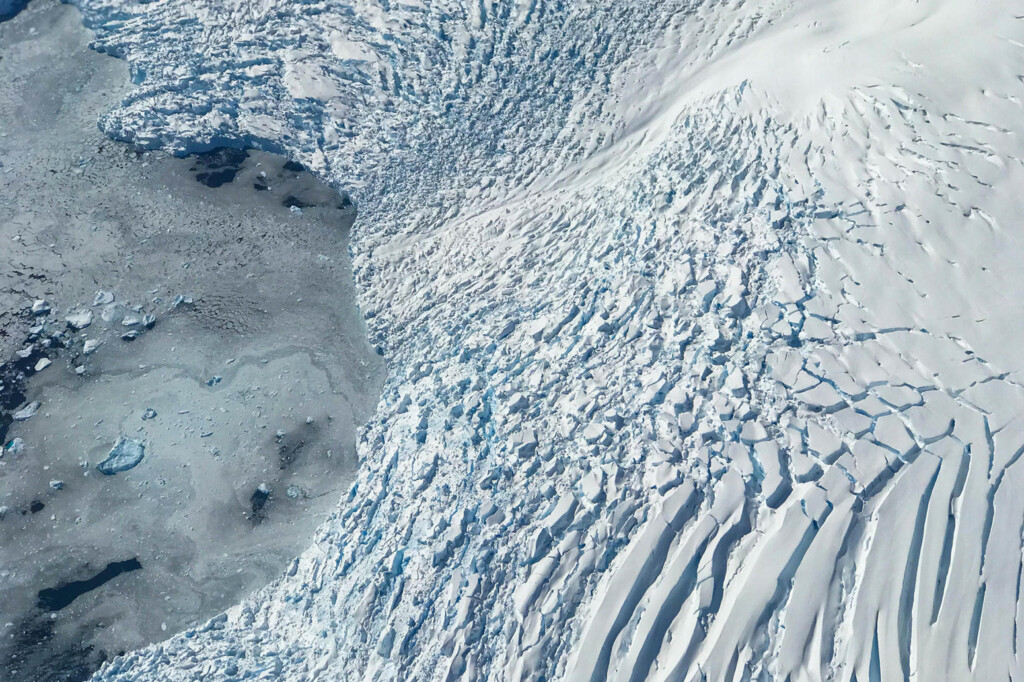
Shelving ice
The new study, published in Geophysical Research Letters, focuses on the Larsen C ice shelf, a floating mass of ice that hugs a stretch of coastline on the Antarctic Peninsula. The shelf made headlines last year when an iceberg twice the size of Luxembourg broke off its easterly edge.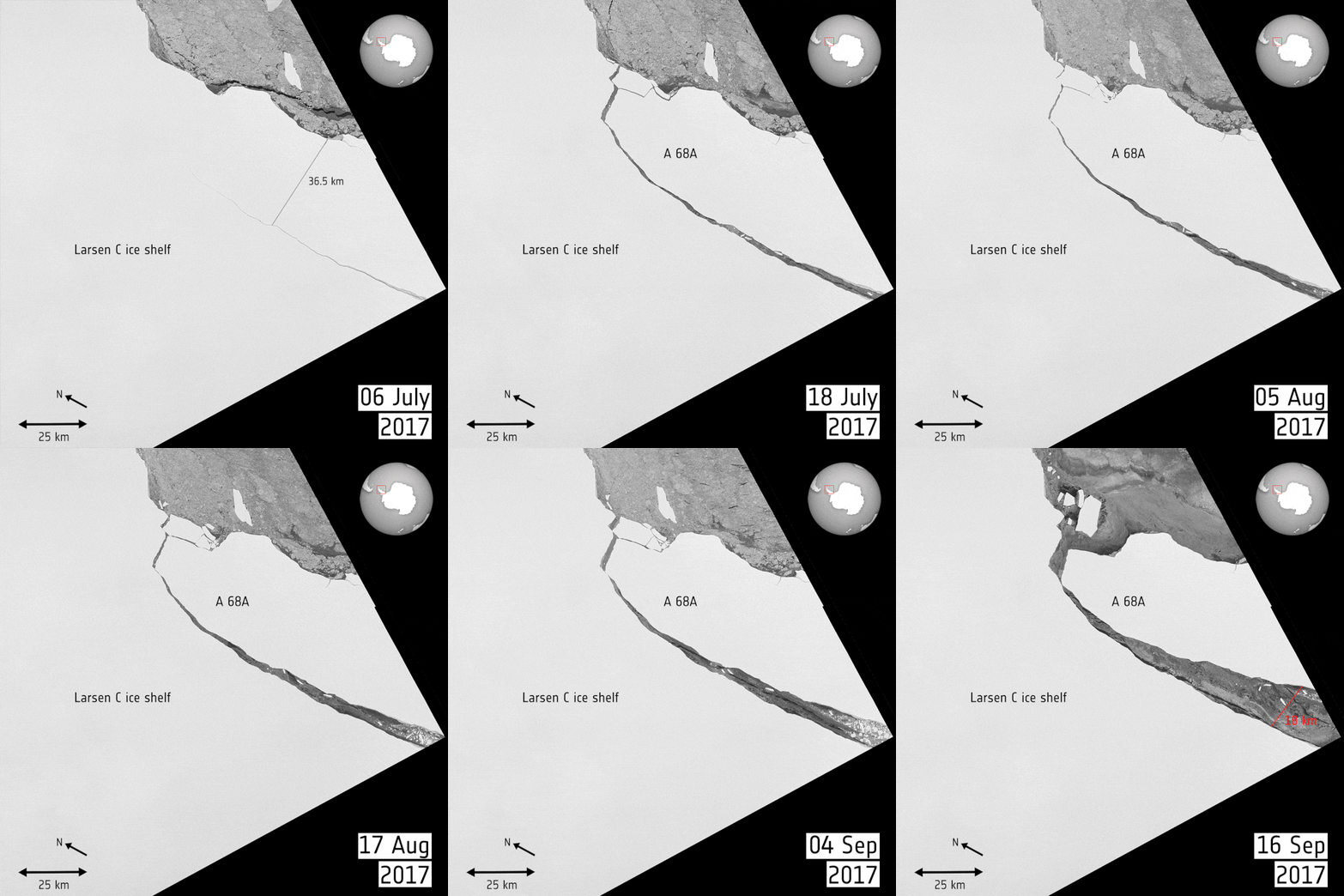
“We were surprised to find that there are locations in Antarctica where up to 20 to 25% of the snowmelt is happening outside of the summer season.
“We have no means to prove that this is a process that has not happened before. It is just that only now do we have the satellite technology – and a weather station – at this location to demonstrate that a lot of melt is happening in winter.”
Measuring melt
As part of the study, the research team installed an automatic weather station close to the Cabinet Inlet on the northwestern part of the ice shelf in 2014. The small purple dot highlights the location of the weather station on the map below.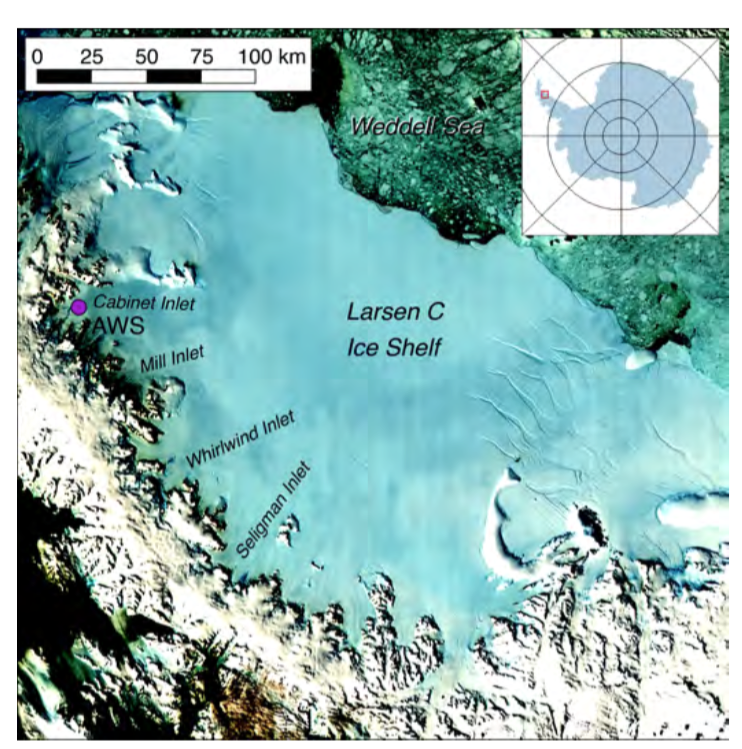
“Our estimate comes from an automatic weather station that has been operating autonomously – non-stop – for the past three years. It sends data over a satellite link, so we can track the weather almost instantly.”
The results show that, in the past three years, 77% of surface melt around the Cabinet Inlet occured in the summer, while 23% took place in the winter. The researchers also buried thermometers deep in the snow around the Cabinet Inlet. These have revealed that, during the winter months, melting occurred at depths of up to three metres.Satellite sentinels
The researchers then compared their observational results to data taken by European Space Agency satellites over the same time period. The satellites use radar, which uses radio waves to detect the presence of meltwater. This makes it easier to monitor Antarctica during the winter, when a lack sunlight makes it difficult to take photographs, Kuipers Munneke says. The radar satellites can capture images at a resolution of 40 by 40 metres, which makes it possible to detect pools of meltwater sitting on top of the ice shelf, he adds. The images below show the presence of meltwater pools, which appear as long black swirls, on Cabinet Inlet (top left) and three adjacent Larsen C inlets (locations shown on the map above). The images were all taken during the winter months of 2015 and 2017.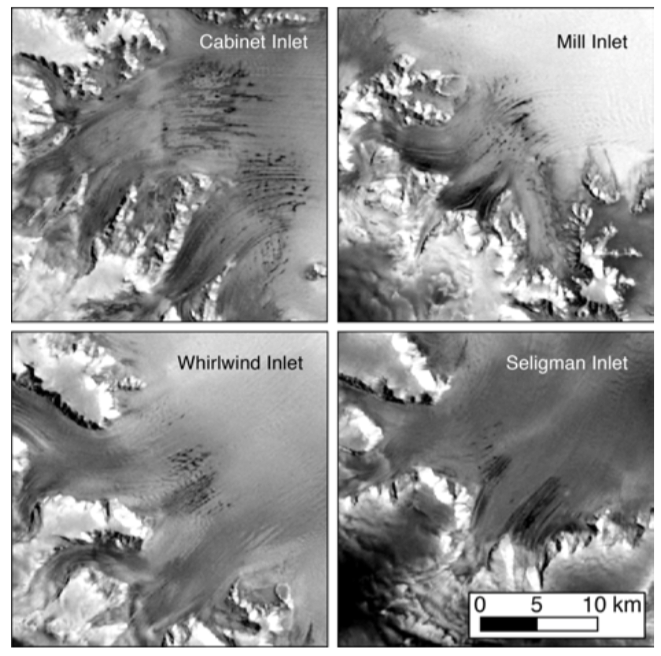
Winds of change
All of the winter melt events were caused by a combination of strong wind, high temperatures and low relative humidity, the weather station results show. Such conditions are the hallmarks of the “foehn winds” that sometimes flow over the Antarctic Peninsula mountain range, the study says. Foehn winds occur when air passes over mountains before reaching land. As the air travels over a mountain, it can pick up heat in a variety of ways, including through moisture loss, changes in pressure, turbulence and warming by the sun. These warm, blustery conditions are likely to be responsible for the short sudden bursts of melting across Larsen C’s inlets, the research finds. Because inlets are found along the edge of the ice shelf, they are largely exposed to incoming foehn winds. While the researchers did not detect a growing trend in the number of winter melt days per year across the ice shelf over the past decade, they expect that the impact of foehn winds is likely to increase with future climate change. This is because foehn winds in this region are triggered by the arrival of westerly winds, which are projected to strengthen under climate change, Kuipers Munneke says:“The strength of the westerlies depends on the temperature difference between the tropics and the south pole.
“The South Pole will remain cold [with climate change], but the rest of the southern hemisphere will warm up. This increases the temperature difference, and thus also the strength of the westerlies.”
Collapsing concerns
Surface melt across Larsen C leads to the formation of meltwater ponds and lakes, which typically refreeze later on in the winter. As a result, surface melt does not directly contribute to sea level rise, Kuipers Munneke says. However, the presence of meltwater pools on top of the ice puts a great deal of pressure on the shelf, increasing its chances of ice shelf collapse. The presence of meltwater is believed to have played a role in the recent collapse of the nearby Larsen A and Larsen B ice shelves, the study notes:“These ponds may have exerted so much pressure that these…ice shelves collapsed into numerous icebergs in recent decades.”
When an ice shelf collapses, the ground ice beneath it becomes free to flow more quickly into the ocean, causing sea level to rise. Research suggests that glaciers behind ice shelves may accelerate by as much as five times following a rapid collapse. It is possible that the winter melting observed across Larsen C could also be happening on other ice shelves, Kuipers Munneke says:“[The results] would in principle hold for other ice shelves. However, we have not yet been able to find winter melt of this magnitude in other locations in Antarctica.”
Winter melting may also be occuring on the McMurdo ice shelf, which is located close to the Ross Sea in southern Antarctica, says Dr Alison Banwell, a glaciologist at the Scott Polar Research Institute, University of Cambridge, who was not involved in the study. She tells Carbon Brief:“The presence of winter melting is not necessarily surprising to me as during some fieldwork that I undertook on the McMurdo Ice Shelf, Antarctica, we found evidence of subsurface melting – also down to about three metres – as late as March. Previously, melting on Antarctica’s ice shelves was only thought to occur in December and January, with only minimal or no melting outside of this time period.
“If winter melting is widespread across many Antarctic ice shelves, it could have a significant influence on ice shelf thinning rates and stability.”
Article information
Kuipers Munneke, P. et al. (2018) Intense winter surface melt on an Antarctic ice shelf, Geophysical Research Letters, doi.org/10.1029/2018GL077899
Updated on 3 May to amend definition of foehn wind.