
Rainforests: Scientists concerned climate change is altering the tropical life cycle
Changing seasons
In every part of the world, plants rely on cues from their environment, including changes in sunshine, temperature and rainfall, to determine when to start producing leaves, flowers or fruit. The study of this phenomenon is known as plant “phenology”.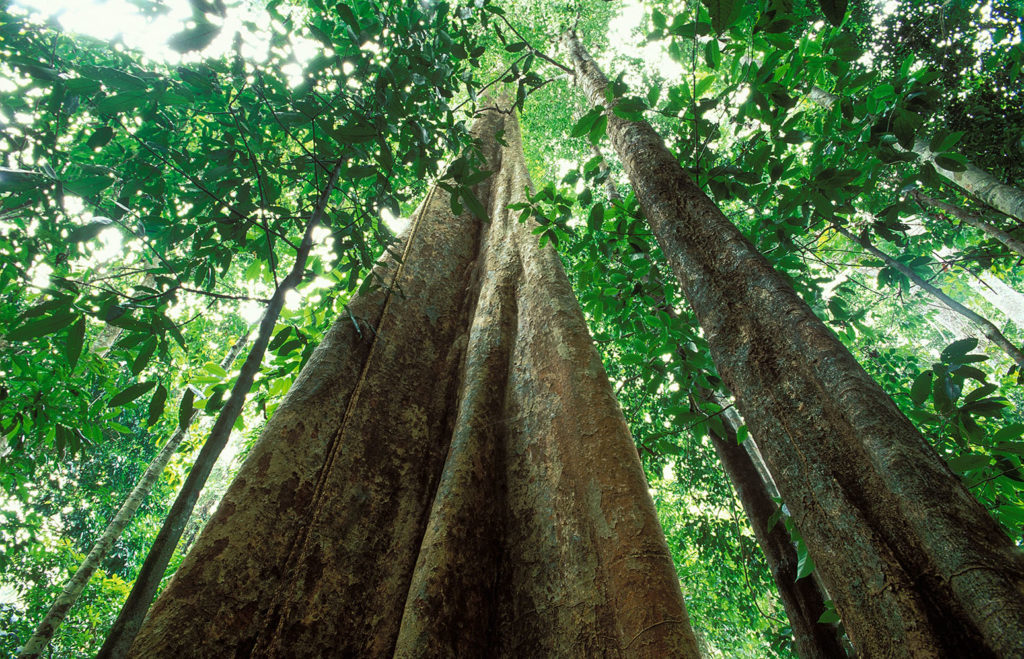
“In the tropics, we don’t have sharp seasons, so it’s more difficult to track changes. Instead, we have to know the cycle and, over time, see if the cycle is changing.”
Most rainforests have a wet and a dry season, which is caused by annual changes in rainfall. But many tropical plants do not time events, such as flowering, in accordance with these seasons, says Dr Joseph Wright, from the Smithsonian Tropical Research Institute in Panama. At the conference, Wright presented a talk on the environmental controls of leaf fall and flowering in tropical rainforests. He told Carbon Brief:“I work on a 16 sq km site in Panama with 2,000 plant species. Every month of the year, there are several hundred species flowering. At the peak month, there’s probably a thousand species flowering. But even in the minimum month, there’s 200 species flowering.”
Because tropical plants do not time their life cycles according to the seasons, it is more difficult to work out what environmental cues could be causing the plants to begin flowering, Wright said:“It could be unusually low temperature. It could be the beginning of the rainy season. Or it could be sunlight. These hypotheses are very vague.”
Data drought
Another limitation in the tropics is a lack of long-term climate and plant data, the researchers said. In Europe and North America, scientists and nature enthusiasts alike have been recording the date of the first bud, leaf and flower for thousands of species for more than a century. This long record has enabled researchers to track how plants are responding to global warming. Recent research (pdf) from the Met Office finds that spring is currently advancing at a rate of 2.5 days per decade across Europe. However, in the tropics, there are very few known historical records and little funding available for research to be conducted, Wright said:“There’s an incredible north-south divide. The northern hemisphere is rich and there’s tonnes of excellent universities and national research councils and so, as a consequence, in the northern temperate zone we have an incredible knowledge base. There’s tonnes of scientists and there’s very few species.
“You go to the tropics, we have the opposite situation. Countries are poor, each country might have one national university and the vast majority have no national research programme. But there’s thousands of species, there’s a hundred times more species and three orders of magnitude fewer scientists.”
Measuring mismatch
Despite a lack of historical knowledge, a growing number of researchers are trying to find new ways of understanding how climate change could affect the natural cycle of tropical rainforests. One key area of this new research is to understand how shifts in forest cycles could affect the unique community of animals that live in the tropics. It is still unclear how climate change may affect rainfall patterns in much of the tropics, but research (pdf) suggests that rainforests could experience longer dry periods by the end of the century. A research paper published by Morellato and her colleagues in 2016 in the journal Biological Conservation attempts to evaluate how a longer dry season caused by climate change could affect the timings of key events in the rainforest. It suggests that a longer dry season could cause plants to start flowering later on in year. This is shown in the chart below, where blue bars show the amount of monthly rainfall, while blue lines show the percentage of plants that are producing flowers. Red lines show the percentage of plants producing fruit. On the chart, red-dashed arrows show how a longer dry season caused by climate change could lead to later plant reproduction via flowering. Later flowering could lead to less time available for plant pollination, which will result in fewer plants producing fruit the following year.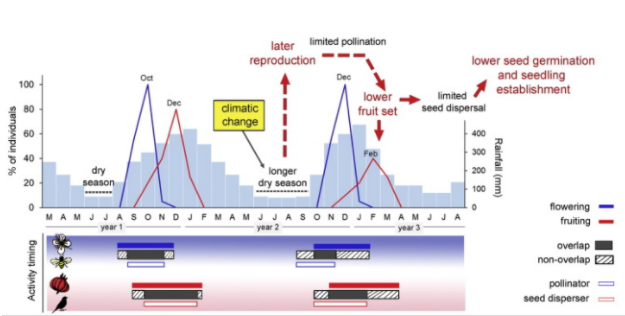
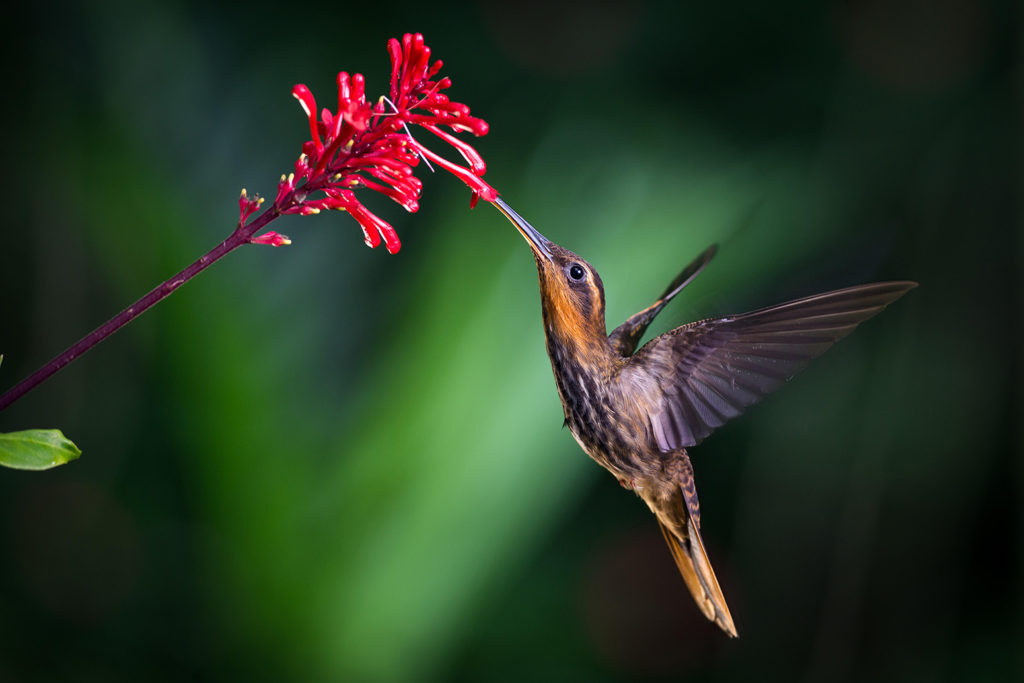
“The reliable and continuous availability of floral resources in the tropics has enabled strong and diverse adaptations in flower visitors, maintaining rich assemblages of highly specialised floral foragers, such as bees and hummingbirds.”
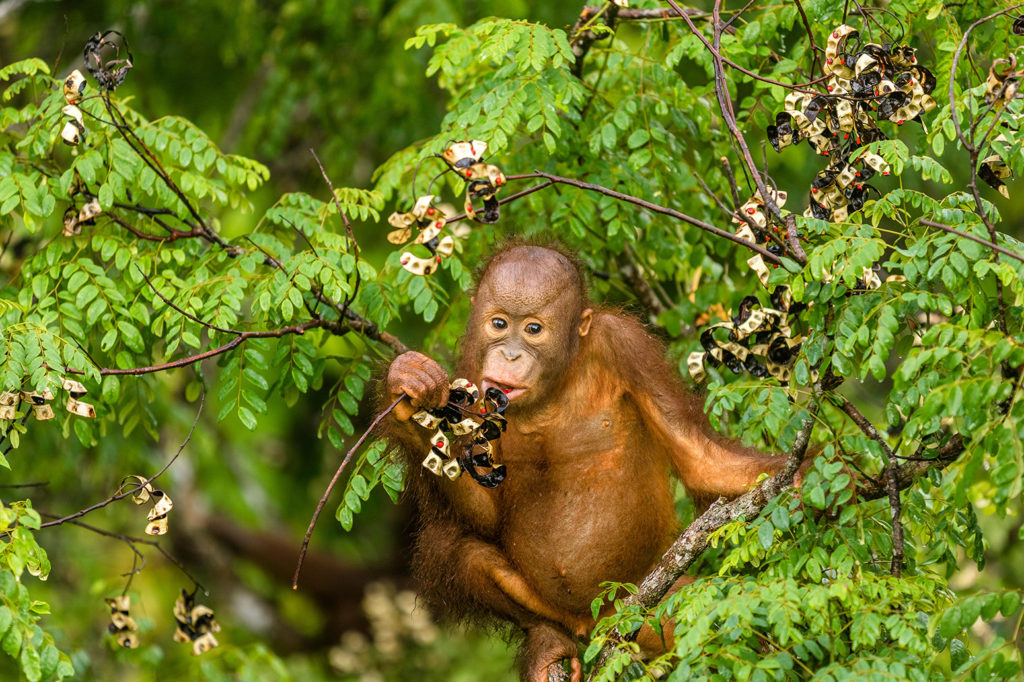
On top of this, a reduction in fruit availability in the following year as a result of climate change could cause a “mismatch” in the activity time of fruit trees and fruit-eating animals, which are known as “frugivores”. The paper reads:“Frugivorous animals critically rely on fruits, and fundamental aspects of their ecology – including diet, population size, social behaviour reproduction, and movements – depend on fruit abundance and seasonality.”
‘Critical to every organism’
Although recent research outlines the species most at risk from shifts to the tropical cycle, it is likely that such changes will affect almost every animal found in the rainforest in some way, Morellato said:“In the tropics, almost all species rely, at some point in their lives, on a plant in flower or in fruit. Changes in phenology will affect the animal community in forests, that’s for sure.”
Fully understanding how climate change is affecting plant phenology will be key to protecting rainforest wildlife, Wright said:“Primary producers [plants] are critical to every organism, every animal, every consumer in the forest. The more we’re able to get some understanding on what the link between what climate and the plant response is, the more we’re going to be able to make predictions about their chances of survival.”
Article information
Morellato, L. P. C. et al. (2016) Linking plant phenology to conservation biology, Biological Conservation, http://dx.doi.org/10.1016/j.biocon.2015.12.033