Santa Marta: Key outcomes from first summit on ‘transitioning away’ from fossil fuels
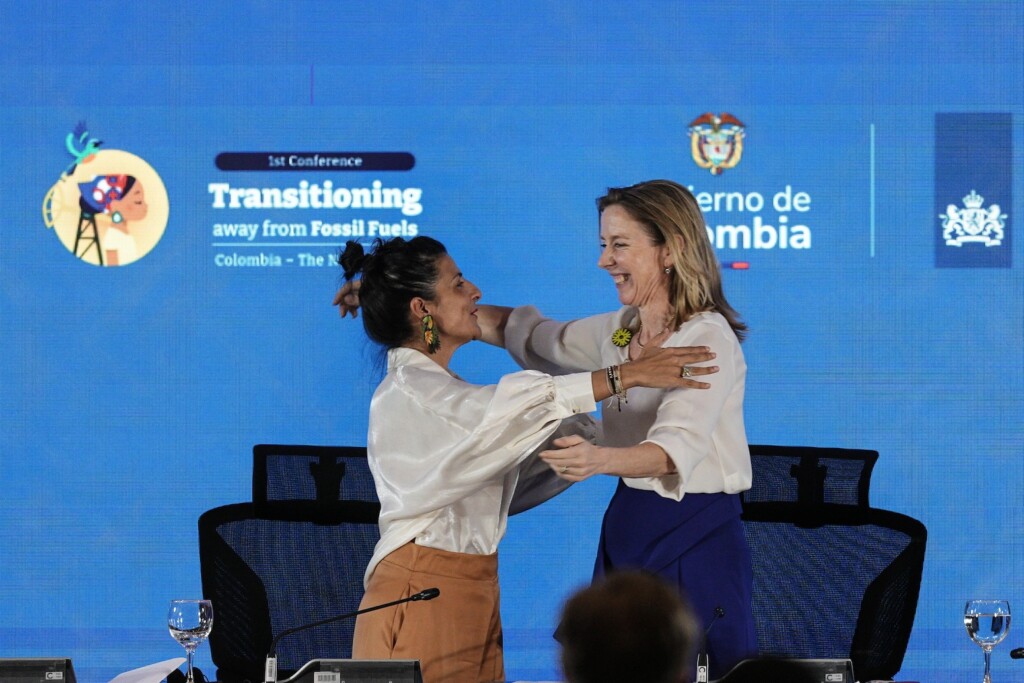
Countries attending a first-of-its-kind summit have walked away with plans to develop national roadmaps away from fossil fuels, along with new tools to address harmful subsidies and carbon-intensive trade.
The first conference on “transitioning away” from fossil fuels held in Santa Marta, Colombia, from 24-29 April saw 57 countries – representing one-third of the world’s economy – debate practical ways to move away from coal, oil and gas.
Against a backdrop of war, a global oil crisis and worsening extreme weather events, ministers and envoys from across the world sat side-by-side in small meeting rooms to have open and frank conversations about the barriers they face in transitioning from fossil fuels to clean energy.
This new format – devised by co-hosts Colombia and the Netherlands – was described as “refreshing”, “highly successful” and “groundbreaking” by countries attending the talks.
The event also featured a “science pre-conference” attended by 400 global academics, which included the launch of a new science panel that will aim to provide agile and bespoke analysis to nations wanting to accelerate their transition away from fossil fuels.
At the summit’s conclusion, Tuvalu and Ireland were announced as the co-hosts of the second transitioning away from fossil fuels summit, which will take place in the Pacific island nation in 2027.
Below, Carbon Brief outlines all of the key takeaways from the talks.
- Colombia and Netherlands leadership
- High-level segment
- Academic meeting
- Indigenous and civil society participation
Colombia and Netherlands leadership
The idea for a specific fossil-fuel transition conference hosted in Colombia first emerged during tense end-game negotiations at the COP30 climate summit in Belém, Brazil.
Amid a push by a group of around 80 nations to refer to a “roadmap” away from fossil fuels in the formal COP30 outcome text, Colombia and the Netherlands jointly announced that they would co-host a summit in Santa Marta in April.
The calls for a fossil-fuel “roadmap” to be mentioned in COP30’s outcome text ultimately failed. However, the Brazilian COP30 presidency promised to bring forward an “informal” fossil-fuel roadmap, drawing on the discussions and debates in Santa Marta.
The Santa Marta conference took place from 24-29 April. It included a “science pre-conference” from 24-25, a day for subnational governments, parliamentarians and other stakeholders and a “high-level segment” with ministers and climate envoys from 28-29.
Colombian environment minister Irene Vélez Torres – herself a former academic – was particularly keen to emphasise the importance of science to the conference, telling journalists: “We need to go back to science and base our decisions on science.” (See: Academic meeting)
From the outset, the hosts stressed that the high-level segment was not a space for negotiations, but rather a forum for countries and other stakeholders to discuss practical steps to move away from fossil fuels.
This format was widely praised by ministers and climate envoys, who described the conversational atmosphere in break-out sessions as “refreshing”, “highly successful” and “groundbreaking”. (See: Closed-door discussions.)
A total of 57 countries participated in the conference, according to the Colombian government.
These countries were: Angola, Antigua and Barbuda, Australia, Austria, Bangladesh, Belgium, Brazil, Cameroon, Canada, Chile, Colombia, Denmark, Dominican Republic, the EU, the Federated States of Micronesia, Finland, France, Germany, Ghana, Guatemala, Iceland, Ireland, Italy, Jamaica, Kenya, Luxembourg, Malawi, the Maldives, the Marshall Islands, México, Mongolia, the Netherlands, Nepal, Nigeria, Norway, New Zealand, Palau, Panama, Philippines, Portugal, Saint Lucia, Senegal, Singapore, Slovenia, the Solomon Islands, Spain, Sweden, Switzerland, Tanzania, Turkey, Tuvalu, Uganda, the UK, Uruguay, Vanuatu, the Vatican and Vietnam.
At the summit’s opening press conference on 24 April, Vélez Torres confirmed that Colombia and the Netherlands had decided to only invite a select group of countries to the conference.
Vélez Torres told journalists that countries including China, Russia and the US were not invited. She suggested that they had not shown the necessary spirit to be part of the “coalition of the willing” and that Colombia wanted to avoid a rehashing of the lengthy debates at COP30. (Carbon Brief understands that India was also not invited.)
In a later press huddle, Dutch climate minister Stientje van Veldhoven clarified that the two co-hosts had partially based their invitation criteria on who showed support for the fossil-fuel roadmap at COP30, saying:
“It was a combination of what happened in Belém and all the existing initiatives that have been driving this agenda for a long time already.”
However, it is worth noting that some countries that had opposed a formal reference to a fossil-fuel roadmap in the COP30 outcome were invited to Santa Marta, according to Carbon Brief’s analysis of the “informal list” of those against the idea in Belém.
For example, Tanzania was invited to take part in the Santa Marta talks, despite appearing on the list of countries opposed to the roadmap in Belém.
On the other hand, neither China nor India were invited, despite having rejected media coverage portraying them as the “blockers” of the fossil-fuel roadmap at COP30.
Country officials and observers expressed a range of views on whether excluding certain countries from the conference was the right approach.
Juan Carlos Monterrey Gómez, Panama’s special representative on climate change, told a small group of journalists that he thought it was the “right decision”, adding:
“This first meeting had to be done with those that wanted something to be done. Otherwise, it would have been a repeat of a UNFCCC meeting.”
UK special representative for climate, Rachel Kyte, told a press huddle that China should feel “welcome to be here”, adding:
“China has to be part of this equation for multiple reasons.”
One veteran observer told Carbon Brief that their impression was that Colombia and the Netherlands had been “overly cautious” about who would have caused disruption if invited to the conference, saying:
“Yes, maybe there is an argument for not inviting countries that have a long history of blocking progress, such as the Gulf states. But, if we look at what countries are really doing on the ground – including JETP [Just Energy Transition Partnerships] initiatives – then more countries should have been here, including Indonesia, for example.”
However, they also urged caution on reading too much into which countries were and were not present, adding that this could also partially be explained by “scheduling and countries’ availability”.
During the summit’s final plenary, van Veldhoven stated that, going forward, it was the Netherlands and Colombia’s wish to create an “open coalition”, including by extending an “invitation for others to join us”.
Dr Maina Talia, the climate minister of Tuvalu, who will co-host the second transitioning away from fossil fuels summit alongside Ireland, told journalists that the island nations would “revisit” and “improve” the criteria used for inviting countries to the conference.
High-level segment
National statements and pledges
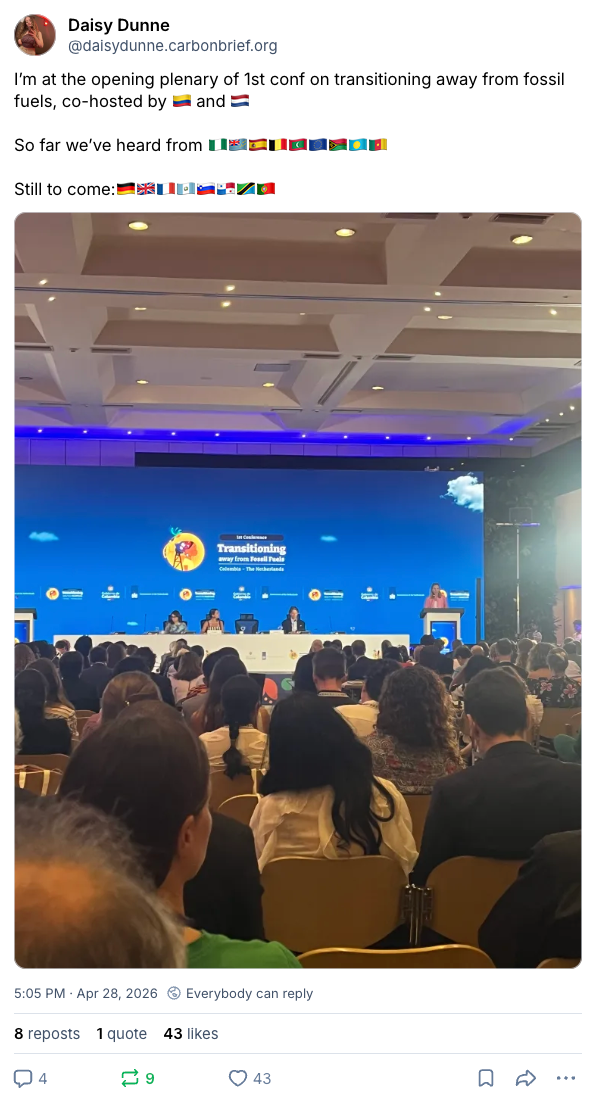
The two-day high-level segment began with an opening plenary, which saw more than 20 countries put forward their views on the need to transition away from fossil fuels.
Developed and developing nations alike spoke of the need to transition away from fossil fuels not only to tackle worsening climate change, but also the high prices, insecurity and volatility associated with continued reliance on coal, oil and gas.
Opening the plenary alongside Colombia, Dutch climate minister Stientje van Veldhoven told countries:
“Price volatility and dependence on imports are structurally and unacceptably impacting our economies. We need to move away from fossil fuels not only because it is good for the climate, but because it strengthens our energy security. Investment in clean energy also lays the foundation for a more resilient and sustainable economy, capable of mitigating these shocks.”
First to speak in plenary was Nigerian minister, Abubakar Momoh, who said:
“Nigeria is actively diversifying its economy away from extracting oil, which accounts for around 80% of our exports. Nigeria strongly believes that it is not whether extraction should decline, but how to organise it so it is manageable, fair and politically viable across countries.”
Also speaking during the session, UK special representative for climate Rachel Kyte said it “would be irresponsible to ignore the second fossil-fuel crisis in five years”.
Several nations also used their interventions to lament a lack of progress in addressing fossil-fuel use during the last 30 years of annual UN climate negotiations.
Dr Maina Talia, climate minister for Tuvalu, said that “for years, international climate negotiations have circled around fossil fuels without directly confronting the core issues”.
Juan Carlos Monterrey Gómez, Panama’s special representative on climate change, told countries:
“For 34 years, we have negotiated the symptoms of the climate crisis and bulletproofed its cause. Thirty-four years of pledges. And where are we now?
“Economies built on fossil fuels are unravelling in real time. Fossil fuels are not just dirty. They are unreliable, they are dangerous and they must end.”
A small number of nations from the Pacific and Africa used their interventions to show their support for the Fossil Fuel Treaty initiative, an idea to negotiate a new legally binding agreement to control fossil-fuel use, currently supported by 18 countries. (The treaty did not feature in the summit’s final outcome.)
France’s special climate envoy, Benoît Faraco, used his intervention to announce that the nation has produced a new roadmap for transitioning away from fossil fuels.
Later on, on the first day, Colombian president Gustavo Petro also gave a speech at the summit, telling countries:
“What I see is resistance and inertia within the power structures and the economy of this archaic energy system. Today, fossil fuels bring death; undoubtedly, that form of capital could commit suicide, taking humanity and life itself. Humanity cannot allow that.”
Closed-door discussions
Following the opening plenary, ministers and climate envoys spent much of the two-day high-level segment in closed-door “breakout sessions”, discussing issues ranging from “planned phase down and closure of fossil-fuel extraction” to “closing gaps in financial and investment systems”.
Carbon Brief understands that each session featured 12 ministers and envoys representing different countries sitting in an inner circle, with an outer circle made up of civil society members and other stakeholders. Each session was led by a different minister, appointed by the co-hosts.
In a departure from UN climate negotiations, the conversations that took place were free-flowing, with ministers and stakeholders given equal opportunities to contribute, observers told Carbon Brief.
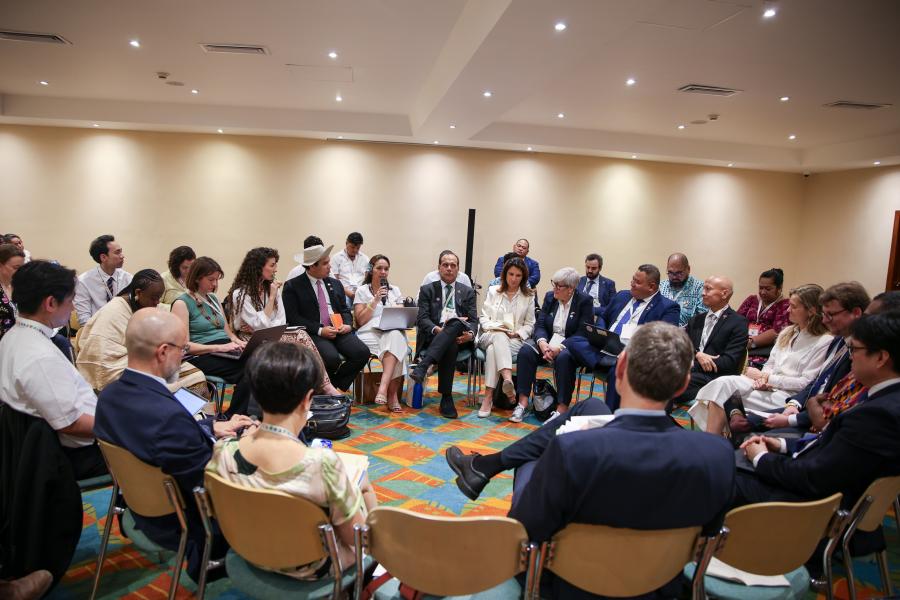
Many countries were highly complimentary of this informal format, describing it in the closing plenary as “refreshing”, “highly successful” and a “safe space for discussion”.
UK special representative on climate, Rachel Kyte, told a huddle of journalists that there was “real value” to having informal conversations with other country officials, saying:
“I have to say that it is really nice to sit in a small circle…In a negotiation, it’s very, very fast-moving and transactional. But now we have had two days to think about [fossil-fuel transition issues] and this only.”
Speaking to Carbon Brief, Panama’s special representative on climate change, Juan Carlos Monterrey Gómez, said the format was “groundbreaking”, adding:
“I’m going to be honest. [At] first I was like: ‘What the f*ck am I doing here? I don’t know where this is going’.
“But then, as the workshop started, I realised there were ministers, envoys, civil society leaders and Indigenous people. They put us in a format where we could not open our computers, so we had to speak from our minds and our hearts. That completely flipped my perception. That kind of space I haven’t seen in my 10-year history with the UNFCCC.”
All of the sessions were held under the Chatham House rule, meaning discussions were not attributable to individual speakers to encourage more open debate.
Co-host nations Colombia and the Netherlands gave a broad overview of the topics and themes discussed during the sessions in a takeaways report. (See: Final outcomes.)
Final outcomes
At the conference’s final plenary session on 29 April, co-host nations Colombia and the Netherlands presented a range of “key outcomes” from the summit.
The first outcome was confirmation of the news that Tuvalu and Ireland will co-host a second transitioning away from fossil fuels conference in the Pacific island nation in 2027.
The co-hosts also announced the establishment of three “workstreams” on issues to bring forward to the second summit.
The first of these workstreams will focus on developing national and regional roadmaps away from fossil fuels.
Speaking in plenary, Vélez Torres said that the roadmaps should be “connected” to countries’ UN climate plans, known as nationally determined contributions (NDCs). She added that it would be important for the roadmaps to be “very clear and honest” about “emissions exported from producing countries”.
The development of the roadmaps will be supported by the newly established science panel for global energy transition and the NDC Partnership, a global initiative helping nations prepare their NDCs, she added.
(At the final press conference, it was clarified that countries are not obligated to produce a new fossil-fuel roadmap and that participation in all of the work streams is voluntary.)
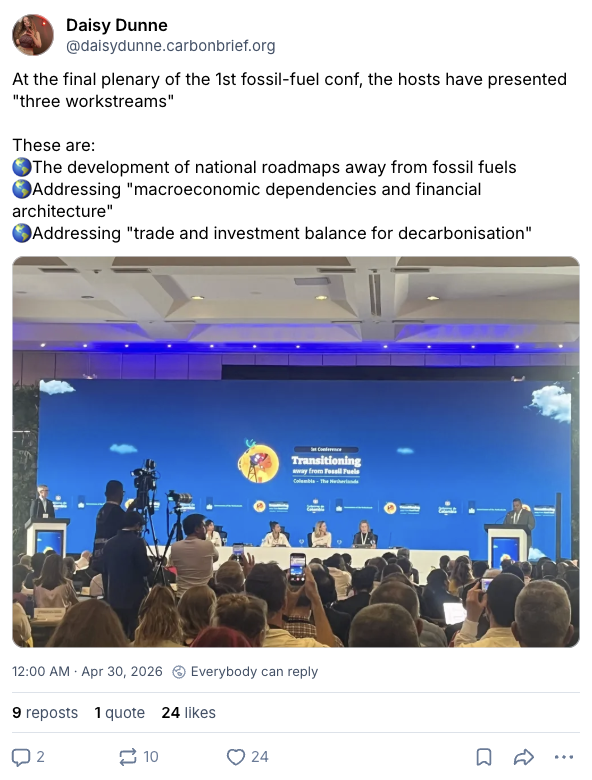
The second workstream will be focused on changing the financial system to better facilitate the transition away from fossil fuels.
This will include work to identify fossil-fuel subsidies and find solutions to “debt traps”. It will be supported by the International Institute for Sustainable Development thinktank, the co-hosts said.
Separately, Dutch climate minister van Veldhoven said that all countries would be invited via “email” to begin a process for identifying and reporting their fossil-fuel subsidies. (The Netherlands is the co-chair of COFFIS, a group of 17 nations that have pledged to remove fossil-fuel subsidies.)
The final workstream will address fossil-fuel-intensive trade, with the aim of “advancing progress towards a fossil fuel-free trade system”, Vélez Torres said. This workstream will be supported by the Organisation for Economic Co-operation and Development (OECD) group of wealthy nations.
A document summing up the co-chair’s takeaways from the summit says that other key outcomes include the establishment of a “coordination group [to] ensure continuity towards the second and subsequent conferences”, adding:
“It will consist of countries leading different alliances and initiatives that are implementing elements of the transition away from fossil fuels, and of the co-hosts of the first and second conferences, Colombia, the Netherlands, Tuvalu and Ireland.”
The document adds that a key task will be delivering the findings of this conference to the COP30 presidency, which is currently preparing a global fossil-fuel roadmap to present at COP31 in November.
Academic meeting
The summit kicked off with a “science pre-conference” attended by around 400 academics from across the globe from 24-25 April, held at the University of Magdalena in Santa Marta.
At the behest of the Colombian government, these scientists split into 11 different “workstreams” to debate a vast array of topics related to transitioning away from fossil fuels.
These ranged from “fossil-fuel phaseout policies” and the role of methane, to “just transitions and economic diversity” and the role of multilateralism.
Speaking on the summit’s first day, Colombian environment minister Irene Vélez Torres – herself a former academic – stressed the importance of science in political decision-making. She told a press conference:
“There has been a growing gap between science and governments, and governmental decisions, and it happens because there is a lot of denialism. There is a lot of economic and political lobbying as well. That is actually deviating [from] scientific rationale.
“The true belief of the countries that are here is that we need to go back to science and base our decisions on science, and back up our decision-making, processes and pathways with science.”
Science panel for global energy transition
The pre-conference saw the announcement of three new scientific initiatives.
The first was a new global science panel, calling itself the “science panel for global energy transition”, which was launched by Dr Johan Rockström, director of the Potsdam Institute for Climate Impact Research in Germany and Dr Carlos Nobre, an eminent researcher on the Amazon rainforest from the University of São Paulo in Brazil.
They announced at a public event in Santa Marta that the panel will involve “50-100 scientists” from around the world and will be based at the University of São Paulo.
The scientists on the panel will aim to provide rapid analysis on how to transition away from fossil fuels for countries and multilateral talks, including bespoke information for nations that request it, they said.
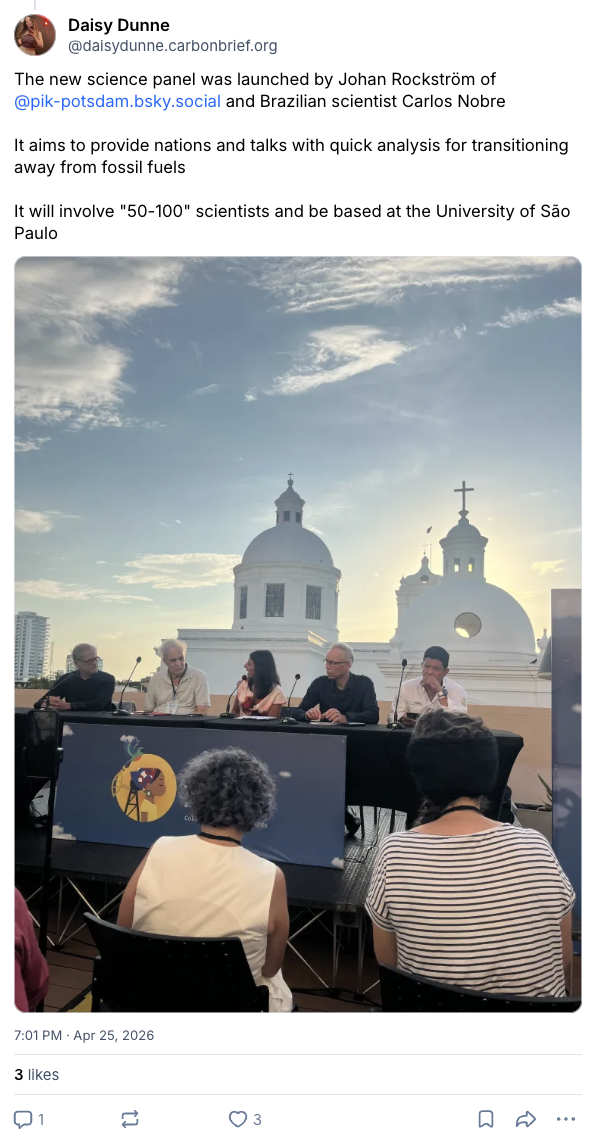
Speaking at its launch, Rockström said the panel will be split into four working groups, focusing on “transition pathways”, “technology solutions”, “policy design and evaluation” and “finance instruments and governments”.
It will have three co-chairs: Dr Vera Songwe, an economist and climate finance expert from Cameroon; Prof Ottmar Edenhofer, chief economist at the Potsdam Institute for Climate Impact Research; and Prof Gilberto M Jannuzzi, professor of energy systems at Universidade Estadual de Campinas in Brazil.
Speaking to Carbon Brief, Nobre said that he and Rockström were first approached with the idea for a new panel by Ana Toni, Brazilian economist and CEO of the COP30 climate summit, while the negotiations were taking place in Belém. He said:
“Johan and myself, we’re not energy transition scientists, but we were the creators of the planetary science pavilion at COP30, that’s why Ana Toni came to us. And we have already invited three top energy transition experts to join us.”
At the launch, Rockström said the panel would be different in several ways from the world’s existing global climate science panel, the Intergovernmental Panel on Climate Change (IPCC).
He said that, in comparison to the “seven-year cycle” for IPCC reports, this panel will “be able to come up with annual updates” and “be able to scale down to the national level”.
Nobre told Carbon Brief that he was among scientists who have grown “frustrated” with some aspects of the IPCC’s process, including the line-by-line approval of summaries for policymakers by all of the world’s governments. He said:
“A long time ago, when I was working as a scientist studying the Amazon, I wanted to include some information about the risks the Amazon faces in one of the summaries. But a representative from my own country [Brazil] said no.
“This panel is totally independent. There is no way for somebody to say ‘you can’t say that’ or ‘you can’t do that’.”
Action insights report
The second new science initiative to emerge from the academic conference was a new “synthesis report”, offering “12 action insights” for how countries can transition away from fossil fuels.
First covered by Carbon Brief, the report contains some explicit “action recommendations” for countries, such as “halt all new fossil-fuel expansion” and “prohibit fossil fuel advertising…recognising fossil fuels as health-harming products”.
The report was first put together by an “ad-hoc” group of 24 scientists at the request of the Colombian government. It was then further debated and refined by many of the 400 scientists gathered at the academic pre-conference in Santa Marta.
A preliminary version of the report was circulated to governments attending the talks.
In addition, one of the report’s coordinating authors, Prof Andrea Cardoso Diaz, from the University of Magdalena, was given a two-minute slot in the opening plenary of the “high-level segment” to highlight its findings to gathered ministers.
Colombia’s fossil-fuel roadmap
The final scientific initiative unveiled at the academic segment was a new roadmap for how Colombia can transition away from fossil fuels. This was drafted by a team led by Prof Piers Forster, head of the Priestley Centre for Climate Futures at the University of Leeds.
The roadmap says that Colombia can cut its emissions from energy use to 90% below 2015 levels by 2050, through ambitious policies to move away from fossil fuels and electrify its transport sector.
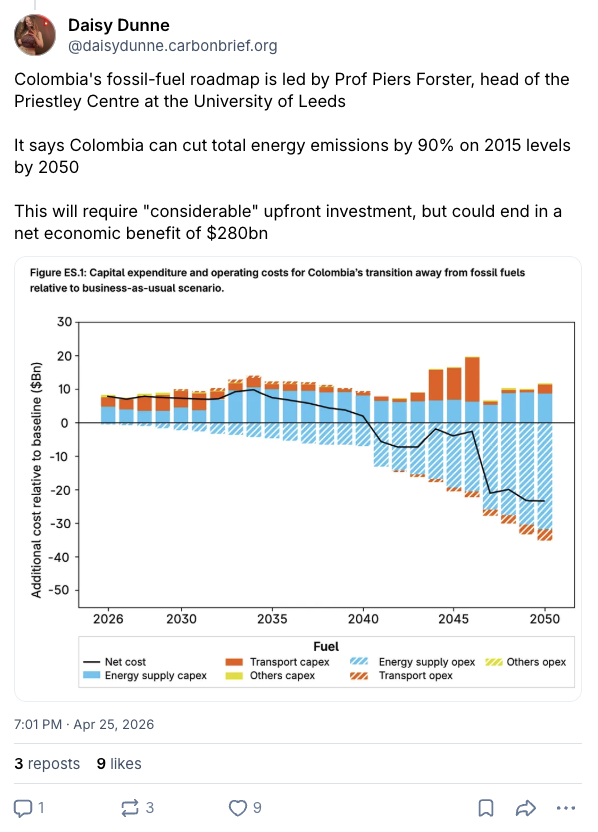
This would require “considerable” upfront investment, with the roadmap estimating the cost to be an average annual investment of around $10bn above a business-as-usual scenario.
However, by the 2040s, Colombia could see net economy-wide savings from transitioning away from fossil fuels, says the analysis, which could reach $23bn annually by 2050.
Speaking to Carbon Brief, Forster said his experience as interim chair of the UK’s Climate Change Committee highlighted to him the importance of presenting national roadmaps in economic terms. He said:
“The biggest issues facing countries are economic and to do with the cost of living. To convince our own government back in the UK to sign up to our recommended carbon budget, we put a lot of work into the economic aspect. So that was also the focus of this work for Colombia.”
Indigenous and civil society participation
In addition to holding a dedicated meeting for scientists, the Colombian government also organised a “People’s Assembly”. This brought together hundreds of Indigenous peoples, Afro-descendent peoples, peasant farmers, trade representatives, women and children and other civil society members.
The goal was to gather the thoughts from these groups on the summit’s main “pillars” of addressing fossil-fuel production, economic constraints and global governance and multilateralism.
According to Climate Lens News, Óscar Daza, the secretary general of the Organisation of Indigenous Peoples of the Colombian Amazon, Karebaju people, told the gathering:
“The Indigenous peoples of the world have made historic demands, such as the non-extraction of natural resources from our territories, so that our resources that are there in the territory remain intact, remain still.
“As Indigenous peoples, we want those historic struggles to somehow be reflected and taken up here by the different states.”
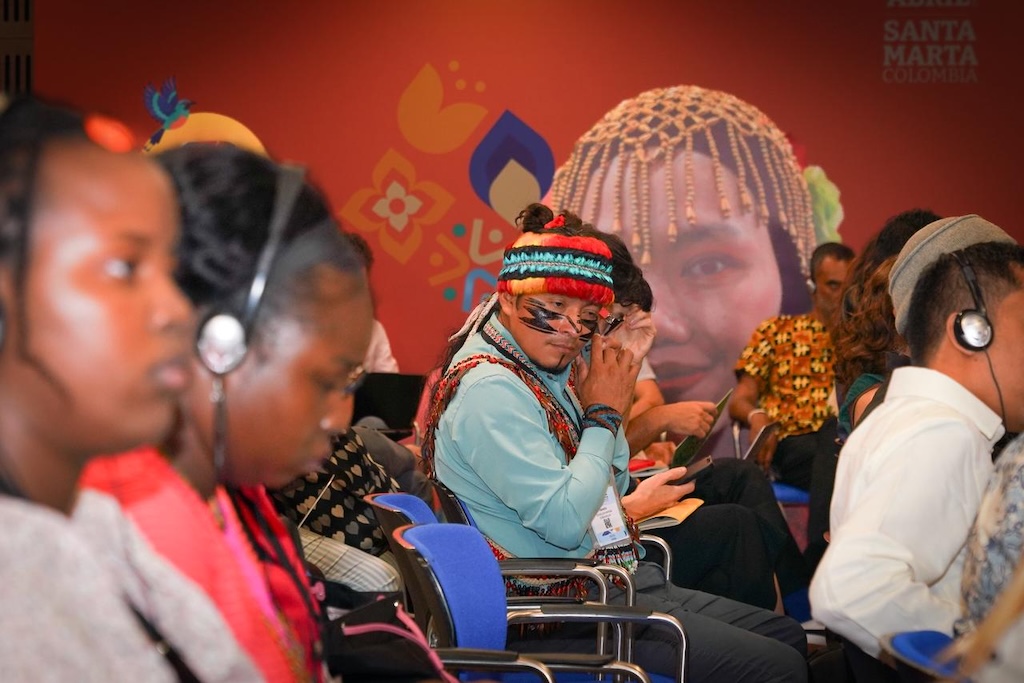
Following on from the meetings, the Colombian government summarised the main talking points discussed by each of these groups in a series of “contributions” documents.
Indigenous peoples and civil society groups were also allocated opportunities to speak during the summit’s high-level segment.
In a departure from UN climate summits – where inputs from civil society are usually heard after countries have finished speaking – the Santa Marta summit invited a range of representatives to speak alongside ministers in the opening and closing plenary sessions.
This included an intervention in the opening plenary by Larissa Baldwin-Roberts, a climate leader from the Bundjalung Nations, who told countries:
“This is the last time we will be a token. You want our pictures, not our voices. You want our stories, not our struggles…True solidarity with each other is the prerequisite to a just transition.”
Indigenous peoples and civil society members were also free to speak in closed-door discussions with ministers, Carbon Brief understands.
Separately from the events organised by the Colombian government, civil society also organised its own “people’s summit”, involving 900 organisations and networks, held in the city of Santa Marta from 24-26 April.
This summit also organised sessions for representatives from different groups to offer their thoughts and insights into the transition away from fossil fuels, ending in a joint “declaration”.
In a statement, Tasneem Essop, the executive director of Climate Action International, said:
“Movements from across the globe and the region – Afro-descendants, feminists, youth, peasants and fisherfolk, social movements and Indigenous peoples converged in a three-day peoples summit in Santa Marta to build a collective consensus on our demands and solutions for the just transition away from fossil fuels.
“[We saw] the adoption of a powerful declaration that spells out our positions on ensuring that the transition has to be rights-based, funded and results in the dismantling of the systems that have caused harm and destruction driven by fossil fuel dependency.”
Related

World falling short on 22 of 23 nature targets for 2030, says draft UN report

Analysis: 84% of nations miss deadline to identify ‘nature-harming’ subsidies by 2025
Access to finance ‘strengthens climate resilience’ among sub-Saharan women