
US could meet Paris emissions pledge with ‘natural climate solutions’, study says
Natural climate solutions
As the special report on 1.5C from the Intergovernmental Panel on Climate Change (IPCC) acknowledges, meeting the 1.5C limit without overshooting will require “negative emissions” – techniques that remove CO2 from the atmosphere and store it on land, underground or in the oceans. To achieve this, the integrated assessment models (IAMs) that generate emission pathways for 1.5C generally rely on large amounts of bioenergy with carbon capture and storage (BECCS). This technique involves burning biomass – such as trees and crops – to generate energy and then capturing the resulting CO2 emissions.
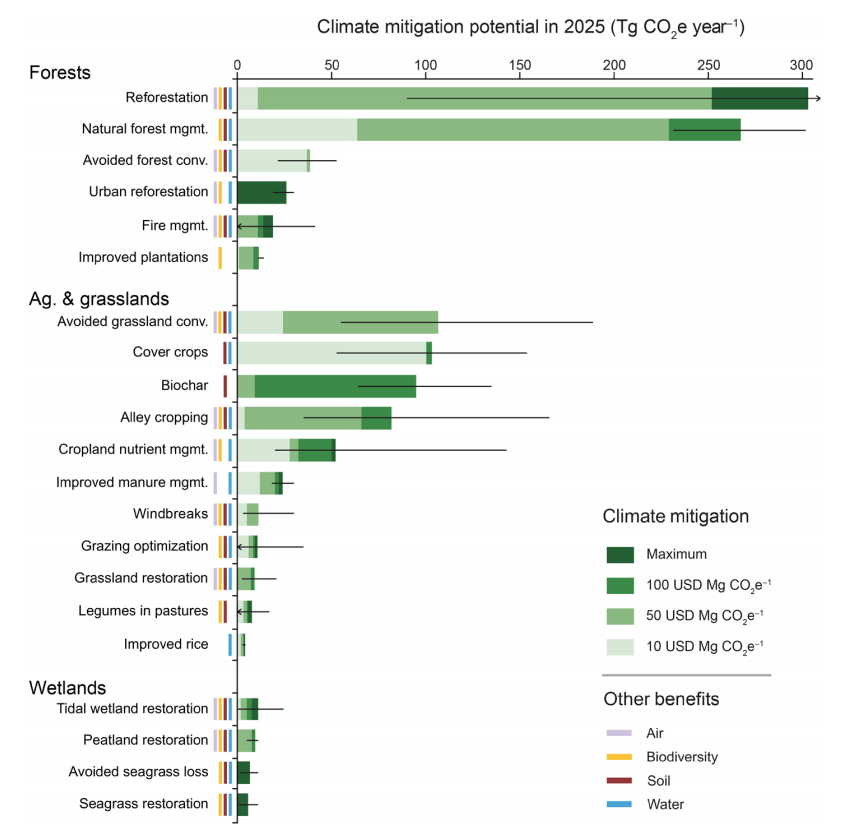
“We looked at 21 different ‘pathways’ for NCS that could be obtained from protection, restoration, and improved management of natural and working lands, including forests, grasslands, wetlands and agriculture.”
The assessment uses a combination of existing studies and new analysis, Fargione says, and is carefully defined to ensure the NCS are “compatible with meeting human needs for cropland and pasture and timber production”.Mitigation potential

Incentives
The findings suggest that NCS could make an important contribution to the emissions cuts pledged by the US under the Paris Agreement – known as their “nationally determined contribution”, or NDC. The US, under President Obama, committed to reduce its GHG emissions by 26-28% from 2005 levels by 2025. Annual GHG emissions in the US have already fallen by around 0.79bn tonnes of CO2e since 2005, says Fargione, largely as a result of replacing some coal-fired power with gas. However, another 1.0-1.1bn tonnes are required. This means that, all other things being equal, NCS could be used to meet the US commitment to the Paris Agreement, the paper concludes. However, there are caveats to this point, the authors stress. First, 1.2bn tonnes of CO2e per year is the maximum potential for NCS in the US. But for NCS to deployed on a large-scale, they need to be incentivised through a price on carbon. The study looks at three different price points for carbon: $10, $50 and $100 per tonne of CO2e, finding that 25%, 76% and 91% of the NCS maximum would be achieved at each price, respectively. (The impact of different carbon prices on the potential for each NCS is shown by the green shading in the earlier chart.) So, in theory, a carbon price of $100 per tonne would be sufficient to achieve enough NCS to meet the NDC. However, current carbon markets typically pay around $10 per tonne, the paper notes, although the EU carbon price recently surpassed $20. And, second, the collective impact of all NDCs across the world is currently not enough to meet the long-term goals of the Paris Agreement, explains Fargione:“It is important to note that the ambition of NDCs needs to be roughly tripled in order to meet the target of staying well below 2C of warming. So NCS offer an opportunity to increase the ambition of the US’s NDC.”
The study shows how “natural systems can play an important role in climate change mitigation”, says Prof Sally Benson of Stanford University, who was not involved in the study. She tells Carbon Brief:“Of course, 1bn tonnes [of CO2e mitigation] per year is small in comparison to the needed emissions reductions, but that scale is important in the overall picture.”
Regional assessment
The study is “great work”, says Prof Sabine Fuss from Humboldt University and the Mercator Research Institute on Global Commons and Climate Change, who also was not involved in the research. (Fuss recently co-wrote a guest post for Carbon Brief on “seven key things to know about negative emissions”.) The findings show “very nicely” that there are “many mitigation and carbon removal practices that we do have experience with and that are technically mature and can be deployed right away”, she tells Carbon Brief:“Importantly, such methods might also run into less problems with respect to public acceptance than some of the more controversial technologies, such as those connected to bioenergy. I think this is an important opportunity to conserve ecosystems, while buying time to reach ambitious climate targets.”
The study is “exactly the type of regional assessment” that is needed for the Talanoa Dialogue that opened at the Bonn intersessional talks in May this year, says Fuss. This is the “facilitative dialogue” agreed at the Paris climate talks as a way to ratchet up the still-inadequate ambition in the NDCs.Wildfires
The paper also draws attention to the importance of fire management in the US as a way of reducing CO2 emissions. It comes as California is battling the most destructive wildfires in its history, which have killed at least 42 people and forced 250,000 to evacuate. A contributing factor to recent wildfires is the policy of fire suppression that has allowed the “fuel load” – or the amount of vegetation – to build up over many years, says Fargione. As a result, when a fire does occur, it is more likely to become severe – leaving few living trees left and very little growth for multiple years afterwards. Reducing the build-up of fuel “helps make sure that our forests keep sequestering carbon”, notes Fargione:“Restoring the natural fire regime through a combination of prescribed fire – the practice that our paper modelled – and thinning creates forests that have low-intensity fires that leave living trees that keep sequestering carbon.”
As the map below shows, the paper focuses on forests in the western US – including the Klamath-Siskiyou and Sierra Nevada regions in California.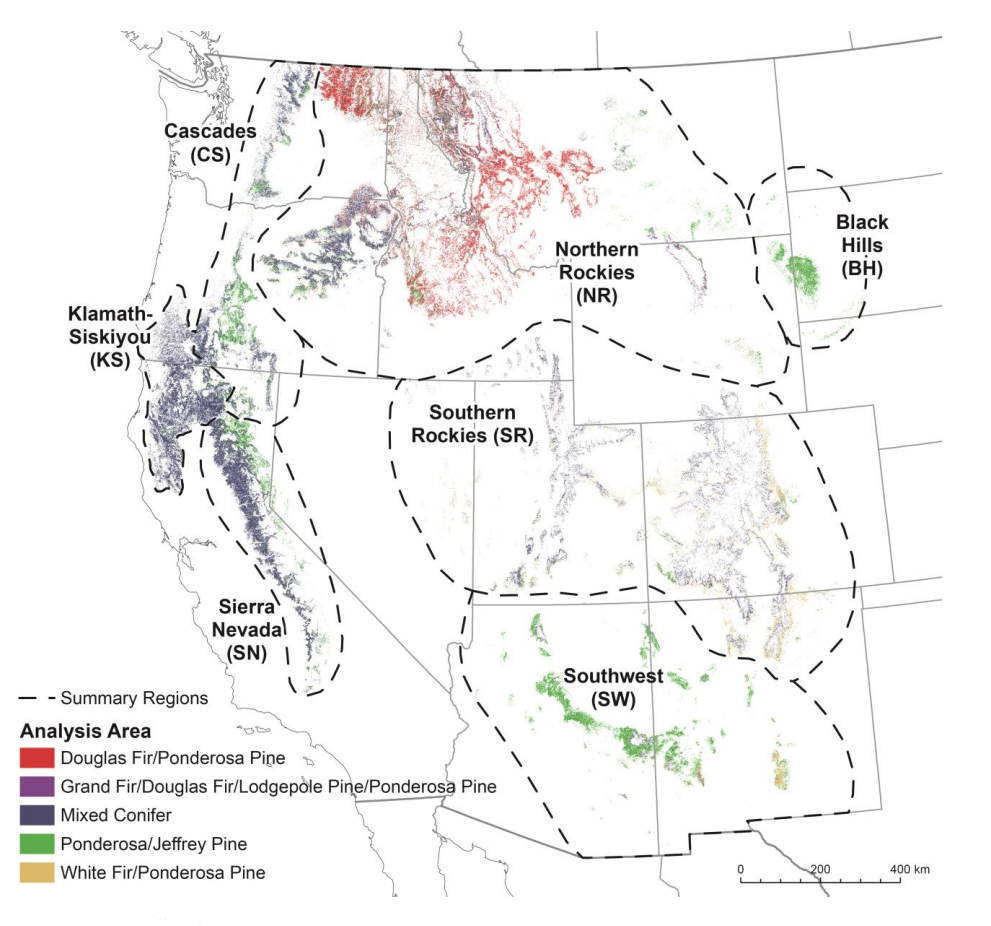
Article information
Fargione, J. E. et al. (2018) Natural climate solutions for the United States, Science Advances, doi:4/11/eaat1869