Q&A: What change of power in Colombia could mean for world’s fossil-fuel transition



Daisy Dunne
06.26.26Daisy Dunne
26.06.2026 | 3:04pmOver the last four years, Colombia has emerged as one of the most vocal advocates for the world to transition away from fossil fuels.
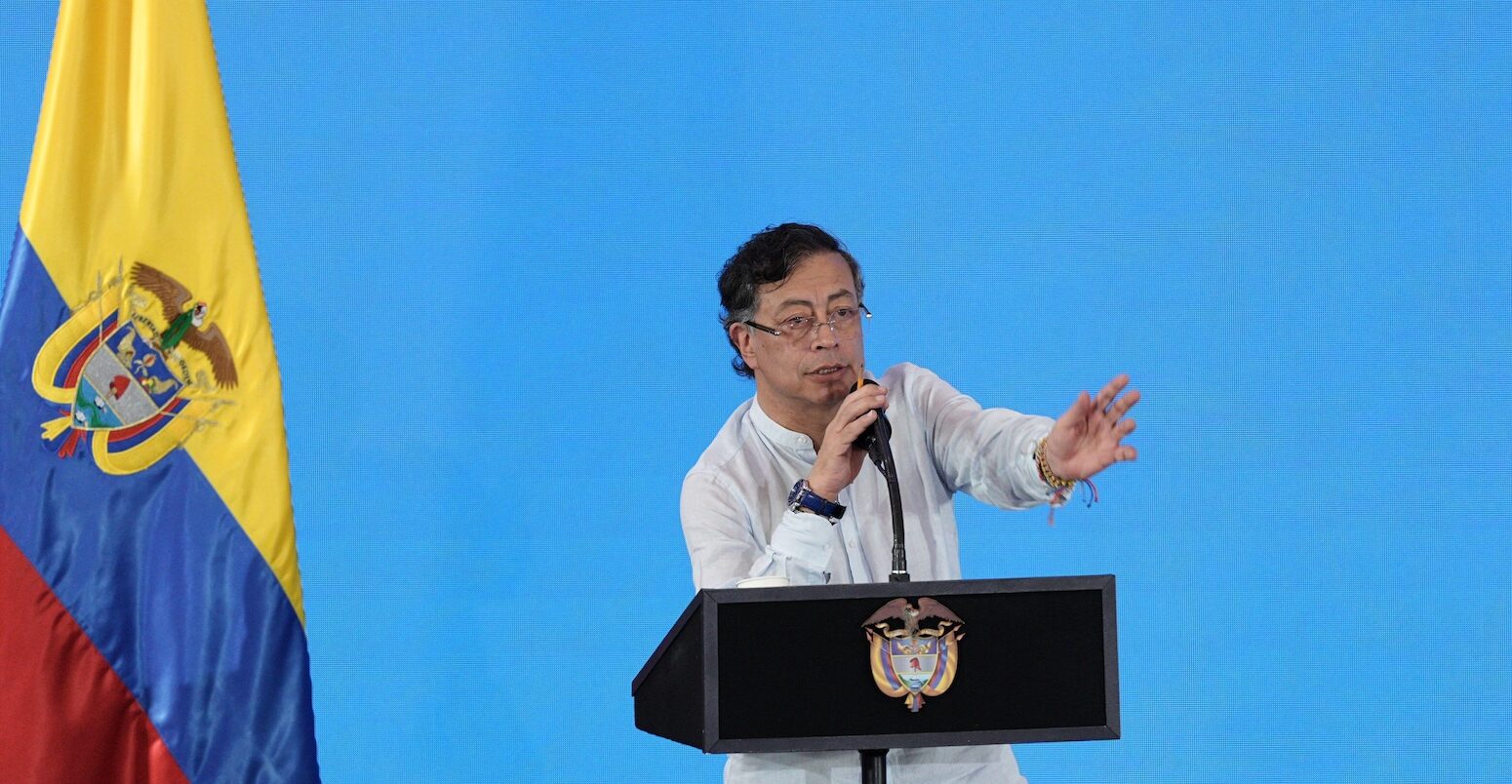
Under the leadership of leftist politician and economist Gustavo Petro, it became the first major oil-and-gas producer to commit to halting all new fossil-fuel expansion.
In April, the nation hosted a first-of-its-kind meeting of countries on transitioning away from fossil fuels, alongside the Netherlands, in the Caribbean city of Santa Marta.
The meeting concluded with a promise for a new “Santa Marta process” spearheaded by Colombia and the Netherlands, a movement of countries that would continue to push for a transition away from fossil fuels at home – and at international climate talks.
But on 21 June, an ally of Petro suffered defeat in a presidential election runoff against Abelardo de la Espriella, a hard-right populist and favourite of US president Donald Trump, who has pledged to boost oil production and pursue “fracking to the max”.
Below, Carbon Brief examines what the loss could mean for Colombia’s stance on fossil fuels, as well as international efforts to transition away from coal, oil and gas, including at the COP31 climate summit in Turkey in November.
- How could the election defeat change Colombia’s stance on fossil fuels?
- How could it affect international efforts to transition away from fossil fuels?
- How could efforts to transition away from fossil fuels feature at COP31?
How could the election defeat change Colombia’s stance on fossil fuels?
In 2022, Petro became Colombia’s first left-wing president in recent history.
Under his leadership, Colombia became the first major oil producer and exporter to halt all new fossil-fuel expansion, boosted renewable energy and saw a sustained decline in deforestation.
At the COP28 summit in 2023, Petro announced that Colombia would become the first major oil exporter to sign the fossil-fuel non-proliferation treaty, a pact to legally control fossil-fuel production and use.
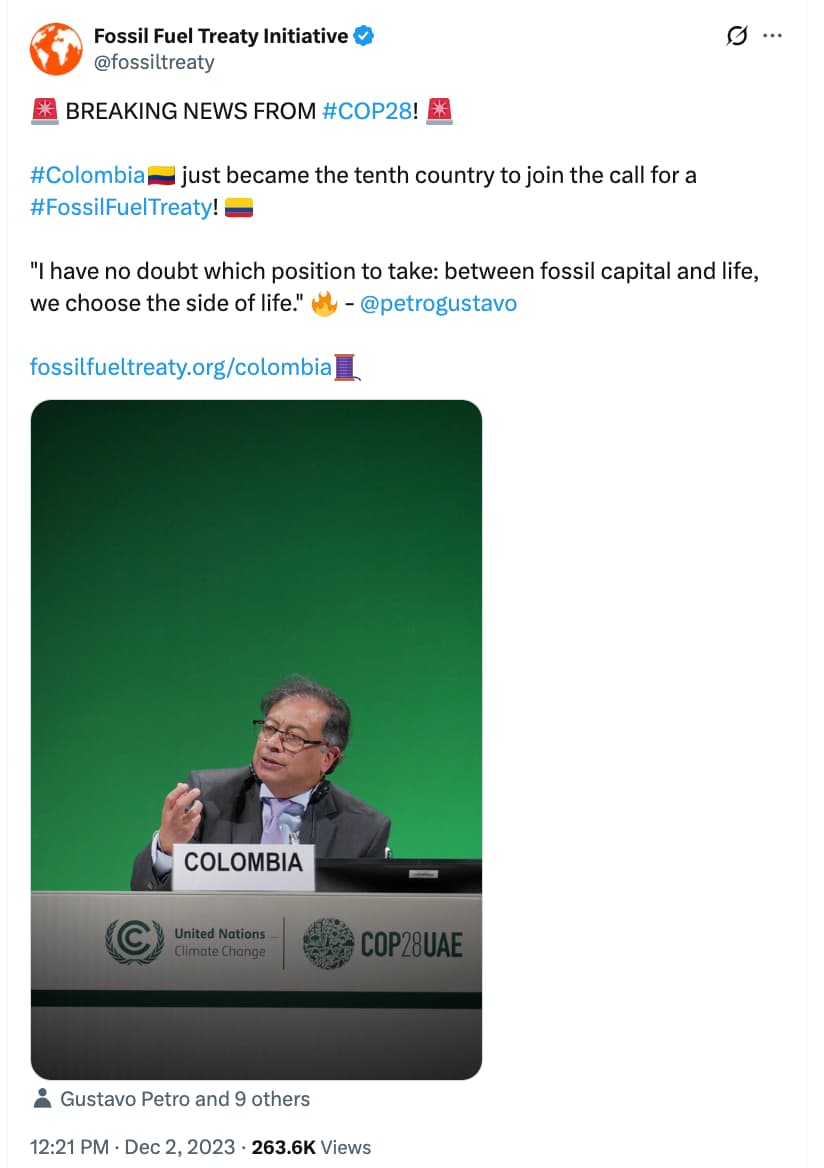
Successive Colombian environment ministers became among the most vocal supporters of transitioning away from fossil fuels at UN climate talks.
This included former minister Susana Muhamad, a political scientist and environmentalist who stepped in to lead the most recent UN biodiversity summit in 2024 after original host Turkey was forced to withdraw following earthquakes.
She was succeeded by Irene Vélez Torres, a former academic who led calls for a “fossil-fuel roadmap” to be part of the formal outcome at the COP30 summit in 2025.
At the sidelines of COP30, Vélez Torres and Netherlands climate minister Stientje van Veldhoven announced plans to co-host a first-of-its-kind summit on transitioning away from fossil fuels in Colombia in April 2026.
(In the end, countries failed to agree to a formally negotiated “fossil-fuel roadmap” at COP30. However, the Brazilian COP30 presidency promised to bring forward a voluntary roadmap instead, informed by the Santa Marta summit.)
Some 57 countries – representing one-third of the world’s economy – participated in the event, with officials describing it as “refreshing”, “highly successful” and “groundbreaking”, according to Carbon Brief’s reporting from Colombia.
The meeting concluded with a range of outcomes, including a second fossil-fuel transition summit to be co-hosted by Tuvalu and Ireland in 2027.
In stark contrast to Petro’s government, new hard-right populist president Abelardo de la Espriella has promised to quickly boost new fossil-fuel and mining projects, including by “fracking to the max”.
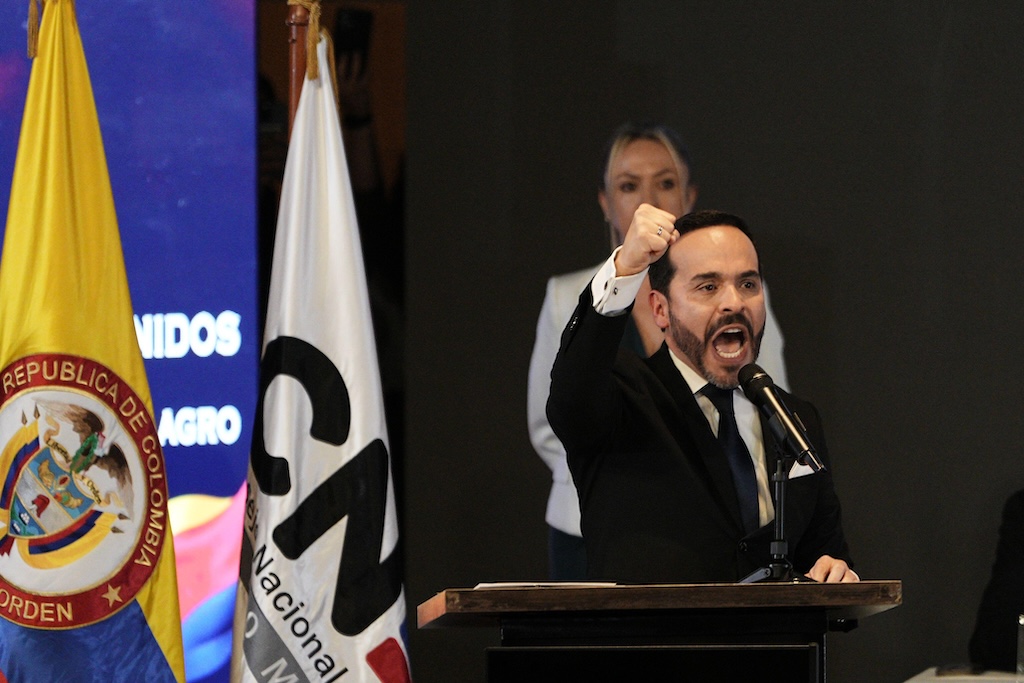
De la Espriella has also promised to build 10 “mega prisons” inside Colombia’s Amazon rainforest.
He has not yet commented on whether he will withdraw Colombia from Santa Marta’s “coalition of the willing”.
How could it affect international efforts to transition away from fossil fuels?
Just two days after the Colombian government’s election defeat, environment minister Vélez Torres took to the stage at London climate action week, alongside Netherlands climate minister van Veldhoven, to present a report on key takeaways from the Santa Marta summit.
The report, written before the election loss, speaks of an ongoing “Santa Marta process” to accelerate the global transition away from fossil fuels. It says that this will be coordinated by Colombia and the Netherlands, along with the two appointed co-hosts of the second conference on transitioning away from fossil fuels, Tuvalu and Ireland.
Acknowledging that this was likely to be one of her last addresses as Colombia’s environment minister, Vélez Torres told the audience that, going forward, the Santa Marta process must be resilient to “political setbacks”.
At the sidelines of the event, Vélez Torres told Carbon Brief that the work her government has done “cannot be erased”, despite a change in power. She said:
“Right now, we are facing the dark nights, this will really shift the politics in terms of energy position and environmental protection. But we are certain that our legacy will continue. It goes beyond governments.”
Dutch minister van Veldhoven told Carbon Brief that the plan for the “Santa Marta process” is to hold fossil-fuel transition summits in a different country every year, with two new co-hosts each time. This could help weather political shocks, she said:
“We know that every couple of years there will be elections. That is why [we have] the idea of rotating presidencies and chairmanships…while we make sure we make use of existing secretariats and organisations that are not subject to political changes every couple of years.
“In that combination, we hope to create a historic legacy and continue to drive the process forward, but also [create space for] a new energy from two new countries every year that bring their own perspective and their own dynamic.”
Although new countries could drive the process forward without Colombia, there are few major oil producers that have shown the same level of commitment to transitioning away from fossil fuels.
Ana Toni, an economist and CEO of the COP30 summit in Brazil, told Carbon Brief at London climate action week that the world will “miss the leadership of Colombia”, but added:
“Not one country will stop this movement. All countries need to chip in. There isn’t one leader for this topic. Everybody needs to join forces.”
How could efforts to transition away from fossil fuels feature at COP31?
At London climate action week, Colombia and the Netherlands presented their Santa Marta report to the Brazilian COP30 presidency.
The COP30 presidency is due to release a voluntary international “fossil-fuel roadmap” ahead of COP31 in Turkey in November, which it has promised will be informed by the takeaways from Santa Marta.
Speaking at the sidelines of London climate action week, Colombia and the Netherlands added that they have had “constructive” conversations with the COP31 co-presidencies, Australia and Turkey, about how to incorporate the discussions from Santa Marta.
Colombian environment minister Irene Vélez Torres told a small group of journalists:
“We had this very interesting conversation with COP31 and they were clearly open to suggestions about what is needed in the discussion in Turkey, and we were explicit about the need to engage with the phasing out of fossil fuels.”
However, both Colombia and the Netherlands added that they were unsure of how this might work in practice.
When asked about whether the Santa Marta discussions could be incorporated into formal COP texts, they were keen to emphasise that all the conversations in Colombia were specifically not negotiations.
They added that they were unsure of whether the group of 57 countries that gathered in Santa Marta would appear as a collective at press conferences or events at the COP31 summit.